
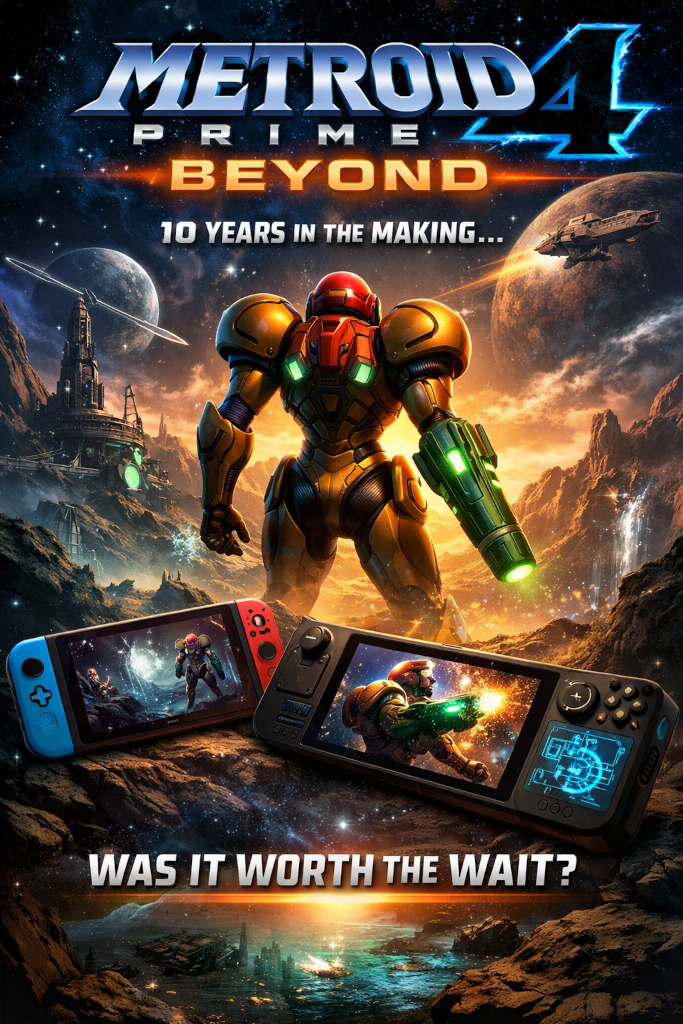
For many long-running franchises, anticipation is measured in months or a few years. For Metroid fans, patience has become a defining trait. The journey toward Metroid Prime 4 has stretched across nearly a decade, marked by silence, restarts, shifting expectations, and an industry that has transformed dramatically in the meantime. With the subtitle Beyond now attached and Nintendo slowly pulling back the curtain, the central question feels unavoidable: after all this time, can Metroid Prime 4 actually live up to the wait?
To answer that, it helps to look not only at what the game appears to be, but also at what the franchise represents and how much the gaming landscape has changed since the original announcement.
A Series Built on Atmosphere and Trust
The Metroid Prime series occupies a rare space in gaming history. When the first Prime released in 2002, it successfully translated a beloved 2D exploration series into first-person without losing its identity. That alone was a remarkable feat. Instead of leaning into twitch shooting, the Prime games emphasized isolation, environmental storytelling, scanning lore, and deliberate pacing. Players were trusted to explore, to get lost, and to piece together meaning from quiet moments rather than constant exposition.
Metroid Prime 2: Echoes pushed difficulty and atmosphere further, while Metroid Prime 3: Corruption expanded scope and narrative ambition on the Wii. Together, they formed a trilogy that many fans still consider definitive examples of immersive design.
By the time Metroid Prime 4 was announced in 2017, expectations were already high, but they were rooted in trust. Nintendo had shown before that it understood how to handle this franchise carefully.
The Announcement That Started a Long Silence
The initial reveal of Metroid Prime 4 was minimal. A logo, a title card, and confirmation that development was underway. At the time, that was enough. The assumption was that the game was several years out, and fans were willing to wait.
Then came the moment that changed everything. In 2019, Nintendo publicly acknowledged that development was not meeting expectations and that the project would be restarted under Retro Studios, the original developer behind the Prime trilogy. In an industry that often avoids transparency, this admission stood out.
For some fans, it was reassuring. It suggested that Nintendo was prioritizing quality over deadlines. For others, it raised concerns about how troubled the project might be behind the scenes. Either way, the clock effectively reset.
A Decade Changes More Than Technology
One of the biggest challenges facing Metroid Prime 4 is not just delivering a good game, but delivering one that feels relevant in a vastly different gaming era.
When the game was first announced, open world design was reaching its peak saturation. Live service models were becoming dominant. Player expectations around accessibility, customization, and post-launch support were evolving rapidly. Since then, those trends have only intensified.
Metroid Prime has never been about chasing trends. Its identity is rooted in deliberate design, quiet exploration, and a sense of loneliness that stands in contrast to most modern blockbuster games. The question is whether that identity still resonates with a broad audience in 2025, or whether it risks feeling out of step.
Early indications suggest that Nintendo is not trying to reinvent Metroid Prime into something it is not. Instead, Beyond appears positioned as a refinement rather than a reinvention.
What Beyond Might Mean for the Series
The subtitle Beyond is doing a lot of heavy lifting. Nintendo has not fully explained its meaning, but it invites speculation. It could refer to narrative themes, new regions beyond known space, or even mechanical evolutions that push the series forward without abandoning its roots.
There are hints that Metroid Prime 4 will expand environmental scale while maintaining interconnected level design rather than adopting a fully open world structure. This would align with the franchise’s tradition of guided exploration, where progression is tied to abilities rather than map size.
If Beyond signifies anything substantial, it may be a deeper integration of narrative and gameplay. The Prime games have always told their stories indirectly, through scan logs, environmental details, and subtle visual cues. Modern players, however, are more accustomed to explicit storytelling. Balancing these expectations without compromising the series’ identity is a delicate task.
Combat and Controls in a Modern Context
First-person combat has changed significantly since Metroid Prime 3. Today’s players are used to highly responsive aiming, customizable controls, and smooth performance across a range of input methods.
Metroid Prime 4 will need to feel modern without turning Samus into a conventional shooter protagonist. Combat in Prime has always been more about positioning, enemy patterns, and strategic use of abilities than raw reflexes.
Control schemes will be particularly important. With Nintendo platforms supporting both handheld and docked play, along with different controller configurations, the game must feel intuitive across all setups. Retro Studios has experience here, but expectations are higher than ever.
Performance also matters. Long load times or inconsistent frame rates would be especially noticeable in a game built around immersion and atmosphere.
Exploration as the Core Experience
If Metroid Prime 4 succeeds, it will likely be because it doubles down on exploration as its defining strength. The sense of being alone on an alien world, gradually uncovering its secrets, remains one of the franchise’s most powerful qualities.
Modern game design often emphasizes constant rewards and frequent checkpoints. Metroid Prime thrives on restraint. Progress feels earned because it requires attention and curiosity. The challenge is preserving that feeling while ensuring the game does not alienate players accustomed to more guided experiences.
Quality-of-life improvements can help here. Subtle navigation aids, clearer ability hints, and improved map readability could make exploration more approachable without undermining its spirit.
The Weight of Expectations
A ten-year wait creates expectations that no single game can fully satisfy. Some fans want a nostalgic return to the Prime trilogy’s exact formula. Others hope for bold evolution. Still others simply want confirmation that the franchise remains alive and relevant.
Nintendo’s handling of the delay suggests an awareness of these pressures. Restarting development was a risky move, but it may ultimately be the reason Metroid Prime 4 exists at all in its current form.
The longer a game takes to release, the more symbolic it becomes. It stops being just another entry in a series and starts representing an entire era of anticipation. That symbolism can be both a burden and an opportunity.
How the Industry Might Receive It
Critical reception will likely hinge on whether Metroid Prime 4 feels timeless rather than dated. If it successfully delivers atmosphere, thoughtful design, and a cohesive world, many reviewers may view it as a welcome counterpoint to trend-driven releases.
Commercial performance is harder to predict. Metroid has always been a respected franchise rather than a massive seller. That may not change, but success does not always mean record-breaking numbers. Sometimes it means reaffirming a brand’s identity and proving that patience can pay off.
For Nintendo, Metroid Prime 4 is also a statement. It signals that some franchises are worth protecting, even if they do not fit neatly into modern monetization strategies.
Is the Wait Worth It?
Whether the ten-year wait was worth it will ultimately depend on individual expectations. For players hoping for a radical transformation, the answer may be complicated. For those who value atmosphere, exploration, and careful design, the wait may feel justified if Beyond delivers on its core promises.
What matters most is that Metroid Prime 4 exists as a thoughtful, confident game rather than a rushed product chasing relevance. In a landscape dominated by seasonal content and rapid releases, there is something quietly powerful about a game that took its time.
If Metroid Prime 4: Beyond succeeds, it will not just be because it is good, but because it reminds players that some experiences are worth waiting for.