
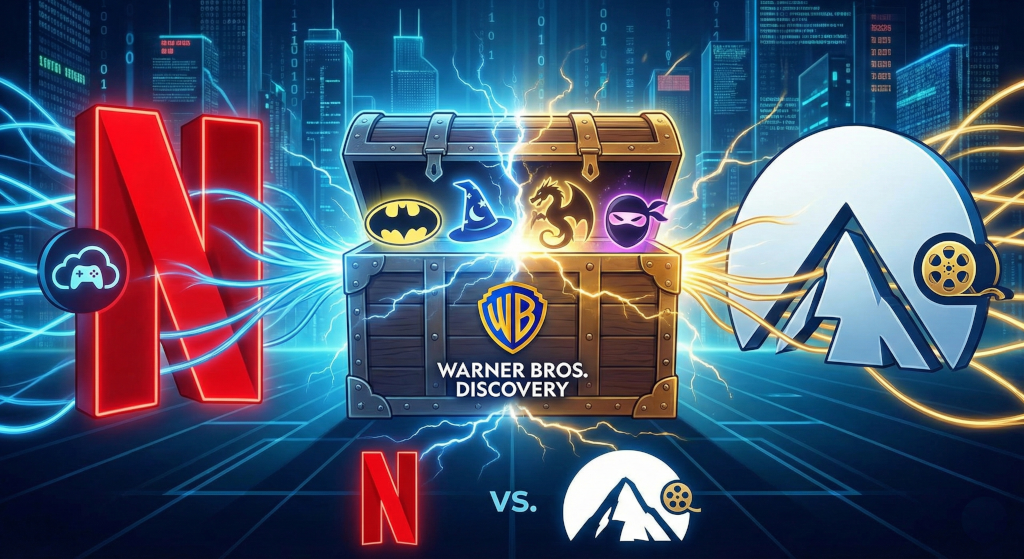
The entertainment industry is currently witnessing a tectonic shift as the boundaries between cinema, television, and interactive media dissolve into a singular ecosystem. At the center of this transformation is a monumental struggle for dominance involving three of the most influential names in global media: Netflix, Paramount, and Warner Bros. Discovery.
The recent $108.4 billion hostile takeover bid by Paramount Skydance for the entirety of Warner Bros. Discovery has sent shockwaves through both the financial sector and the gaming world. While the Warner Bros. board has signaled its preference for a more surgical $82.7 billion deal with Netflix, the implications of this corporate warfare extend far beyond traditional balance sheets.
For gamers and fans of licensed content, this moment marks the beginning of a new era where intellectual property is no longer merely watched but lived through high-end interactive experiences.
The Netflix Vision: From Streaming Giant to Gaming Powerhouse
To understand why a streaming giant like Netflix would engage in a bidding war of this magnitude, one must look at the current state of the global gaming market. As we move through early 2026, the traditional distinction between a movie studio and a game publisher is rapidly vanishing.
Netflix has spent years laying the groundwork for its gaming division, transitioning from simple mobile titles to a “Cloud First” strategy that aims to deliver console quality experiences directly to television screens. By targeting Warner Bros. Discovery, Netflix is not merely looking for more movies to pad its library. It is seeking to acquire one of the most prestigious gaming arsenals in history.
Warner Bros. Games possesses a collection of studios that any platform holder would envy. The list includes Rocksteady, the creators of the Arkham series, NetherRealm, the masters behind Mortal Kombat, and Avalanche Software, the team that delivered the record breaking Hogwarts Legacy.
In a world where the cost of acquiring users is skyrocketing, owning established franchises like DC Comics, Harry Potter, and Game of Thrones provides an incredible competitive advantage. Netflix recognizes that the next decade of growth will not come from passive video alone but from transmedia entertainment where a user might watch a series and then immediately jump into a cloud-based game set in that same universe.
Paramount’s Hostile Gambit: Why David Ellison Bet the Farm
Paramount Skydance, led by David Ellison and backed by the immense wealth of Oracle founder Larry Ellison, offered a significantly higher price of $108.4 billion for the total company. Unlike Netflix, which only wants to purchase the streaming and studio assets, Paramount’s bid included traditional assets like CNN and various linear television networks.
The Warner Bros. board viewed this bid as a potential regulatory nightmare. They argued that a merger of two legacy heavy behemoths would face insurmountable challenges from the Department of Justice due to the extreme concentration of television and film assets. Instead, the board leaned toward the Netflix offer, which focused on the studio and streaming divisions while allowing for a spin off of linear cable properties.
This decision reflects a broader trend in the industry: the future belongs to companies that can master distribution and interactivity, not necessarily those that own the most cable channels. However, the sheer size of the Paramount offer forced Netflix to sweeten its own proposal, turning what was once a simple negotiation into a high stakes auction that could redefine the value of intellectual property for decades to come.
The Cloud First Revolution: Transforming the Living Room
For the gaming community, the prospect of Netflix owning Warner Bros. Games is both exhilarating and terrifying. Netflix has the capital and the infrastructure to turn these franchises into a unified ecosystem. Imagine a scenario where a new DC Universe film premieres on Netflix and, on the same day, a high fidelity interactive mission is unlocked for subscribers. This level of synergy has been the ultimate goal of entertainment for decades, but it has rarely been executed successfully due to the friction of different hardware and software platforms.
Netflix’s cloud technology aims to remove that friction by turning every smart TV into a gaming hub. By 2026, Netflix has already begun rolling out its “Cloud First” strategy, prioritizing television based play over its earlier mobile efforts. Early successes with party titles like Boggle and LEGO Party have shown that there is a massive appetite for social gaming in the living room.
If Netflix can successfully integrate a triple-A title like a new Mortal Kombat or a Hogwarts Legacy expansion into its cloud service, the need for expensive consoles could diminish for a large segment of the casual gaming audience.
Owning the IP: What Happens to Rocksteady and NetherRealm?
There are valid concerns about whether a company driven by data and streaming metrics can truly nurture the creative spirit of a premier game studio. High end game development requires years of patience and a tolerance for delays that often clashes with the quarterly demands of a subscription service.
There is a persistent fear that under Netflix, these legendary studios could be forced into a “games as a service” model designed to maximize daily active users rather than artistic excellence. The industry has seen many instances where a non gaming parent company acquires a successful studio only to shut it down when project cycles do not align with short term financial goals.
However, Netflix has recently adopted a “less is more” philosophy, focusing on fewer high quality projects rather than a flood of mediocre content. This shift could provide the breathing room that studios like Rocksteady need to recover from recent setbacks and focus on the narrative driven single player experiences that made them famous.
The Transmedia Synergy: Why Licensed Content is King
The Paramount bid, though currently rejected by the board, highlighted the immense value of intellectual property in the current market. By offering $108.4 billion, David Ellison signaled that the legacy of Hollywood is still worth a premium if it can be successfully transitioned into the digital age.
Skydance has already shown a deep commitment to gaming through its own interactive division, working on high profile projects like Marvel 1943: Rise of Hydra. Their vision for Warner Bros. would likely have been more traditional, focusing on blockbuster console releases rather than the cloud first, integrated approach favored by Netflix. As this corporate saga unfolds, the real winners are the consumers who crave deeper engagement with their favorite stories.
The Netflix vs. Paramount war proves that the era of licensed content being treated as a secondary merchandise item is over. We are entering an age where a game is considered a core part of a franchise’s narrative, often carrying as much weight as a feature film. This shift is particularly relevant to the competitive gaming scene and the broader community of enthusiasts who value rich lore and consistent world building.
Regulatory Hurdles and the Future of Media Monopolies
The potential merger has not escaped the notice of regulators. A combined Netflix and Warner Bros. entity could control over 30% of the U.S. streaming market, a figure that triggers immediate antitrust scrutiny. Concerns have been raised by theater owners, unions, and rival tech giants like Amazon and Apple. To ease these fears, Netflix has pledged to honor traditional 45 day theatrical windows for major Warner Bros. releases, a significant departure from its previous “day and date” strategy.
The financial stakes are equally high. If Warner Bros. Discovery were to pivot back to Paramount after accepting the Netflix proposal, it would face a multi-billion dollar breakup fee. Conversely, if Netflix fails to close the deal due to regulatory blockades, it may owe Warner Bros. one of the largest penalties in corporate history.
This financial “mutually assured destruction” ensures that both parties are highly motivated to see the deal through to completion by the projected close in late 2026.
Analyzing the Strategic Landscape
| Entity | Primary Strategy | Major Gaming Assets at Stake |
| Netflix | Cloud-first integration, “less is more” strategy, transmedia synergy. | Rocksteady, NetherRealm, Avalanche Software, DC, Harry Potter IP. |
| Paramount | Legacy media revitalization, aggressive all-cash hostile bids. | Mission Impossible, Star Trek, Nickelodeon properties. |
| Warner Bros. | Divesting linear assets to focus on “Warner Bros.” (Studios/Streaming) | Mortal Kombat, Game of Thrones, Hogwarts Legacy, DC Universe |
A New Chapter for Gaming and Community
The $108 billion battle for Warner Bros. Discovery is a sign that we have reached the final stage of the streaming wars. It is no longer about who has the most subscribers, but who can provide the most comprehensive entertainment experience.
As Netflix moves closer to closing its deal, the world will be watching to see if they can finally bridge the gap between Hollywood and the gaming industry. For a gaming community trying to rebuild its roots, these corporate movements provide a wealth of new content to analyze and discuss. While the giants fight over ownership of the IP, the players remain the ultimate judge of quality. Whether it is a cloud based RPG or a competitive league for a new fighting game, the future of gaming looks more integrated, more accessible, and more expensive than ever before.
The corporate bidding wars might decide who owns the characters, but the community decides which stories stay relevant for the next twenty years. Would you like me to create a summary of this article specifically tailored for a Discord announcement to your community?
Why It Matters Today
The next three weeks are critical. If Paramount cannot convince a majority of shareholders to back them by the February 20 deadline, their hostile bid will likely collapse, clearing the way for the Netflix vote in March.
However, even if Netflix wins the shareholder vote, the deal faces a grueling 12–18 month regulatory review by the DOJ. For us in the gaming community, this means the future of franchises like Mortal Kombat and Hogwarts Legacy remains in corporate limbo until at least 2027.