
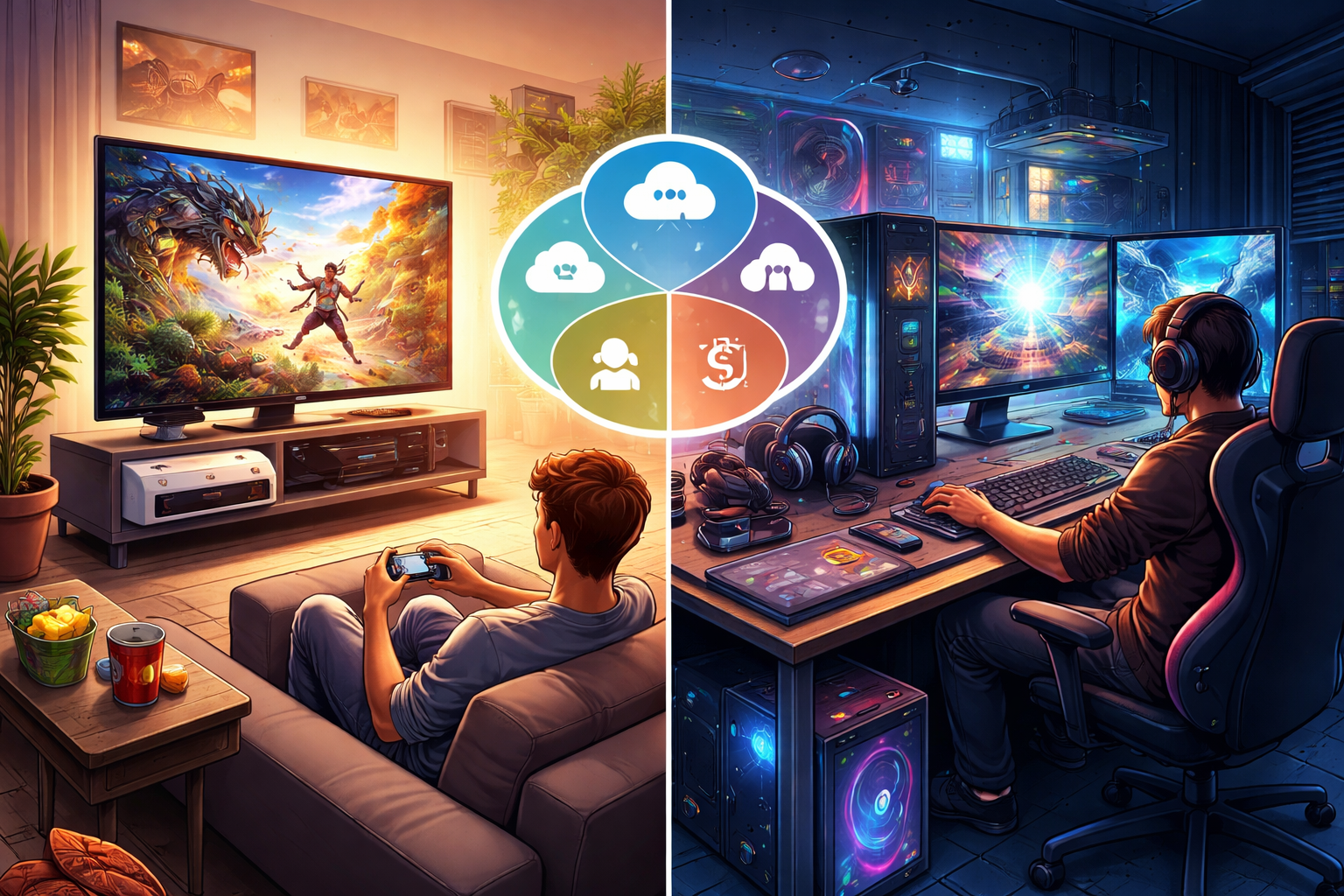
For decades, the console vs PC debate has been framed as a rivalry fueled by tribal loyalty, spec sheets, and internet arguments that rarely evolve. Consoles were for simplicity and affordability. PCs were for power and flexibility. That framing still exists, but in 2025 it no longer tells the full story. Hardware convergence, subscription ecosystems, cross-play, and shifting player lifestyles have fundamentally changed what this decision means.
The real question is no longer which platform is “better.” It is which platform aligns with how you actually play, what you value, and how much control you want over your gaming experience.
This article strips away the noise and focuses on what genuinely matters in 2025 when choosing between console and PC.
The Performance Gap Has Narrowed in Meaningful Ways
Raw performance used to be the centerpiece of this debate. PCs offered higher frame rates, better visuals, and faster hardware cycles, while consoles lagged behind but offered consistency. In 2025, that gap still exists, but its practical impact is smaller than ever for most players.
Modern consoles are capable of stable high frame rate gameplay, often targeting 60 frames per second as a baseline and reaching higher with performance modes. Upscaling technologies, dynamic resolution scaling, and smart rendering pipelines allow console games to look far better than their hardware alone would suggest.
PCs still dominate at the high end. Ultra-wide monitors, high refresh rates beyond 120Hz, and advanced graphical settings remain the domain of PC gaming. However, diminishing returns kick in quickly. The leap from 60 to 144 frames per second is noticeable. The leap from 144 to 240 is not meaningful for most players outside of competitive environments.
What matters more in 2025 is not peak performance, but consistency. Consoles provide predictable performance targets. PCs provide adjustable performance with the tradeoff of setup, tuning, and occasional troubleshooting. Neither is inherently superior. They simply serve different tolerances for friction.
Convenience vs Control Is the Real Divide
The most important distinction between console and PC today is not power. It is philosophy.
Consoles prioritize immediacy. You power on the system, select a game, and play. Updates are largely automatic. Hardware compatibility is guaranteed. Settings are minimal by design. The experience is curated to remove complexity.
PCs prioritize control. You choose your hardware, peripherals, operating system environment, graphics settings, mods, and software stack. That control enables customization and optimization, but it demands engagement. Drivers need updates. Games may require tweaking. Troubleshooting is sometimes unavoidable.
In 2025, this difference matters more than ever because people’s free time is increasingly fragmented. Many players are balancing work, families, side projects, or content creation. If gaming time is limited, friction becomes a deciding factor.
Consoles excel at fitting into short, predictable play sessions. PCs excel at becoming a personalized hub for long-form engagement and experimentation.
Cost Is No Longer Just About the Hardware
For years, consoles won the affordability argument by default. A single purchase gave access to a complete gaming experience. PCs required a larger upfront investment. In 2025, the cost equation is more nuanced.
Consoles still offer lower entry costs, especially when purchased during sales or bundled promotions. However, subscription fees for online multiplayer and premium services accumulate over time. Over the lifespan of a console generation, these recurring costs can rival or exceed hardware savings.
PCs demand more upfront spending, particularly for mid-to-high-end builds. However, online multiplayer is typically free, game prices are often lower through sales and storefront competition, and backward compatibility is effectively unlimited. A well-built PC can remain viable for many years with selective upgrades rather than full replacement.
What matters is not which option is cheaper on day one, but how you prefer to pay. Consoles spread costs over time through subscriptions and closed ecosystems. PCs front-load costs but offer more long-term flexibility.
Game Libraries Are More Overlapping Than Ever
Exclusive games once defined platform loyalty. In 2025, exclusivity still exists, but it is no longer the decisive force it once was.
Many games launch simultaneously across console and PC. Cross-play is increasingly common, allowing friends to play together regardless of platform. Save data synchronization across ecosystems is improving, reducing the penalty for switching devices.
Consoles still host exclusive titles, particularly first-party releases designed to showcase specific hardware features. PCs still dominate in genres like strategy, simulation, mod-heavy RPGs, and experimental indie projects. However, the overlap is substantial enough that exclusives alone rarely justify a platform choice unless a specific franchise is central to your gaming identity.
The more meaningful difference is how you access games. Consoles emphasize subscription libraries and curated storefronts. PCs emphasize open marketplaces, modding communities, and long-tail access to older titles.
Modding and User Creativity Remain a PC Advantage
One area where the gap has not closed is user modification and creative control.
PC gaming thrives on modding. Players extend game lifespans, fix bugs, add accessibility features, create entirely new experiences, and personalize mechanics in ways developers never intended. In 2025, modding is not just a hobby. It is a core part of how certain games are designed to live and evolve.
Consoles have made limited strides in supporting mods, but these implementations are constrained by security, certification, and platform policies. The result is a curated, restricted form of modding that cannot match the depth or freedom of PC ecosystems.
If your enjoyment of games includes tweaking systems, experimenting with user-created content, or participating in creative communities, PC remains unmatched.
Input Methods and Ergonomics Matter More Than Ever
Another overlooked factor is how you physically interact with games.
Consoles are optimized for controllers and couch-based play. This setup excels for action games, sports titles, and cooperative experiences shared in the same space. Living room ergonomics matter, and consoles are designed around them.
PCs offer unparalleled input flexibility. Mouse and keyboard remain superior for precision-based genres. Controllers, flight sticks, racing wheels, accessibility devices, and custom input setups integrate seamlessly. Multi-monitor configurations and desk-based ergonomics support long sessions and multitasking.
In 2025, hybrid setups are increasingly common. Many PC players use controllers for certain games and keyboards for others. Some console players integrate monitors and desks rather than televisions. The lines blur, but the underlying design assumptions remain.
Your physical comfort, preferred posture, and input style should carry significant weight in your decision.
Social and Community Dynamics Have Shifted
Gaming is no longer an isolated activity. Social systems now extend beyond in-game chat to streaming platforms, community servers, and persistent online identities.
Consoles offer tightly integrated social features that are easy to use and standardized. Voice chat, friend lists, and party systems work consistently across games. This lowers friction for casual social play.
PC gaming leans into external platforms for community building. Voice servers, forums, mod repositories, and streaming tools integrate into a broader digital ecosystem. This approach requires more setup but enables deeper community engagement and content creation.
In 2025, neither approach is inherently better. What matters is whether you prefer a contained, polished social layer or a flexible, expansive one that connects gaming to broader online activities.
Longevity and Ownership Are Increasingly Important
As digital ownership becomes more abstract, platform policies matter more.
PC ecosystems generally allow greater access to files, save data, and software longevity. Older games remain playable even decades later, often through compatibility layers or community support. If a storefront closes, alternatives usually exist.
Consoles are improving in backward compatibility, but access is still tied to platform policies and licensing agreements. When a generation ends, long-term access to certain titles may depend on corporate decisions rather than technical feasibility.
In 2025, players who value preservation, archival access, and long-term ownership tend to favor PC. Players who prioritize simplicity and trust platform holders to manage continuity tend to favor consoles.
The Right Choice Depends on You, Not the Internet
The most important truth in 2025 is that the console vs PC debate is no longer about winning. It is about alignment.
Choose a console if you value simplicity, predictable performance, living room play, and minimal setup. Choose a PC if you value customization, long-term flexibility, creative control, and integration with broader digital workflows.
Many players now own both, using each for different purposes. That reality alone should tell you something: the divide is no longer ideological. It is situational.
What actually matters now is not which platform has more teraflops or exclusives, but which one fits your time, your habits, and your priorities.
In 2025, the smartest choice is the one that gets you playing the way you want, without friction, frustration, or regret.