

Game: Halo Combat Evolved (Xbox)
Rankings: GWL Legacy Leaderboard for Halo Combat Evolved (Xbox)
Steam: Halo: Combat Evolved (PC)
 Halo: Combat Evolved was already a legend by the time we brought it into competition in 2005 for Xbox. Originally released in 2001 and later ported to PC, Halo: CE helped define console multiplayer culture. LAN parties, split-screen rivalries, and system-link tournaments made it one of the most socially competitive shooters of its era.
Unlike the twitch-heavy military shooters dominating esports at the time, Halo emphasized map control, power weapon timing, shield management, and movement across wide, open arenas. Gunfights weren’t instant deletes. They were layered exchanges. Breaking shields, controlling rockets or sniper rifles, and maintaining positional dominance mattered as much as raw aim.
When we opened Halo, Combat Evolved for competition on July 25, 2005, it wasn’t because it was trending upward in the broader competitive scene. It was because our community asked for it. A poll showed enough interest to justify building out structured ladders, and we gave it a fair opportunity.
Between July 25, 2005 and December 21, 2005, we recorded 40 matches across five ladders. Our most successful ladder was the 1v1 – CE Slayer, with 24 matches.
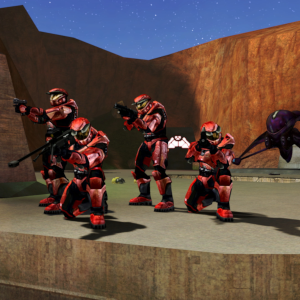 Slayer was Halo’s purest competitive mode. No objectives. No distractions. First to the kill limit wins. In 1v1 form, it became a tense contest of aim, strafing, grenade placement, and most importantly, power weapon control. Rockets and sniper rifles didn’t just spawn randomly. They spawned predictably. Players who controlled timing controlled the match.
That ladder accounted for the majority of our Halo activity. It made sense. Smaller formats were easier to organize, easier to schedule, and easier to sustain.
We also supported team ladders, including 2v2 Capture the Flag and 3v3 Team Slayer, with only 1 match each.
Capture the Flag in Halo was always a staple of competitive play elsewhere. It demanded coordination, flag runs timed around weapon spawns, and careful defensive setups. Team Slayer emphasized map rotations and power weapon cycling across squads rather than individuals.
Within our league, however, these team formats never gained traction. Participation was limited. Teams showed interest but didn’t multiply. Compared to larger competitive hubs that already had established Halo ecosystems our ladders remained modest.
In 2005, Halo’s competitive heart largely beat on Xbox. Major tournaments and structured leagues focused heavily on console play. We weren’t just launching a ladder. We were trying to build momentum in a scene whose center of gravity lived elsewhere. Still, the effort was real.
Forty matches in under five months is not insignificant. It wasn’t explosive growth, but it was sustained participation. Players queued up. Teams formed. Rivalries had the opportunity to start. And just as importantly, we listened to our community.
They asked for Halo. We delivered Halo. We gave it structure, rules, and a fair shot.
In the end, competition continued to thrive more strongly on other platforms and other sites. Growth plateaued. Rather than let the ladders sit idle, we made the decision to close that chapter. But those 40 matches remain part of our story.
Halo: Combat Evolved represents a moment when we expanded based on member demand, not market trends. It shows that even when a game doesn’t become a flagship for a league, it can still carve out a meaningful, if brief, competitive run.
The players mattered. The matches mattered. And for five months in 2005, Halo had its place here.