Game: Legions: Overdrive
Rankings: GWL Legacy Leaderboard for Legions Overdrive
Website: Legions: Overdrive
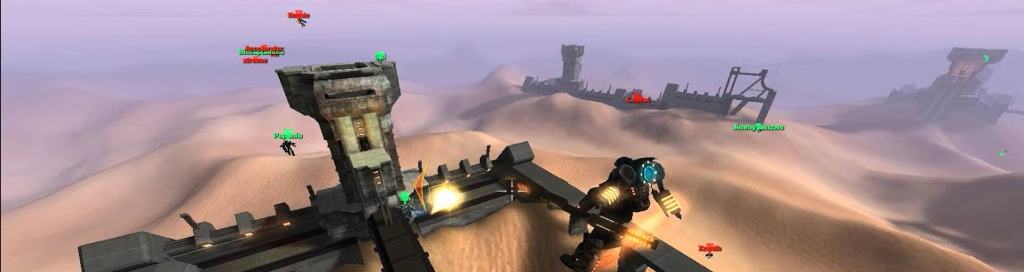
 Legions: Overdrive (originally released as Fallen Empire: Legions) arrived in 2008 with a very specific mission, to recapture the magic of the Tribes formula. Developed by GarageGames and led by former Dynamix developers, the same studio behind Starsiege: Tribes, and it was widely viewed as a spiritual successor to the franchise.
It wasn’t officially part of the Tribes IP. It didn’t carry the name. But anyone who had spent time in Tribes 2 recognized the DNA immediately. Jetpacks, skiing, high-speed traversal across massive rolling terrain, projectile-based combat that rewarded prediction over hitscan reflexes.
Legions leaned into movement as skill expression. Players chained slope slides to maintain momentum, launched into the air with jetpacks, and engaged in mid-air duels that felt more like aerial chess than traditional shooter combat. It was fast, sometimes blisteringly so. For fans of Tribes-style gameplay, it felt like a return to form in a market increasingly dominated by grounded, corridor-based shooters.
Given our success with Tribes 2, we believed there was potential here. The logic was simple. If our community embraced Tribes,
and Legions was built by former Tribes developers, then there was reason to think interest might carry over.
So we gave it structure and we launched a 1v1 Duel Ladder on January 23, 2010. In total, we recorded 6 matches before closing the ladder on February 21, 2010.
One month with six matches but real competition.
The short lifespan wasn’t due to a lack of respect for the game. In fact, the opposite was true. We recognized what it was attempting to do. We saw the mechanical depth. We understood the appeal of skill-based movement and projectile timing. But traction never materialized.
 Legions existed in a niche that was already niche. The original Tribes competitive community had fragmented over time, and while Legions attracted passionate players, the ecosystem never centralized in a way that made ladder growth easy. Some players preferred to remain with legacy Tribes titles. Others waited for what would eventually become Tribes: Ascend. The player base was enthusiastic but small and scattered.
Within our league, that translated into limited participation. We didn’t see expanding brackets. We didn’t see rival teams forming around the ladder. We saw a handful of dedicated competitors giving it a shot. And sometimes, that’s the story.
Legions: Overdrive represents one of the shortest competitive chapters in our history. But it also represents something important. We were willing to support innovation within a familiar genre. We didn’t only chase established titles. We gave space to games that felt like they deserved one.
Six matches may not define an era but they define effort. Those duels happened. Those players showed up. For one month in 2010, Legions had a place here.
And even brief chapters deserve to be preserved.