
Game: Half Life 2
Rankings: GWL Legacy Leaderboard for Half Life 2
GWL Game Review: Half-Life 2 Revisited: A Benchmark That Still Holds Its Ground
Steam: Half Life 2
 Half-Life 2 is remembered primarily for its groundbreaking single-player campaign, physics-driven gameplay, narrative immersion, and the now-iconic Gravity Gun. But alongside the campaign, Half-Life 2: Deathmatch emerged as a multiplayer experience built around the same Source engine physics that made the base game revolutionary.
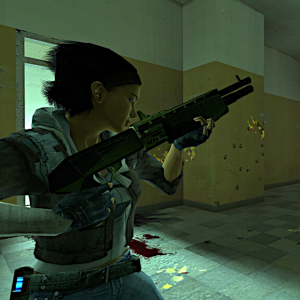
In Deathmatch, traditional arena instincts met environmental chaos. The Gravity Gun wasn’t just a novelty. It was a weapon. Players could launch saw blades, radiators, explosive barrels, and any loose object across the map. Combined with classic firearms like the SMG, shotgun, and crossbow, it created a hybrid style of combat that rewarded both aim and improvisation.
Maps like Lockdown and Overwatch became playgrounds for vertical movement and physics-based ambushes. The skill ceiling wasn’t purely mechanical. It was creative. The best players understood spawn timing, choke points, and object placement just as much as weapon control.
Elsewhere in the competitive landscape, Half-Life 2: Deathmatch found modest but dedicated communities. It never reached the dominance of Counter-Strike within the Source ecosystem, but small leagues and ladders formed around 1v1 and small-team formats. Its competition was niche, but it existed.
Within our league, we opened a single ladder 1v1 – DeathMatch. In total, we recorded 4 matches. The structure was there. The rules were there. The opportunity was there. But traction never followed.
 Half-Life 2’s multiplayer scene had to compete not only with other franchises, but with its own sibling: Counter-Strike: Source. For many competitive players on the Source engine, Counter-Strike was the natural home. It offered a more established competitive identity, clearer objective formats, and a deeply entrenched ecosystem.
Half-Life 2: Deathmatch, by contrast, felt more experimental. More chaotic. More physics-driven than tactically rigid. For some, that was its appeal. For others, it made sustained structured competition harder to build around.
We gave it a chance with four matches were played and were recorded. That’s four instances where players chose to compete under our structure rather than casually on public servers. It didn’t scale or grow and it didn’t become a flagship. But it happened.
Half-Life 2 represents another example of our willingness to support games with competitive potential, even when that potential didn’t translate into long-term activity within our ecosystem. Not every title catches fire in every league. Sometimes the competitive culture consolidates elsewhere.
The ladder existed. The matches were real. The effort was genuine.
And that’s why it remains part of our history.