
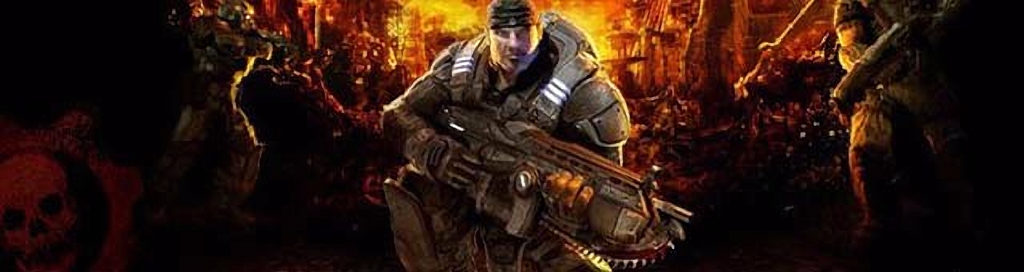
Game: Gears of War
Rankings: GWL Legacy Leaderboard for Gears of War
Steam: Gears of War (Reloaded) (PC)
 Gears of War launched in late 2006 and quickly became one of the defining titles of the Xbox 360 generation. Built on the Unreal Engine, it introduced a weighty, cover-based combat system that felt unlike anything else in competitive shooters at the time. Movement was deliberate. Gunfights were brutal. The now-iconic “roadie run” and shotgun duels became symbols of its high-risk, high-reward gameplay.
Where most competitive shooters emphasized speed and twitch reflexes, Gears of War emphasized positioning, angles, and timing around cover. Maps were tight and vertical. Power weapons spawned at fixed intervals, forcing coordinated pushes and map control battles. Shotgun play in particular became the centerpiece of competitive identity with up-close, split-second engagements that punished hesitation.
At the time, the game was extremely popular within the console competitive scene and became one game of a few that we supported for consoles as we were mostly a PC competitive site. Xbox Live integration made matchmaking accessible, and third-party competitive sites quickly established structured ladders and tournaments. Execution mode, in particular, became the standard for serious play.
Within our league, we focused on 1v1 Execution. Execution mode removed respawns. Once eliminated, a player stayed down unless revived before being finished. In team formats, this created tense, methodical rounds. In 1v1, it became something even more intense as a slow, tactical duel where every movement around cover mattered and every shotgun engagement could end the round instantly.
It was a format built for discipline and nerves. We opened Gears of War on April 11, 2007 and supported it through August 9, 2007—four months of genuine effort. In that span, we recorded 6 matches.
The players who competed showed up with intent. They weren’t casually testing the waters. They were trying to give the game a foothold within our structure. But momentum never materialized. New teams didn’t follow. The ladder didn’t expand.
 Unlike some of the other games we supported where traction slowly built, Gears of War faced a different challenge: the competitive community was already firmly established elsewhere. Major third-party sites had effectively locked down the ecosystem. Teams had homes. Rivalries were anchored. The competitive gravity was heavy.
We were attempting to break into a scene that had already chosen its primary platforms.
After four months, it was clear that the effort wasn’t translating into sustainable growth. There’s a difference between slow growth and stagnation. This was the latter. Rather than leave a ladder open without activity, we made the decision to close it.
That decision wasn’t about the quality of the game. Gears of War was immensely popular. It was mechanically deep. It had a thriving competitive base but it simply wasn’t thriving here.
Six matches do not define the broader competitive history of Gears of War but they define our attempt to support it.
The players who competed during those four months stepped into something uncertain. They gave the ladder legitimacy by participating. They gave the effort credibility by showing up. Even in a short-lived chapter, competition happened.
That matters.
This page preserves that brief but sincere attempt to carve out space within a tightly controlled competitive ecosystem. It reflects a time when we were willing to take risks on major titles, even when breaking into established scenes proved difficult.
We opened the door. We gave it time and when it became clear the community wasn’t forming around us, we closed it with respect.
The matches remain. The players remain part of our history.
Even short chapters deserve to be remembered.