

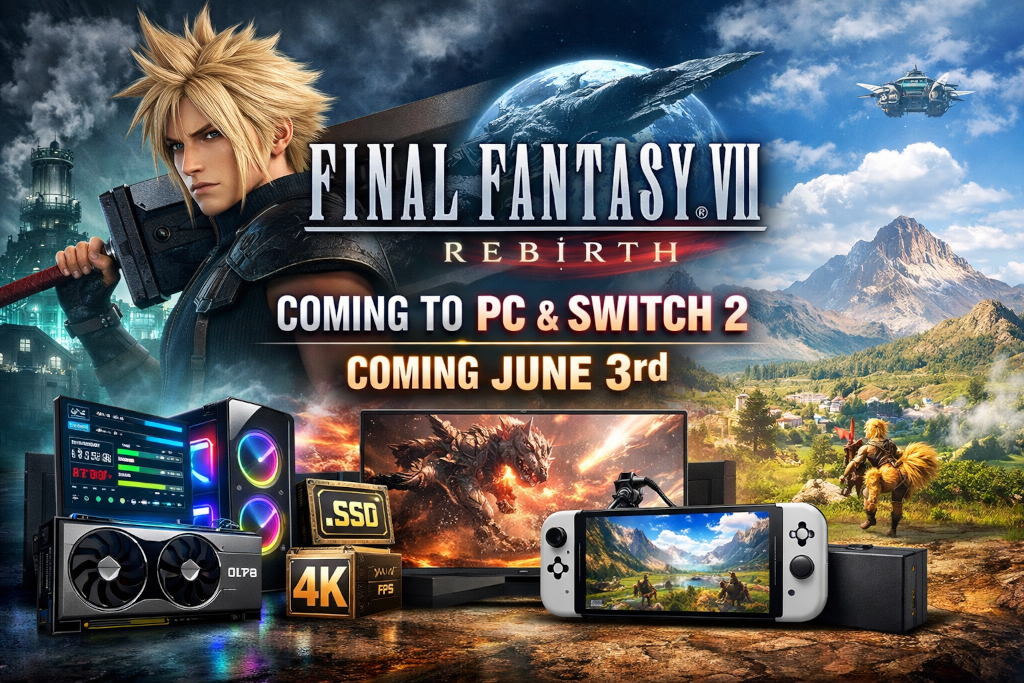
Breaking Down the June 3rd Release Date and Expected PC Performance Requirements
For many players, the return to Gaia has been more than a remake. It has been a reintroduction to one of the most influential role playing worlds ever created. Now, with Final Fantasy VII Rebirth expanding beyond its initial platform, anticipation is building once again. A June 3rd launch window for PC and the newly announced Nintendo hardware has sparked fresh discussion about performance, optimization, and what players should realistically expect from their systems.
As a competitive gaming community that grew up during the golden age of PC tournaments and custom ladders, we care deeply about performance. Frame pacing, hardware scaling, and platform parity matter. So let’s break down what this release means, what kind of PC hardware will likely be required, and how the Switch 2 version could compare.
A Quick Look at the Game Itself
Final Fantasy VII Rebirth is the second installment in Square Enix’s reimagined Final Fantasy VII project. Rather than offering a strict one to one recreation of the 1997 original, the modern trilogy expands the story, introduces open region design, and layers in real time action combat with strategic party switching.
Rebirth shifts the focus beyond Midgar and opens the world dramatically. The game features large, explorable regions connected through story progression. Each zone contains side activities, combat challenges, and character driven quests. Compared to its predecessor, the scale is significantly larger. That scale has direct implications for hardware performance.
On PlayStation 5, players had the option between a graphics mode targeting higher resolution and a performance mode aiming for smoother frame rates. This dual mode design tells us something important. The game is demanding.
Why the PC Release Matters
When major console titles make their way to PC, the conversation quickly shifts from narrative and gameplay to optimization and scalability. PC players expect granular settings. They expect control over resolution scaling, anti aliasing methods, texture quality, shadow detail, and advanced lighting features.
The earlier PC release of Final Fantasy VII Remake Intergrade provided a useful reference point. While visually impressive, that port initially faced criticism for stuttering and inconsistent frame pacing on some hardware configurations. Over time, patches improved performance, but it highlighted how demanding Unreal Engine based titles can be when moving from fixed console hardware to diverse PC setups.
Rebirth is larger in scope and more ambitious in its world design. That means higher CPU streaming demands, heavier GPU loads for environmental detail, and more strain on storage bandwidth.
Expected Minimum and Recommended PC Requirements
While official specs for this release window may evolve, we can make educated projections based on the engine, the PS5 hardware baseline, and trends in similar ports.
Likely Minimum Requirements
These specs would aim for 1080p at 30 frames per second on low to medium settings:
-
- CPU: Intel Core i5 8400 or AMD Ryzen 5 2600
- GPU: NVIDIA GTX 1660 or AMD RX 5600 XT
- RAM: 16 GB
- Storage: SSD required, likely 100 GB or more
The SSD requirement is almost guaranteed. Modern open world titles rely heavily on fast asset streaming. Mechanical drives often introduce texture pop in and traversal hitching.
Likely Recommended Requirements
For 1440p at 60 frames per second on high settings:
-
- CPU: Intel Core i7 10700K or AMD Ryzen 5 5600X
- GPU: NVIDIA RTX 3060 Ti or AMD RX 6700 XT
- RAM: 16 to 32 GB
- Storage: NVMe SSD preferred
These projections align with the performance profile of other high fidelity Unreal Engine games released over the past two years.
High End Expectations
Players targeting 4K at 60 frames per second with ultra settings will likely need:
-
- CPU: Modern 8 core processor
- GPU: RTX 4080, RTX 4090, or Radeon 7900 XTX tier
- RAM: 32 GB
Ray tracing support is possible, though not confirmed. If included, it would significantly raise GPU requirements.
CPU Bottlenecks and Open World Streaming
Large contiguous environments create heavy streaming demands. Unlike corridor based design, open zones require constant asset loading as the player moves across terrain.
CPU performance plays a larger role here than many players realize. Background tasks such as AI routines, physics calculations, and world event triggers can cause frame dips if single core performance is lacking.
Players running older quad core CPUs may experience stutter even if their GPU meets recommended specs. This has become a common pattern in modern AAA PC releases.
Storage speed also matters. NVMe drives significantly reduce traversal stutter compared to SATA SSDs, though both are preferable to traditional hard drives.
What About Switch 2?
The mention of a version for Nintendo’s next generation hardware has generated a different kind of excitement. While final hardware specifications remain officially limited, expectations point toward a system significantly more powerful than the original Switch.
A few performance realities are worth considering:
- Resolution will likely target dynamic 1080p in docked mode
- Handheld mode may run closer to 720p or use aggressive upscaling
- Frame rate could target 30 frames per second for stability
If advanced upscaling technology similar to DLSS is supported through NVIDIA hardware integration, the system may achieve impressive visual clarity relative to its power envelope.
The key question is asset scaling. Texture resolution, shadow fidelity, and environmental density will likely be reduced compared to the PC and PS5 versions. However, portability changes the equation. Being able to experience a large scale RPG on the go is a compelling tradeoff.
Graphics Settings PC Players Should Prioritize
When tuning performance, certain settings usually offer better frame gains than others.
- Shadows: Reducing shadow resolution often delivers immediate performance improvements.
- Volumetric lighting and fog: These can be GPU intensive.
- Ambient occlusion quality: Medium settings typically offer a good balance.
- Resolution scaling: DLSS, FSR, or similar technologies can provide large boosts with minimal visual loss.
Texture quality generally impacts VRAM usage more than raw frame rate, provided sufficient memory is available.
Players with 8 GB GPUs may need to lower texture settings at higher resolutions to avoid stutter.
Will This Become a Benchmark Title?
Large scale RPGs often become unofficial stress tests for new hardware. Titles with expansive environments and cinematic combat tend to expose weaknesses in mid range builds.
Rebirth has the ingredients to become one of those titles. Detailed character models, particle heavy combat sequences, and large terrain maps combine into a demanding workload.
For our community members who enjoy pushing their systems to the limit, this could become a useful reference point. It may even find its way into PC performance leaderboards and optimization discussions alongside competitive shooters and esports focused titles.
Community Impact
Even though this is not a competitive arena title, its release has ripple effects. High profile RPG launches draw traffic, spark hardware upgrades, and energize gaming communities.
PC players debating upgrade paths will weigh GPU generations, CPU core counts, and storage solutions. Console players will evaluate whether portability outweighs graphical fidelity.
For us, covering these moments is part of rebuilding a broader gaming conversation. Not every game needs a ladder or tournament to matter. Some releases remind us why we built communities in the first place.
Final Thoughts
The June 3rd PC and Switch 2 release of Final Fantasy VII Rebirth represents more than a platform expansion. It highlights how modern RPGs push hardware boundaries and demand thoughtful optimization.
PC players should prepare for substantial storage needs and potentially demanding GPU requirements. Those with older CPUs may want to monitor system performance closely. Switch 2 owners can likely expect a visually scaled but impressively portable version of the adventure.
As we move closer to launch, official specifications will clarify much of this speculation. Until then, the safe assumption is this: if your system handles recent Unreal Engine open world titles comfortably at your target resolution, you should be in solid shape.
And if not, June might be the excuse you needed to justify that long overdue hardware upgrade.