
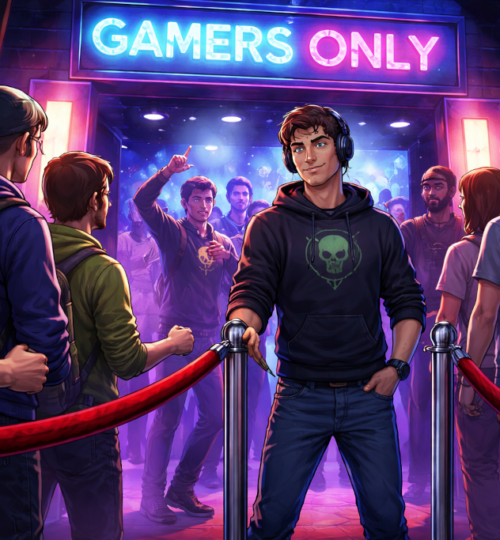
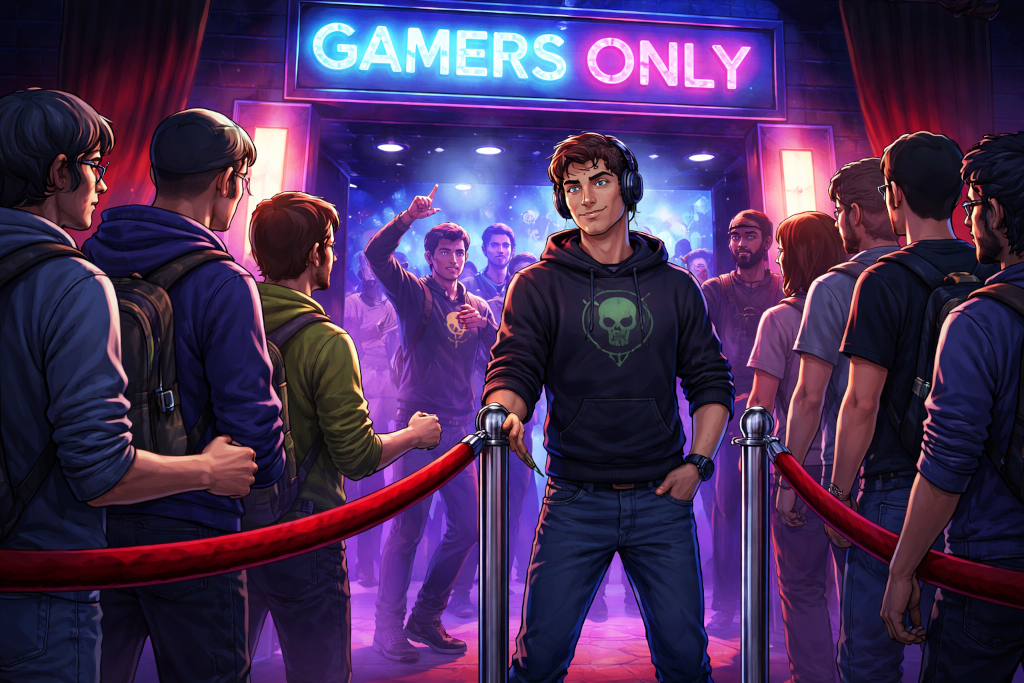
Gaming has always been about belonging. Whether it was a group of friends huddled around a CRT monitor in the early 2000s, players grinding ranked ladders in competitive shooters, or entire communities organizing tournaments online, the heart of gaming has never been just the software. It has been the people.
Yet alongside that sense of belonging, another pattern has always existed. Gatekeeping.
Gatekeeping in gaming is not new. It did not begin with social media. It did not begin with esports. It did not begin with streaming culture. It has evolved with each generation of platforms, but its roots run deep. To understand why it persists, we have to look at where it starts.
What Gatekeeping Actually Means
At its core, gatekeeping is the act of deciding who qualifies as a “real” member of a community and who does not. In gaming, this can show up in many ways:
- Questioning whether someone is a “real gamer”
- Mocking players for skill level, preferred platform, or genre
- Dismissing newer fans of a franchise
- Attacking people for playing casually instead of competitively
- Treating access to knowledge as power rather than something to share
Gatekeeping is rarely framed as exclusion. More often, it is framed as protection. Protecting tradition. Protecting standards. Protecting competitive integrity. Protecting identity.
That framing is what allows it to survive.
The Early Roots of Gaming Identity
To understand where gatekeeping starts, we need to rewind to the early years of organized online play.
In the late 1990s and early 2000s, competitive gaming communities formed around server browsers, IRC channels, and third party tournament websites. There were no built in ranked systems for most games. If you wanted organized competition, you had to seek it out. You registered on a website. You joined a ladder. You scheduled matches. You reported scores manually.
That friction created commitment.
Being part of a competitive community required time, effort, and social connection. You learned server etiquette. You recognized team names. You built rivalries. You earned reputation.
When access requires effort, identity strengthens.
Gatekeeping often begins at this point. When people invest time and identity into something, they become protective of it. Newcomers are not just new players. They are unproven. They have not “paid dues.” That mindset can harden quickly.
Skill as Social Currency
Competitive gaming amplified gatekeeping because skill became currency.
In a ladder system, rankings are public. Wins and losses are visible. Reputation spreads. Being highly ranked grants authority. In that environment, skill is not just performance. It becomes status.
When skill equals status, exclusion becomes tempting.
If a player is struggling, they may be mocked rather than mentored. If someone prefers casual modes over ranked play, they may be dismissed as not serious. If someone joins a competitive discussion without high level credentials, their voice may be minimized.
This dynamic is not unique to gaming. Sports communities have similar patterns. So do music scenes and hobbyist groups. But gaming’s online nature magnifies it. Anonymity reduces accountability. Public metrics amplify comparison.
The result is a culture where proving yourself often feels mandatory.
The “Real Gamer” Narrative
One of the most persistent forms of gatekeeping is the “real gamer” narrative.
It can sound like:
- You only play on console? Not a real gamer.
- You only play single player games? Not a real gamer.
- You started playing this franchise recently? You are not a real fan.
- You use aim assist? That does not count.
- You enjoy story over mechanics? Casual.
This mindset reduces a diverse global hobby into a narrow definition shaped by personal bias.
Gaming today spans competitive esports titles, story driven RPGs, indie experiments, mobile games, and everything in between. According to industry data from organizations like the Entertainment Software Association, the average gamer is not a teenage stereotype. The player base is broad across age, gender, and background.
Yet the outdated image of who “counts” still lingers.
Gatekeeping persists because identity is powerful. When someone has built part of their identity around gaming, expanding the definition can feel like dilution. If everyone is a gamer, what makes my experience unique?
That insecurity fuels exclusion.
Platform Wars and Tribalism
Another root of gatekeeping is platform tribalism.
For decades, console wars have shaped online discourse. Rivalries between ecosystems such as those built around Sony, Microsoft, and Nintendo have often gone beyond playful debate. Players tie identity to hardware choices. Performance metrics, exclusives, and online infrastructure become battlegrounds.
PC versus console arguments add another layer.
These debates can be entertaining. They can also become toxic.
Gatekeeping thrives in tribal environments. When groups define themselves in opposition to others, insiders are elevated and outsiders are ridiculed. The same pattern appears in competitive communities around specific franchises, whether it is a tactical shooter, a fighting game, or a sports title.
Tribalism simplifies complex ecosystems into “us” versus “them.” That simplicity is emotionally satisfying. It is also corrosive.
Streaming Culture and Performance Pressure
Modern streaming culture has added new dimensions to gatekeeping.
Platforms like Twitch and YouTube have turned gaming into spectator entertainment. Skill is now not only ranked but broadcast. Personalities shape narratives. Clip culture highlights mistakes.
On one hand, this has democratized visibility. Anyone can build an audience. On the other hand, it has intensified performance pressure.
When mistakes are immortalized in clips and chat reactions, vulnerability shrinks. Players may hesitate to try new roles or genres publicly. Communities may pile onto underperforming teammates.
Gatekeeping shifts from “are you a real gamer” to “are you good enough to be seen.”
Visibility amplifies scrutiny.
Nostalgia and the Golden Age Effect
Many communities believe their golden age is behind them.
You will hear it in conversations about server browsers. About LAN parties. About early esports. About specific patches that felt more balanced. About older matchmaking systems.
Nostalgia is powerful because it blends memory with emotion. It filters out frustration and highlights camaraderie.
Gatekeeping often hides behind nostalgia.
Statements like “You would not understand, you were not there” can shut down meaningful dialogue. Instead of sharing history, some use it as a barrier. The implication is that only those who experienced a specific era truly belong.
But gaming has always evolved. Matchmaking systems replaced manual server lists in many titles. Built in ranking replaced third party ladders. Cross platform play reshaped communities. These shifts are not inherently better or worse. They are different.
When change feels like loss, gatekeeping becomes a defense mechanism.
Why It Persists
Gatekeeping persists for several reasons.
First, identity attachment. When gaming becomes central to someone’s sense of self, they protect it fiercely.
Second, scarcity mentality. If status is limited, sharing it feels threatening. If skill is rare, mentoring others feels like giving up advantage.
Third, anonymity. Online environments reduce social cost for exclusionary behavior.
Fourth, algorithmic amplification. Social media platforms reward outrage and conflict. Extreme opinions travel farther than nuanced ones.
Finally, insecurity. At its core, gatekeeping is often fear. Fear of losing relevance. Fear of being outpaced. Fear that the culture is shifting beyond your control.
Exclusion becomes a way to reclaim certainty.
The Competitive Paradox
Competitive gaming presents a paradox.
Competition requires standards. It requires rules. It requires performance. Not everyone will win. Not everyone will rank highly. That structure is part of its appeal.
But competition does not require exclusion.
There is a difference between maintaining competitive integrity and dismissing entire groups of players. There is a difference between constructive criticism and ridicule. There is a difference between preserving history and weaponizing it.
Healthy competitive ecosystems balance intensity with accessibility. They create on ramps for new players. They document history without gatekeeping it. They mentor without condescension.
The paradox is resolved when competition is about performance within a match, not worth as a person.
Building Communities Without Gates
Communities do not become inclusive by accident. They are shaped intentionally.
It starts with language. Replace “prove yourself” with “let’s see what you can do.” Replace “you do not belong here” with “here is how this works.” Replace dismissal with documentation.
It continues with structure. Clear rules reduce arbitrary enforcement. Transparent ranking systems reduce suspicion. Public resources lower barriers to entry.
It thrives on memory. Archive match history. Celebrate past champions. Preserve screenshots and stories. But use history as a bridge, not a wall.
It grows through mentorship. Experienced players teaching newcomers strengthens both. Teaching reinforces knowledge. Learning builds loyalty.
Communities that survive long term understand something simple. Growth does not erase legacy. It expands it.
The Future of Gaming Culture
Gaming is no longer niche. It is one of the largest entertainment industries in the world. Professional esports leagues fill arenas. Indie developers find global audiences. Cross platform ecosystems blur hardware lines.
With that scale comes diversity.
More players. More perspectives. More playstyles. More expectations.
Gatekeeping will not disappear entirely. As long as identity and competition exist, tension will exist. But its influence can shrink.
The most resilient gaming communities are not those with the highest walls. They are those with the strongest foundations. Foundations built on shared passion, documented history, and competitive spirit that welcomes challengers rather than rejecting them.
Gaming has always been about proving what you can do inside the match. It does not need to be about proving that you deserve to be there in the first place.
The next chapter of gaming culture will not be defined by who is kept out. It will be defined by how well communities remember why they started playing at all.