
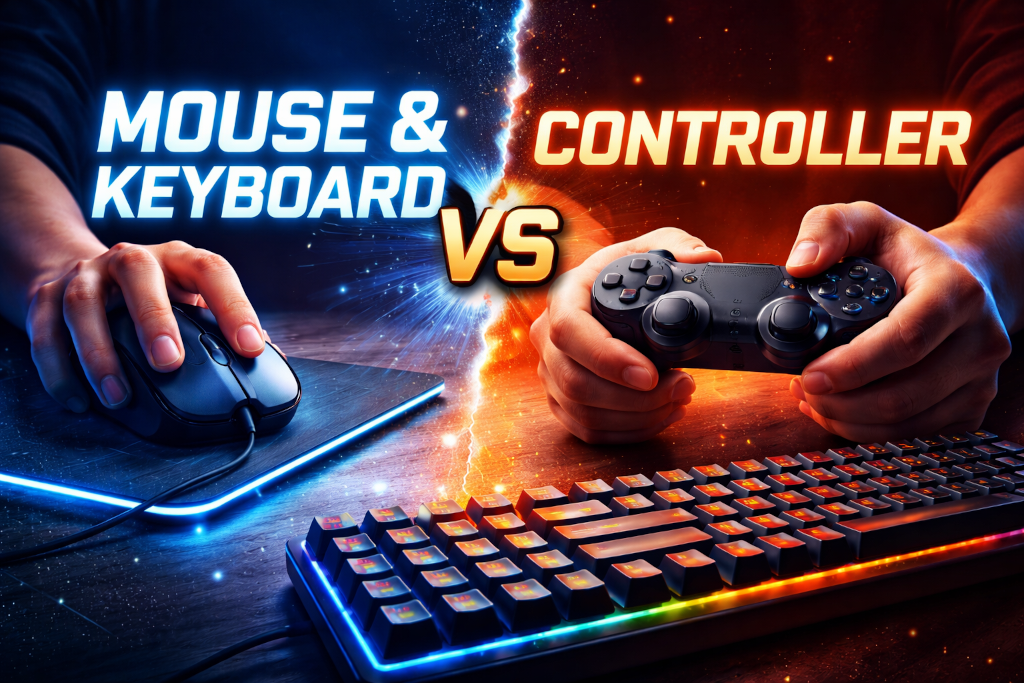
For decades, console gaming and PC gaming lived in clearly defined lanes. Consoles were built around controllers, designed for couch play, split screens, and accessibility. PCs were built around mouse and keyboard, offering precision, customization, and an almost limitless ceiling for competitive play. Those boundaries are no longer as clear as they once were. Today, more console players are plugging in a mouse and keyboard, sometimes officially supported, sometimes through adapters, and often sparking heated debates in the process.
At the center of that debate is a simple but emotionally charged question: is mouse and keyboard on console cheating, or is it a natural evolution of gaming hardware and player choice? The answer is more complicated than either side usually admits.
How Mouse and Keyboard Entered the Console Space
The presence of mouse and keyboard on consoles did not begin as a grassroots exploit. In many cases, it was invited in. Modern consoles support USB and Bluetooth peripherals at the system level. Several major games now include native mouse and keyboard support on console, allowing players to plug in without adapters or workarounds. This was not done accidentally.
As games became more complex, especially in genres like shooters, strategy games, and simulation titles, developers recognized that controllers were not always the ideal input method for every player. Cross play between PC and console further blurred the line. If PC and console players are already sharing the same lobbies, the argument goes, why restrict input methods on one platform but not the other?
From a technical standpoint, mouse and keyboard support is not a hack. It is a supported feature in many modern titles. The controversy arises not from its existence, but from how it intersects with competitive balance.
Precision vs Accessibility
Mouse and keyboard offer undeniable advantages in certain types of games, particularly first person shooters. A mouse allows for faster target acquisition, finer aim control, and more consistent micro adjustments than an analog stick. Keyboard inputs also allow for more bindings and faster directional changes.
Controllers, on the other hand, are built around accessibility and ergonomics. They are comfortable for long sessions, easy to learn, and paired with features like aim assist to compensate for their lack of raw precision. Aim assist exists because controllers need it to remain competitive in fast paced shooters.
The tension arises when mouse and keyboard players enter controller dominated spaces. If aim assist remains active, mouse users can gain a hybrid advantage. If aim assist is disabled, controller users may feel overwhelmed. Balancing these two inputs in shared environments is one of the hardest problems in modern multiplayer design.
Native Support vs Adapters
Not all mouse and keyboard usage on console is created equal. There is an important distinction between native support and adapter based usage.
Native support is straightforward. The game recognizes mouse and keyboard input directly and often places those players into appropriate matchmaking pools. In some cases, mouse and keyboard users are matched with PC players or other mouse users, reducing competitive friction.
Adapters are more controversial. These devices translate mouse input into controller signals, effectively disguising the input method. From the game’s perspective, the player is still using a controller. This can allow mouse users to retain controller aim assist while benefiting from mouse precision.
This is where many accusations of cheating originate. While adapters are legal hardware devices, their use often violates the intended competitive balance of a game. Some developers actively attempt to detect and block adapter usage, while others struggle to reliably differentiate between legitimate controller inputs and translated signals.
The difference between official support and emulated input matters. One is an open design choice by developers. The other exists in a gray area that undermines trust in competitive fairness.
Cross Play Changed Everything
Before cross play became common, the question of mouse and keyboard on console was largely theoretical. Console players competed against other console players. PC players stayed on PC. Input methods were siloed by platform.
Cross play erased that separation. Suddenly, platform mattered less than matchmaking. Friends on different systems could play together. Player pools grew larger and healthier. But input disparity became unavoidable.
Once PC players entered console lobbies, the idea that console gaming must remain controller only became harder to defend. If a console player is already competing against mouse users on PC, allowing mouse and keyboard on console does not necessarily introduce a new imbalance. In some cases, it simply removes an artificial limitation.
However, not all games handle cross play equally. Some allow input based matchmaking. Others do not. In poorly balanced systems, frustration grows quickly, especially when players feel they are losing to hardware rather than skill.
Competitive Integrity and Perception
In competitive gaming, perception matters almost as much as reality. Even if data shows that mouse and keyboard does not dramatically skew outcomes, players who believe the system is unfair will disengage.
Console communities have historically been sensitive to anything that feels like a PC advantage invading their space. This is not just about winning or losing. It is about identity. Console gaming has long been associated with accessibility and level playing fields. Mouse and keyboard can feel like an intrusion into that culture.
On the other side, mouse and keyboard users often argue that skill should not be constrained by platform traditions. If a console can support the input, and the game allows it, then players should be free to choose what works best for them.
Both perspectives are valid, which is why the debate persists.
Developers Are Caught in the Middle
Game developers are tasked with satisfying wildly different player expectations while maintaining healthy matchmaking and long term engagement. Supporting mouse and keyboard can expand a game’s audience and future proof it against changing hardware trends. At the same time, mishandling input balance can fracture a community.
Some developers take a strict approach. Mouse and keyboard users are separated into distinct matchmaking pools. Others allow mixed input but adjust aim assist and sensitivity settings dynamically. A few avoid native support altogether, forcing players into unofficial solutions that create even more controversy.
There is no universal solution because every game is different. A tactical shooter has different requirements than an arcade shooter. A competitive ranked mode has different expectations than a casual playlist.
What is clear is that ignoring the issue is no longer viable. Players are more informed, more vocal, and more willing to leave games that feel unfair.
Is It Cheating?
The word cheating carries heavy weight. It implies deception, rule breaking, and malicious intent. Mouse and keyboard usage on console does not always fit that definition.
If a game officially supports mouse and keyboard, and the player uses it within the game’s rules, it is not cheating. It is an intended feature. Even if it provides advantages in some situations, those advantages exist by design.
If a player uses an adapter to bypass input restrictions, exploit aim assist, or gain advantages not intended by developers, the situation becomes murkier. While not illegal in a legal sense, it often violates the spirit of fair competition. Many players and developers consider this behavior equivalent to cheating, even if enforcement is inconsistent.
Intent and transparency matter. Using supported features openly is different from disguising input methods to gain hidden advantages.
Is It Evolution?
From a broader perspective, mouse and keyboard on console may simply reflect where gaming is headed. Consoles are no longer closed boxes with fixed identities. They are increasingly flexible entertainment systems that blur the line between PC and console.
Players want choice. They want to play how they are comfortable. They want to use the input method that best suits their physical needs, preferences, or competitive goals. Locking consoles into a single input paradigm may feel increasingly outdated as hardware and software converge.
The evolution argument does not dismiss concerns about fairness. Instead, it challenges developers to design systems that account for multiple inputs without compromising integrity. That is a difficult task, but not an impossible one.
Where the Community Fits In
Community driven platforms, forums, and competitive hubs play a critical role in shaping how these debates evolve. Clear rules, transparent matchmaking, and honest discussions can reduce friction. When players understand how inputs are handled and why decisions are made, trust improves.
As gaming communities rebuild and grow, especially those rooted in competitive history, these conversations matter. Input methods, fairness, and accessibility are not side issues. They are central to how modern gaming communities define themselves.
The Middle Ground
Mouse and keyboard on console is neither inherently cheating nor unquestionably fair. It exists on a spectrum defined by implementation, transparency, and intent.
When supported natively and balanced thoughtfully, it expands player choice and reflects the evolving nature of gaming hardware. When abused through deceptive methods, it undermines competitive trust and fuels resentment.
The future likely lies in better input based matchmaking, clearer communication from developers, and communities that recognize nuance instead of defaulting to absolutes.
Gaming has always evolved through friction. New hardware challenges old assumptions. New players challenge old norms. Mouse and keyboard on console is just the latest chapter in that ongoing story.
The question is no longer whether it belongs. The question is how well the industry, and its communities, can adapt to make it work for everyone.