
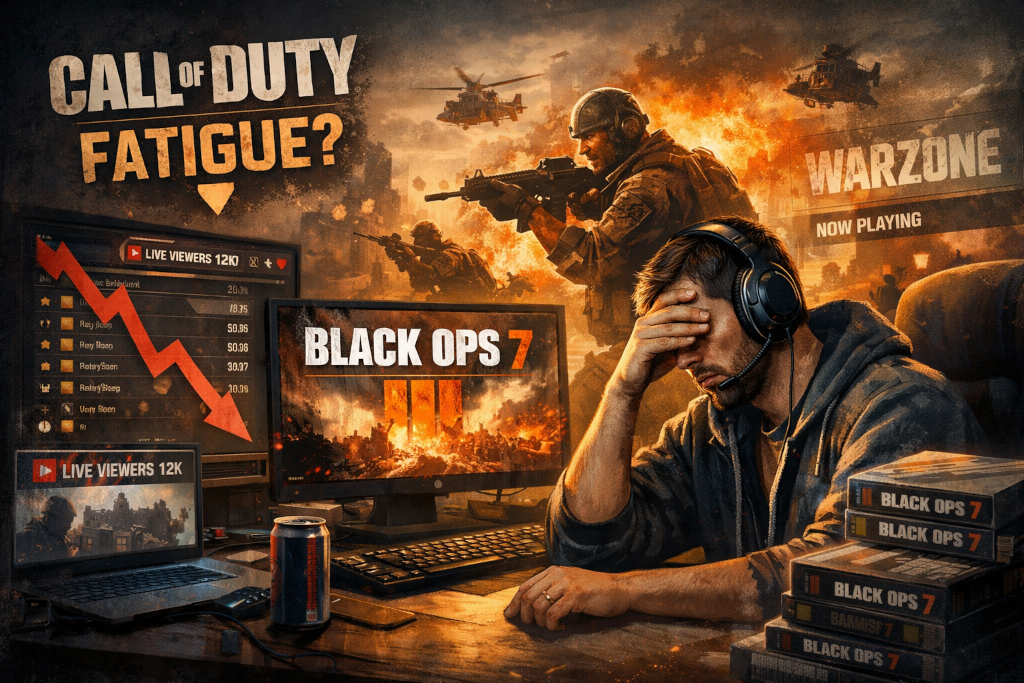
When Black Ops 7 launched, it did exactly what the Call of Duty franchise has done for nearly two decades. It topped sales charts, dominated social media timelines, and filled lobbies across every major platform within hours. On paper, it was a success. Yet almost immediately, a different narrative began circulating. Despite being the top-selling release of its launch window, Black Ops 7 showed signs of a softer opening compared to previous entries. Engagement metrics plateaued faster. Streaming viewership dipped sooner. Player sentiment felt more restrained.
This contrast has reignited a long-running debate within the gaming community. Is Call of Duty finally experiencing real franchise fatigue, or are expectations simply misaligned with how the market has changed?
This article examines the launch performance of Black Ops 7, the factors contributing to its perceived weakness, and whether this moment represents a meaningful shift for one of gaming’s most dominant series.
The Meaning of a “Weaker” Launch
Calling the launch of Black Ops 7 weak requires context. By almost any traditional metric, the game succeeded. It sold millions of copies in its opening days. It ranked at the top of digital storefronts. Matchmaking queues were instant, and server capacity held steady under heavy load.
The term “weaker” does not mean unsuccessful. Instead, it reflects relative performance. Compared to earlier Call of Duty launches, especially during the peak years of the franchise, Black Ops 7 did not generate the same explosive momentum. The gap between launch hype and sustained engagement appeared narrower. Retention curves flattened faster than expected. Community buzz cooled more quickly.
In a franchise accustomed to breaking its own records, anything less than exponential growth can feel like a warning sign.
Franchise Saturation and Annual Release Pressure
One of the most common explanations offered for this softer launch is franchise saturation. Call of Duty has followed an annual release cycle for nearly twenty years. For long-time players, this rhythm is both familiar and exhausting.
Each new installment promises innovation, but the core structure remains largely intact. Multiplayer modes follow recognizable patterns. Progression systems reset. Loadouts are rebuilt. Seasonal content rotates. Even meaningful mechanical changes can feel incremental when framed against the same loop players have repeated for thousands of hours.
With Black Ops 7, many players expressed a sense of déjà vu. The game was polished and competent, but for some, it did not feel essential. Skipping a year no longer feels like missing out. Live service updates and carryover progression in companion titles have reduced the urgency to migrate immediately.
Fatigue in this context is not rejection. It is indifference, and that is more dangerous for a franchise than outright backlash.
The Warzone Effect on Player Expectations
Another major factor shaping the launch perception of Black Ops 7 is the presence of Warzone. The free-to-play battle royale has fundamentally altered how players interact with the Call of Duty ecosystem.
For millions of players, Warzone is now the primary entry point. Traditional multiplayer and campaign modes have become secondary experiences. When Black Ops 7 launched, many players evaluated it not as a standalone product, but as an extension of Warzone.
This shift creates tension. Players who primarily engage with free content are less likely to purchase full-priced releases unless they offer a dramatic gameplay shift. If Black Ops 7 does not significantly change how Warzone feels, its value proposition weakens for that audience.
The result is a launch that looks strong on sales charts but softer in overall cultural impact. The community conversation remains focused on the live service platform rather than the new boxed release.
Campaign Reception and Single-Player Priorities
Historically, the Black Ops sub-series has been praised for its campaigns. Psychological storytelling, experimental mission design, and memorable characters helped distinguish it from other entries in the franchise.
With Black Ops 7, the campaign received solid but muted responses. Reviews described it as competent, visually impressive, and narratively coherent, but rarely exceptional. For a series that once pushed boundaries, this reception matters.
Campaigns no longer drive the majority of sales, but they influence perception. A standout single-player experience can elevate an entire release and generate goodwill. A merely adequate campaign reinforces the idea that the franchise is playing it safe.
For veteran players, this contributes to fatigue not because the content is bad, but because it feels cautious.
Multiplayer Design and the Skill Ceiling Problem
Multiplayer remains the backbone of Call of Duty, and Black Ops 7 delivered a familiar mix of fast-paced gunplay, map variety, and progression systems. Yet early feedback highlighted a recurring concern: accessibility versus mastery.
In recent years, Call of Duty has prioritized onboarding and retention for new players. Skill-based matchmaking, streamlined mechanics, and generous progression systems reduce frustration for casual audiences. However, this design approach can flatten the skill ceiling.
Competitive players and long-term veterans often report fewer opportunities to express mastery. When every match feels tightly controlled and outcomes feel predetermined, engagement suffers over time.
This tension is not unique to Black Ops 7, but its launch amplified the discussion. For some players, the multiplayer felt polished but emotionally flat. The highs were lower, even if the lows were smoother.
Streaming, Spectatorship, and Visibility
Launch performance today is measured not just in sales, but in visibility. Streaming platforms play a major role in shaping public perception.
Compared to previous entries, Black Ops 7 saw a shorter peak on major streaming platforms. Viewer numbers surged at launch but declined more quickly than expected. This does not mean players stopped playing, but it does suggest reduced spectator appeal.
Games that thrive on streaming often feature emergent moments, unpredictable outcomes, and visible skill expression. When gameplay feels standardized, it can be less compelling to watch.
This decline in streaming momentum feeds the fatigue narrative. Even if the player base remains large, reduced visibility can make the launch feel quieter than it actually is.
Changing Player Demographics and Time Investment
Another overlooked factor is the aging Call of Duty audience. Many long-time fans who grew up with the franchise now have less time to commit. Careers, families, and broader gaming options compete for attention.
Black Ops 7 launched into a market where players are more selective. Fewer people commit to one title for an entire year. Instead, they rotate between games, genres, and platforms.
In this environment, even a strong release may struggle to dominate attention the way earlier Call of Duty titles once did. This is not a failure of design, but a reflection of how players engage with games in 2026.
Is This Real Fatigue or a Market Correction?
So is Call of Duty fatigue real? The answer depends on how fatigue is defined. There is no mass exodus. Sales remain strong. The franchise is still a market leader. However, the unquestioned dominance that once defined every launch is no longer guaranteed.
What Black Ops 7 reveals is not collapse, but normalization. The franchise is settling into a new phase where success is measured by stability rather than spectacle.
Players are more critical. Expectations are higher. Loyalty is conditional. Annual releases no longer feel like cultural events by default. This shift does not doom Call of Duty, but it does challenge it to evolve in more meaningful ways.
What This Means Going Forward
For developers and publishers, the launch of Black Ops 7 offers clear signals. Incremental innovation may no longer be enough. Differentiation must be tangible. Risk may be necessary.
For players, it confirms something many already feel. Engagement is no longer automatic. Time and money are spent more deliberately.
For community-driven platforms and independent gaming hubs, this moment matters. As major franchises stabilize, spaces that emphasize discussion, competition, historical context, and player-driven content can regain relevance. The era of centralized dominance is giving way to a more fragmented gaming ecosystem.
Final Thoughts
Black Ops 7 is not a failure. It is a mirror. It reflects a franchise that remains powerful but is no longer immune to broader industry shifts. The question is not whether Call of Duty is dying. It is whether it can redefine what success looks like in a market that has matured alongside its audience.
Fatigue may be real, but it is not fatal. It is feedback. And how the franchise responds to that feedback will shape its next decade.