
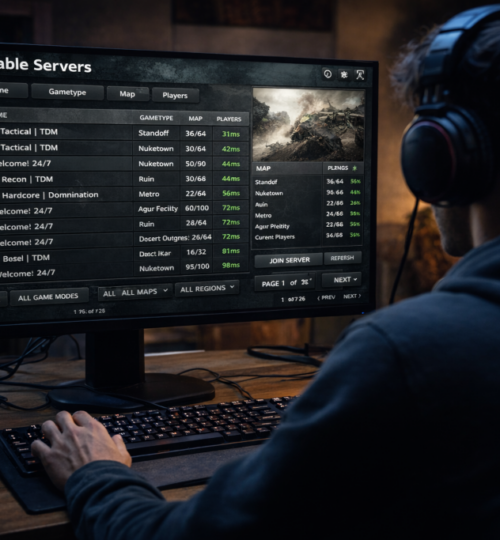
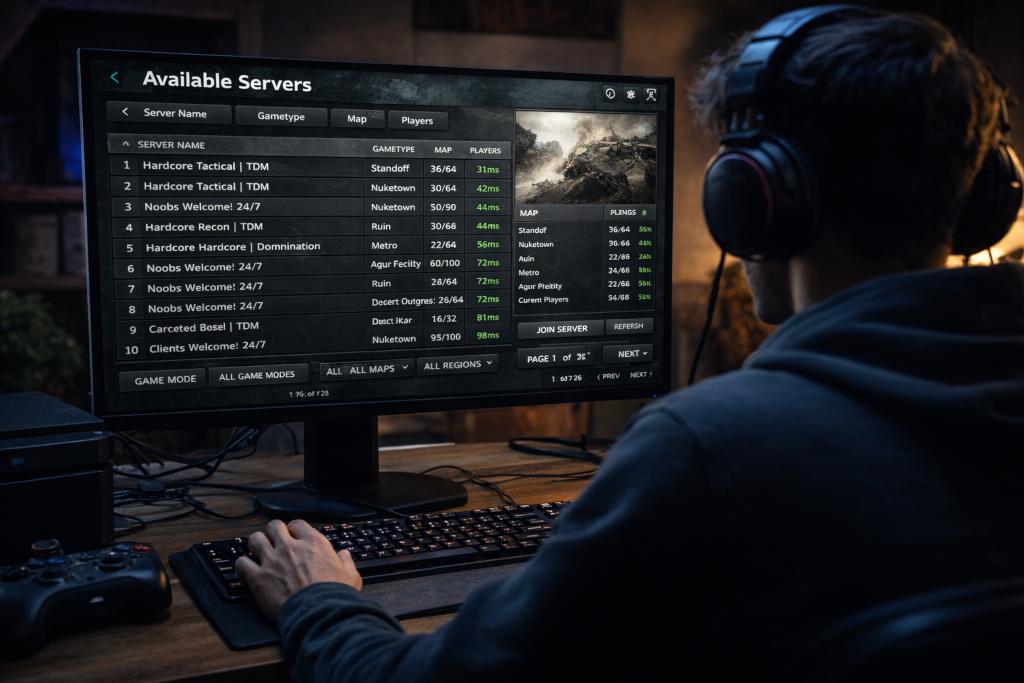
For players who grew up on competitive multiplayer shooters, the server browser is not just a feature. It is a philosophy. It represents control, transparency, and community. You choose your map. You choose your region. You see the ping. You recognize the server name. You find familiar players. You build rivalries.
Yet in modern flagship shooters such as Call of Duty: Black Ops 7 and Battlefield 6, that experience has largely been replaced by automated matchmaking systems driven by hidden algorithms. The conversation has become louder with each new release. Players keep asking for server browsers. Developers keep doubling down on skill based matchmaking.
This is not a simple case of stubbornness. It is a complex intersection of design philosophy, business incentives, data science, player retention strategy, and platform standardization.
Let us break it down.
What a Server Browser Actually Represents
In earlier eras of multiplayer shooters, particularly on PC, server browsers were standard. Players opened a list of active servers. They could sort by ping, player count, map, or custom server name. Many servers were privately hosted, sometimes rented by communities or clans. Admins set rules, curated map rotations, and enforced standards.
The benefits were clear:
- Transparent ping and connection quality
- Map choice and rotation control
- Community identity tied to specific servers
- Player driven moderation
- The ability to avoid certain maps or rule sets
For competitive players, especially those who thrived in league environments, server browsers created ecosystems. Clans practiced on familiar servers. Scrims were organized manually. Public servers became recruitment hubs.
It was imperfect. Servers could be unbalanced. Admin abuse existed. New players could get steamrolled. But players had agency.
The Rise of Skill Based Matchmaking
Modern shooters increasingly rely on skill based matchmaking, often abbreviated as SBMM. In this system, players are not choosing a server. Instead, they enter a matchmaking queue. The system evaluates metrics such as kill to death ratio, recent performance, accuracy, score per minute, and possibly hidden engagement metrics. The algorithm attempts to build teams of similar skill levels.
From a business standpoint, the reasoning is straightforward.
Large publishers behind franchises like Call of Duty: Black Ops 7 and Battlefield 6 operate at global scale. These games launch simultaneously across console and PC platforms. They rely on crossplay pools. Their monetization includes battle passes, cosmetic bundles, and seasonal content. Retention is everything.
Research in multiplayer game design has consistently shown that players who experience repeated, overwhelming losses early in their playtime are more likely to quit permanently. New player retention directly impacts revenue. SBMM attempts to create fairer matches, especially for casual players.
Developers argue that most players do not want to get crushed by top tier competitors in public lobbies. They want matches that feel competitive but achievable.
The problem is perception versus data.
Why Developers Resist Bringing Server Browsers Back
1. Population Fragmentation
Modern shooters are designed around unified matchmaking pools. A server browser can fragment the population. If players cherry pick only certain maps or rule sets, other playlists can become underpopulated.
From a developer perspective, keeping everyone inside centralized matchmaking ensures faster queue times and more consistent distribution across modes.
2. Monetization and Engagement Metrics
Matchmaking systems are not just about skill. They can incorporate engagement based matchmaking. While companies rarely confirm exact details, industry analysts have long speculated that matchmaking may also consider playtime patterns and churn risk.
If a system can detect that a player is on a losing streak and at risk of quitting, it can theoretically adjust match difficulty. A server browser removes that control layer.
Developers can measure everything inside SBMM. They can A B test lobby compositions. They can fine tune retention curves. With open server lists, that level of control diminishes.
3. Cross Platform Ecosystems
Older server browser culture thrived in PC environments where players could host dedicated servers. Console ecosystems historically restricted that freedom. Today, major shooters are cross platform by default.
Maintaining parity across PC, Xbox, and PlayStation complicates server hosting models. Centralized matchmaking ensures uniform infrastructure and moderation standards.
4. Cheating and Security
Centralized server architecture allows tighter anti cheat integration. Peer hosted or community hosted servers can introduce vulnerabilities. For publishers, maintaining authoritative servers simplifies enforcement.
The Player Perspective: Why SBMM Feels Frustrating
Despite the logic, many competitive and long time players feel alienated.
One core complaint is the loss of transparency. In a server browser, you know your ping. You know the map before joining. You see whether a lobby is nearly full. With matchmaking, players often enter blind and rely on post match screens for information.
Another complaint is consistency. SBMM can create lobbies that feel like ranked play even in casual modes. Every match can feel intense. For some players, especially veterans, public matches used to be a mix of skill levels. Some games were easy. Some were challenging. The variety created a natural rhythm.
When every match feels optimized to be close, fatigue sets in.
Additionally, server browsers fostered long term social bonds. You would see the same names repeatedly. That continuity built communities organically. In algorithm driven matchmaking, lobbies disband frequently. Social continuity weakens.
Why the Debate Is Strong in Call of Duty and Battlefield
The frustration is amplified in franchises with deep multiplayer histories.
Call of Duty built its early PC legacy on dedicated servers before shifting heavily toward console focused matchmaking. As the franchise expanded, the design philosophy shifted toward fast matchmaking and unified playlists.
Battlefield, especially during the PC heavy eras of titles like Battlefield 2 and Battlefield 3, became synonymous with large scale server lists. Battlefield communities were often organized around specific servers with custom rules and long running map rotations.
When newer installments reduce or de emphasize server browsing, long time fans feel something foundational has been removed.
The tension is cultural, not just technical.
Are Developers Ignoring Players?
It may seem that way, but the reality is more nuanced.
Developers absolutely see the demand. Forums, social media, and content creators amplify the request every release cycle. However, internal metrics may show that the majority of active players engage with matchmaking and do not leave because of the absence of server browsers.
Publishers prioritize data over nostalgia.
There is also a vocal minority effect. Highly engaged competitive players are more likely to discuss these issues online. Casual players who simply queue into matches may not voice concerns.
From a corporate standpoint, if SBMM increases retention by even a small percentage across millions of players, that outweighs the dissatisfaction of a smaller group.
Is There Anything on the Horizon?
There are a few potential middle ground solutions that have surfaced in the industry.
Hybrid Systems
Some games experiment with partial server browsing. Players can see available matches within a matchmaking pool without fully returning to dedicated server culture. This keeps infrastructure centralized while increasing transparency.
Ranked Versus Casual Separation
Clearer separation between strict SBMM ranked modes and looser casual modes could reduce frustration. If public playlists allow broader skill variance while ranked modes enforce tight matchmaking, both audiences may be served.
Community Tools
Developers could expand clan tools, persistent lobbies, or custom game browsers separate from standard playlists. This allows community building without fragmenting the main matchmaking pool.
However, none of these solutions have been fully embraced at scale in recent iterations of major shooters.
The Real Question: What Do Publishers Optimize For?
At its core, this debate comes down to optimization.
Server browsers optimize for agency and community identity. SBMM optimizes for retention and controlled experience curves. Modern AAA shooters are expensive to build. Development budgets can exceed hundreds of millions of dollars. These games are not one time purchases anymore. They are live services with seasonal content, battle passes, and long term monetization strategies.
Retention drives revenue. Algorithms drive retention. Until data shows that server browsers meaningfully increase revenue or player base growth, publishers are unlikely to fully revert to older models.
Where Communities Step In
This is where independent competitive communities have historically thrived. Third party platforms, custom tournaments, and external ladders provided structure beyond public matchmaking.
Even in a world dominated by SBMM, organized competitive ecosystems can exist outside official systems. They require infrastructure, trust, and sustained effort, but they can revive aspects of what server browsers once enabled.
The hunger for structured competition has not disappeared. It has simply shifted forms.
Final Thoughts
The absence of full server browsers in games like Call of Duty: Black Ops 7 and Battlefield 6 is not accidental. It is the product of deliberate design decisions shaped by modern business models and player retention strategies.
Developers likely understand the emotional and cultural attachment players have to server lists. Many of them grew up with those systems. But they operate inside economic frameworks where engagement metrics, churn reduction, and cross platform scalability take precedence.
Will server browsers return in full force? It is unlikely in the immediate future. More probable is a hybrid evolution where transparency and community tools expand without abandoning centralized matchmaking.
For now, the tension remains. Players want control. Publishers want consistency. And somewhere between nostalgia and analytics lies the future of multiplayer shooters.