
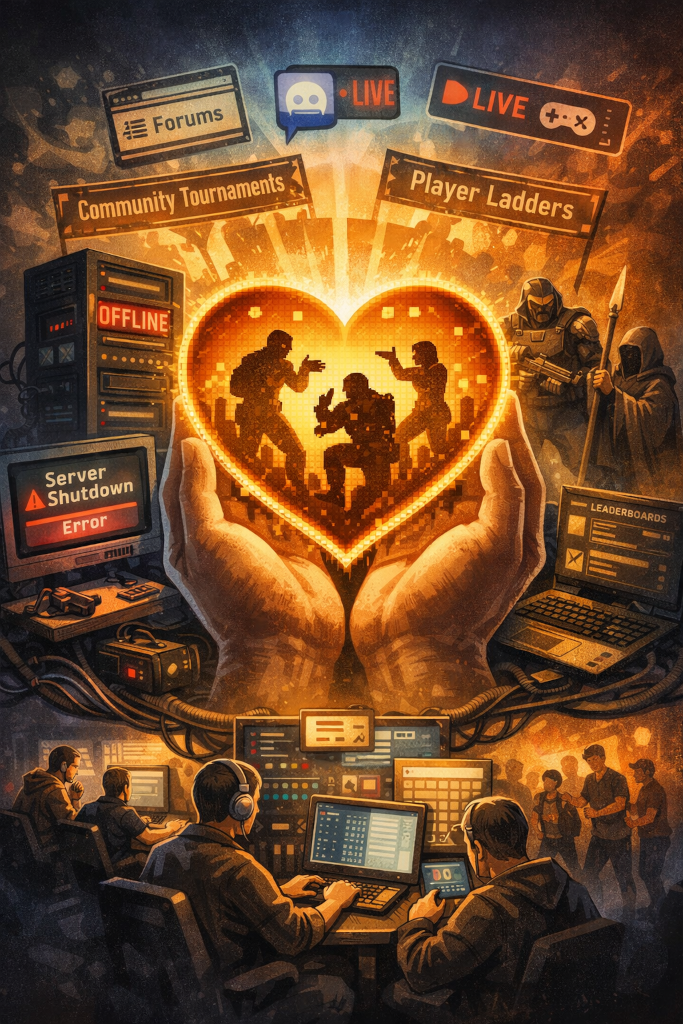
There is a quiet truth in gaming that rarely shows up in trailers or sales reports. Some games do not survive because of publishers, marketing budgets, or post launch roadmaps. They survive because players refuse to let them disappear. Long after official servers shut down, after sequels move on, and after the industry declares a title obsolete, communities step in and keep the lights on. These players do not just play games. They preserve them.
The modern games industry often treats longevity as a service. A game lives as long as it receives updates, seasonal content, and official support. When that support ends, many assume the experience is over. History tells a different story. Many of the most memorable competitive scenes did not last because of developer backing alone. They lasted because communities organized themselves, built tools, hosted servers, tracked stats, and created reasons to keep coming back.
This is the story of how communities save games from dying, and why that role matters more today than ever.
Games Are Code. Communities Are Culture.
A game can exist perfectly intact on a hard drive and still be functionally dead. What gives a multiplayer game life is not only mechanics or balance, but shared culture. Rivalries, reputations, inside jokes, recurring events, and familiar names turn software into a living space. Once that culture disappears, even technically playable games feel empty.
Communities provide continuity. They remember how a game used to feel. They preserve rule sets, competitive formats, and unwritten norms. When official development moves on, community members become historians, moderators, archivists, and organizers all at once.
This is especially true for competitive games. Rankings, ladders, and tournaments give players a reason to improve. When those systems vanish, communities often rebuild them from scratch using forums, stat trackers, and custom tools. In many cases, these systems end up being more flexible and player focused than the originals.
The Gap Between Official Support and Player Demand
Game companies operate on release cycles, market trends, and revenue targets. Players operate on attachment, mastery, and shared experience. Those motivations do not always align.
When a publisher sunsets a game, it is usually because resources are being redirected. Servers cost money. Staff time costs money. From a business perspective, it makes sense. From a player perspective, it feels like abandonment.
Communities fill that gap. They host private servers, organize matches, and create unofficial ladders. They run Discord servers, forums, and stat sites. They document patches, balance changes, and exploits long after official patch notes disappear. What begins as nostalgia often turns into stewardship.
In many cases, communities keep games alive long enough for publishers to notice renewed interest. There are multiple examples where revived player activity led to re releases, remasters, or official acknowledgments years later. Without those communities, that interest would never have been visible.
Competitive Infrastructure as a Lifeline
For competitive games, infrastructure is survival.
Leaderboards, ladders, and leagues are not just numbers on a page. They create stakes. They turn casual play into long term engagement. When official infrastructure disappears, the absence is felt immediately. Matches lose context. Improvement loses measurement.
Community run infrastructure restores meaning. Even simple stat tracking can reignite interest. Players return to see where they rank. Teams reform. Old rivalries resurface. New players join because there is something to climb toward.
This infrastructure often starts small. A forum thread. A shared spreadsheet. A fan made website. Over time, it evolves into something robust. Match reporting systems, seasonal resets, automated rankings, and historical archives emerge. What started as a workaround becomes a backbone.
Social Gravity Keeps Players Orbiting
Games rarely survive on mechanics alone. They survive because of people.
A strong community creates social gravity. Players log in not just to play, but to see familiar names. They stay for conversations, debates, and shared memories. Even when gameplay becomes repetitive, the social layer adds variety.
Discord has become a modern version of the old game forum. Voice channels replicate the feeling of team rooms. Text channels replace match threads. Announcements and pinned messages function like front page news. Communities that adapt to these tools maintain cohesion even as platforms change.
This social layer also lowers the barrier for returning players. Someone who has been away for years can rejoin, ask questions, and find their footing again. Without a community, returning feels awkward. With one, it feels like coming home.
Preservation Through Participation
One overlooked role of gaming communities is preservation.
Games are not just entertainment products. They are cultural artifacts. Mechanics, maps, balance philosophies, and even bugs reflect the era they came from. When games disappear entirely, that history is lost.
Communities preserve knowledge. They document strategies. They archive patches. They record tournaments. They keep mods, tools, and installers available. In doing so, they ensure that future players can experience games as they were, not just as memories.
This matters more as digital distribution becomes dominant. Physical copies fade. Online dependencies increase. Without communities stepping in, many games would simply vanish when servers go dark.
Why Older Games Often Build Stronger Communities
Interestingly, older games often have tighter communities than newer ones.
Modern games are designed for scale. Matchmaking systems emphasize speed and convenience. Players rotate quickly. Interaction is brief. Names blur together. While this model works well for accessibility, it can dilute long term social bonds.
Older competitive games often required more effort. Players sought out servers. They joined forums. They scheduled matches manually. That friction created commitment. When someone invested time to join a community, they tended to stay.
As a result, when official support ended, these communities were already self sufficient. They knew how to organize because they always had to. Saving the game was a natural extension of how they already played.
Community Leadership Is Invisible Work
Saving a game is not glamorous.
Admins moderate disputes. Developers maintain tools in their free time. Organizers chase players to submit results. Moderators deal with burnout, conflict, and endless edge cases. Most of this work is unpaid and often unrecognized.
Yet without it, nothing functions.
Strong communities usually have a few dedicated individuals who refuse to let things fall apart. They adapt rules when populations shrink. They merge ladders. They simplify formats. They make hard decisions to keep things playable rather than perfect.
This flexibility is something official systems often lack. Companies plan for scale. Communities plan for survival.
The Role of Modern Platforms in Revival Efforts
Today, communities have more tools than ever.
Discord, GitHub, streaming platforms, and modern web hosting make it easier to rebuild infrastructure that once required entire teams. A small group can now run ladders, host events, and broadcast matches with minimal cost.
At the same time, discoverability remains a challenge. New players are less likely to stumble into niche communities organically. This makes content creation important. Articles, videos, and social posts act as entry points. They tell people that a game is still alive, that others still care.
Reviving a community is often less about technology and more about communication. Letting people know there is a place to gather again is the first step.
Why Community Driven Survival Still Matters Today
Some might argue that modern live service models make community rescue unnecessary. After all, many games now receive years of official support.
The reality is that support still ends. Trends shift. Studios close. Licenses expire. When that happens, the same pattern repeats. Either a community exists to carry the game forward, or it fades quietly.
Community driven survival also keeps the industry honest. It reminds publishers that players value depth, competition, and continuity. It shows that games can outlive monetization cycles. In some cases, it even influences how future games are designed.
Games Do Not Die. They Are Forgotten.
A game rarely dies all at once. It fades. Servers empty. Match times increase. Content stops. Eventually, people stop checking in.
Communities interrupt that process. They give players a reason to remember. They provide structure where none exists. They turn nostalgia into participation.
When communities save games from dying, they are not just preserving software. They are preserving shared experiences. Friendships. Rivalries. Skills earned over years. Those things cannot be patched or remastered. They only survive if people care enough to keep them alive.
And as long as there are players willing to organize, document, and welcome others back, some games will never truly disappear.