
For most of its history, PC gaming has thrived on a simple promise. If you were willing to learn, tinker, and upgrade over time, you could get better performance, more flexibility, and longer system lifespans than any closed console platform could offer. That promise is now being tested harder than it has been in decades.
As 2026 approaches, the cost of core PC components continues to rise at a pace that feels disconnected from the average gamer’s budget. Graphics cards are becoming luxury items, RAM prices are climbing as demand explodes outside the gaming market, and even storage is no longer the safe, predictable upgrade it once was. For many players, the question is no longer which GPU to buy. The question is whether upgrading at all still makes sense.
The GPU Price Problem Is No Longer Temporary
High GPU prices used to come in waves. A new architecture launch would drive early adopter pricing, crypto mining would distort supply, or a global event would disrupt manufacturing. Gamers learned to wait it out. Prices would normalize, eventually.
This time feels different.
Reports circulating through hardware outlets, including coverage from TechSpot, suggest that both AMD and NVIDIA are expected to raise prices on current generation graphics cards in early 2026. These increases are not tied to a single supply shock. They are tied to sustained pressure across manufacturing, memory supply, and demand from sectors far outside gaming.
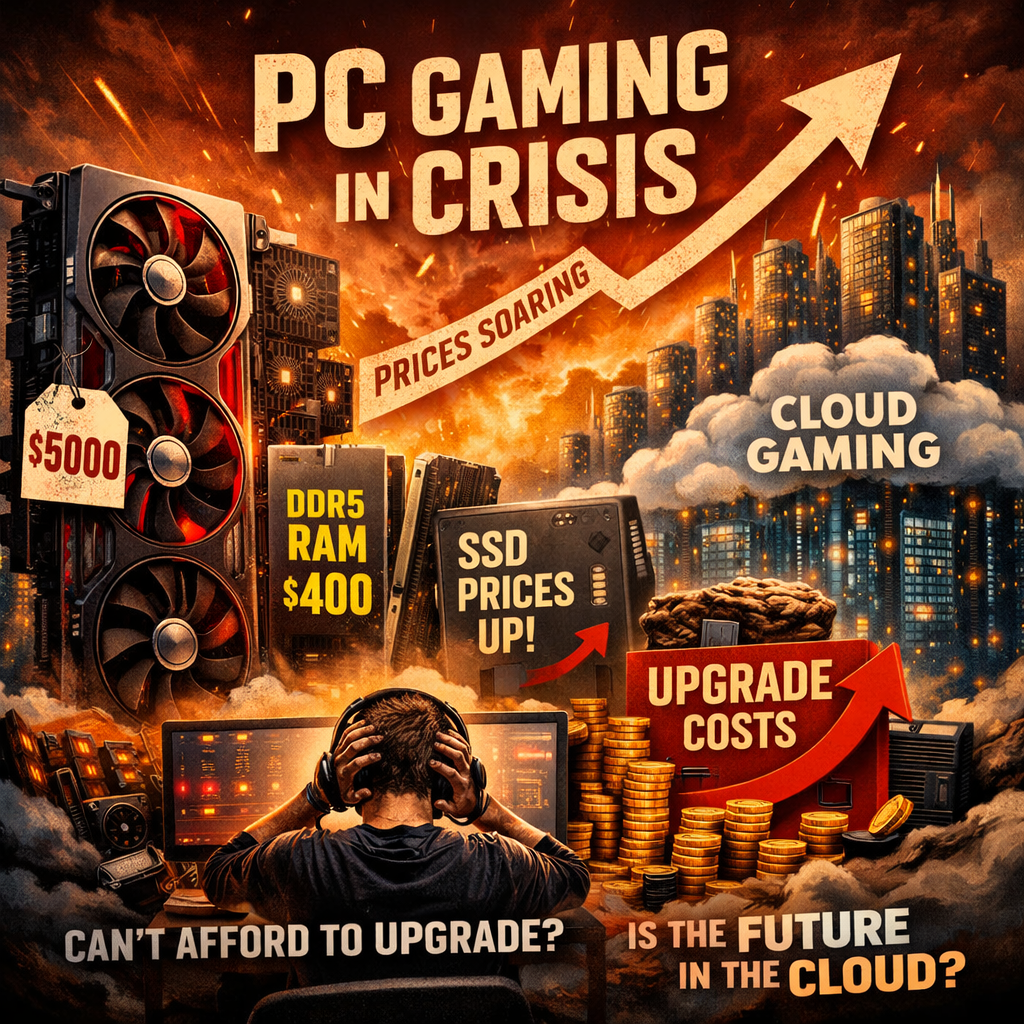
The most eye catching example is the rumored jump in flagship pricing. The RTX 5090 is expected to rise dramatically from an already staggering MSRP ($2000), with some projections placing it near the $5,000 mark. That number is shocking, but it is also revealing. It shows where the market ceiling is being pushed, even if most gamers never intend to buy a flagship card.
Historically, when the top end moves up, everything below it follows. Midrange cards inherit higher price tiers, entry level models creep upward, and the used market tightens as fewer people upgrade.
Enthusiast Hardware Sets the Tone for Everyone Else
It is true that the average gamer does not need a flagship GPU. Most players are gaming at 1080p or 1440p, often on hardware that is several generations old. Many current titles run extremely well on GPUs released five or six years ago.
But pricing is not about need alone. It is about perception and momentum.
When flagship cards reach prices that resemble full gaming PCs from just a few years ago, it reshapes expectations across the entire product stack. A $700 midrange card suddenly looks reasonable when compared to a $2,000 flagship. When that flagship jumps to $5,000, a $1,200 midrange card becomes easier to justify on paper, even if it would have been considered absurd not long ago.
This is how price normalization happens, and it is why enthusiasts indirectly affect everyone else. Even gamers who never touch top tier hardware still feel its gravitational pull.
RAM Prices Are Being Driven by an Entirely Different War
While GPU pricing dominates headlines, RAM is quietly becoming one of the most serious long term problems for PC gaming.
Unlike graphics cards, RAM demand is being driven heavily by the AI sector. Data centers, training clusters, and inference farms consume enormous amounts of memory, and they do so continuously. This demand does not fluctuate with gaming seasons or product launches. It grows steadily and aggressively.
Modern AI workloads favor large pools of fast, high density memory. As a result, manufacturers prioritize contracts that serve enterprise and infrastructure customers over consumer channels. Gamers are left competing for the leftovers of a market that no longer revolves around them.
The result is predictable. Prices rise, availability tightens, and budget builds become harder to justify. RAM was once the easiest upgrade to recommend. Add more memory, extend the life of your system, and keep playing. That advice is now less reliable when even modest capacity kits command premium pricing.
Storage Is No Longer the Cheap Win It Used to Be
For years, SSD pricing felt like the one bright spot in PC hardware. Capacity increased, prices fell, and performance improved almost year over year. That trend is slowing.
Rising NAND costs, supply chain consolidation, and increased demand from enterprise and cloud services are pushing storage prices upward again. High capacity NVMe drives are no longer impulse upgrades. Even SATA SSDs are losing their bargain status.
When combined with expensive RAM and GPUs, storage costs add yet another layer to the barrier of entry for new PC gamers.
Entry Level PC Gaming Is Becoming a Real Problem
Taken individually, none of these issues kill PC gaming. Together, they create a serious accessibility problem.
A new gamer looking to build or buy a PC in 2026 faces a harsh reality. Even modest systems cost significantly more than they did just a few years ago, while offering less dramatic performance improvements. Meanwhile, consoles still provide a fixed cost, plug and play experience that handles modern games well enough for most players.
This does not mean PC gaming is dying. It does mean it is becoming more exclusive, and that shift carries long term consequences.
PC gaming has always relied on a healthy influx of new players. Those players eventually become enthusiasts, modders, content creators, and community leaders. If the entry point becomes too expensive, that pipeline slows.
Why Gamers Are Choosing Not to Upgrade
During the height of the COVID era, many gamers accepted inflated prices out of necessity. Entertainment options were limited, time at home increased, and gaming became a primary outlet. Hardware purchases felt justifiable even when they hurt.
That context no longer exists.
Today, gamers are more selective. They are asking harder questions about value. Does a new GPU meaningfully improve their experience, or does it simply enable higher settings they barely notice during actual gameplay. Does faster RAM reduce stutters, or is the difference academic.
For a growing number of players, the answer is no. The performance gains do not justify the cost.
This creates a feedback loop. Fewer upgrades lead to lower sales. Lower sales force manufacturers to raise prices further to maintain margins. Higher prices discourage even more buyers.
How the Industry Might Respond
If hardware sales slow significantly, the gaming industry will not sit still. Several possible responses are already emerging.
One is a renewed focus on optimization. Developers may place greater emphasis on scaling performance across a wider range of hardware. Games that run well on older GPUs and lower memory configurations will reach larger audiences. This benefits players who are holding onto their systems longer.
Another possibility is the rise of alternative hardware vendors targeting budget conscious gamers. Smaller manufacturers could attempt to carve out niches with stripped down designs, lower margins, or region specific offerings. Whether they can survive against giants with massive R&D budgets remains uncertain.
Cloud gaming is also waiting in the wings. While it has struggled with latency, cost, and ownership concerns, it becomes more attractive when local hardware prices spiral upward. If maintaining a capable gaming PC becomes prohibitively expensive, streaming becomes a compromise some players are willing to accept.
Consoles Are Feeling the Pressure Too
These issues do not stop at the PC market. Console manufacturers rely on many of the same components, including RAM and storage. Rising costs complicate pricing strategies and release timing for next generation hardware.
If consoles launch at significantly higher prices, they risk the same resistance PC hardware is facing. If they delay launches, they risk stagnation. Neither option is ideal.
This shared pressure suggests that the entire gaming ecosystem is entering a period of recalibration.
The Irony of a Slower Upgrade Cycle
There is an ironic upside to all of this. Gamers may end up saving money simply by buying less.
Longer hardware lifespans encourage developers to target stable baselines. Players become more familiar with their systems and optimize their setups instead of chasing specs. Communities form around squeezing performance out of existing hardware rather than discarding it.
PC gaming grew originally because it rewarded knowledge and patience. In some ways, rising prices are forcing a return to that mindset.
What Comes Next
The next few years will reveal how flexible the gaming hardware industry really is. If prices continue to climb unchecked, something will have to give. Either manufacturers find ways to reduce costs, developers adjust expectations, or gamers redefine what acceptable performance looks like.
PC gaming has survived many inflection points. It has weathered console competition, mobile gaming booms, and industry consolidation. This challenge is different, but not insurmountable.
For now, the smartest move for many gamers may be the simplest one. Stick with what works, resist unnecessary upgrades, and focus on the games themselves rather than the hardware arms race surrounding them.
Ironically, in a time of record breaking prices, the best advice for 2026 might be this. Play more, buy less.