
For more than two decades, open world games have represented a promise. Vast landscapes. Total freedom. A sense that anything you see can be reached, explored, and conquered on your own terms. Early open worlds felt revolutionary because they broke away from tightly scripted levels and invisible walls. They invited curiosity instead of directing it.
Over time, however, something shifted. As hardware improved and development budgets grew, open worlds expanded in size, density, and complexity. Maps became larger. Quest lists became longer. Icons multiplied. What once felt liberating now often feels exhausting. This growing sense of burnout has a name many players recognize instantly: open world fatigue.
This article explores how we got here, why bigger worlds do not always lead to better experiences, and what developers can learn from a growing segment of players who are asking for less sprawl and more meaning.
The Original Appeal of Open Worlds
The early appeal of open world design was not size alone. It was agency. Players could choose where to go, when to go, and how to approach challenges. Exploration felt personal because the world reacted to curiosity rather than demanding completion.
Classic open world design focused on a few core ideas:
- Discovery driven by landmarks rather than icons
- Player choice over pacing
- A sense that exploration itself was the reward
In these games, the map was often incomplete or lightly marked. You found points of interest by noticing terrain, structures, or environmental cues. The world felt alive because it trusted the player to engage with it naturally.
As technology improved, developers gained the ability to build larger worlds with more detail. That capability slowly became expectation.
When Scale Becomes a Burden
Modern open world games often advertise map size as a primary feature. Hundreds of square miles. Dozens of regions. Thousands of activities. On paper, this sounds like value. In practice, it can feel overwhelming.
The problem is not exploration itself. The problem is obligation.
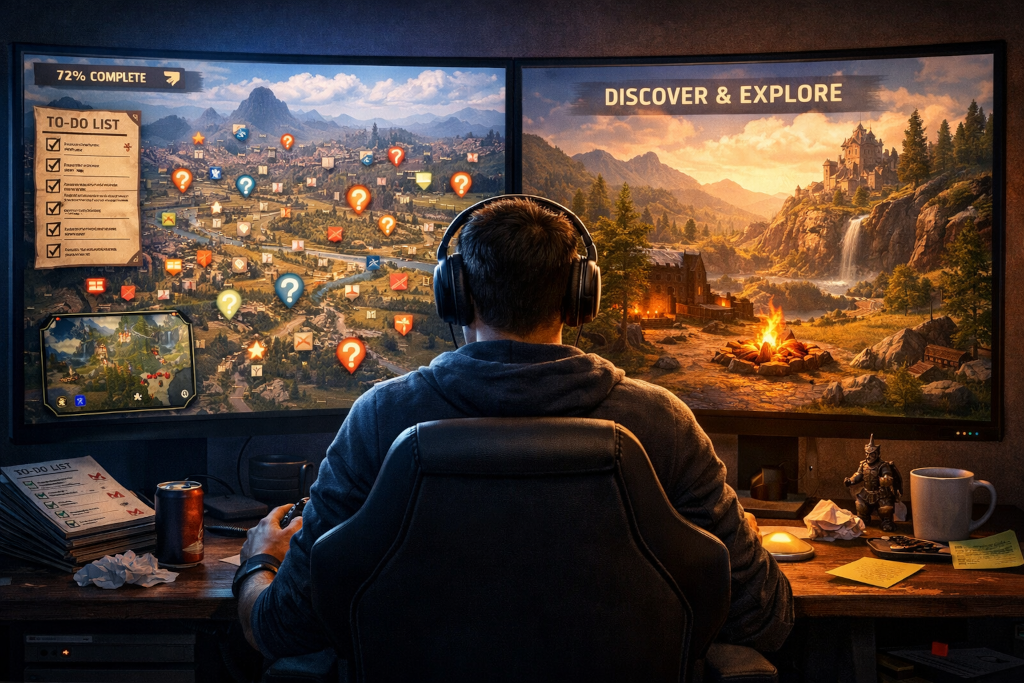
When a game presents a massive map filled with icons, checklists, collectibles, and side activities, it subtly shifts the player’s mindset. Exploration stops being about curiosity and starts becoming about completion. Instead of asking “What is over there?” players ask “What do I still need to clear?”
This checklist mentality leads to fatigue in several ways:
- Repetitive activities disguised as variety
- Long travel times that add little meaningful interaction
- Side quests that exist to fill space rather than deepen the world
What once felt like freedom begins to feel like work.
The Illusion of Choice
Many large open worlds offer choice, but that choice is often superficial. Players may choose the order of activities, but the activities themselves are structurally identical. Clear a camp. Collect an item. Escort a character. Repeat.
When every region follows the same template, scale loses its impact. The world may be larger, but the experience becomes flatter. Players recognize patterns quickly, and once those patterns are understood, the remaining content feels predictable.
This is where fatigue sets in fastest. Not because there is too much to do, but because too much of it feels the same. Meaningful choice requires consequences, variation, and narrative weight. Without those elements, freedom becomes an illusion stretched across a massive map.
Time Investment and Modern Players
Another factor driving open world fatigue is time. Many modern players are not teenagers with endless hours. They are adults balancing work, family, and other responsibilities. A game that demands 80 to 120 hours to see its core content can feel inaccessible rather than inviting.
This does not mean players want shorter games. It means they want games that respect their time.
When progress is padded by travel, grinding, or filler objectives, players become more aware of the cost of engagement. Fatigue builds not because the game is long, but because the length feels inefficient. A tightly designed 30 hour experience often leaves a stronger impression than a bloated 100 hour one.
Narrative Dilution in Massive Worlds
Storytelling also suffers when worlds become too large. In narrative driven games, pacing matters. Emotional beats lose impact if they are constantly interrupted by unrelated side content.
A dramatic story moment followed by three hours of collecting resources or clearing map icons creates tonal dissonance. Players may forget key plot points or lose emotional momentum.
Some games attempt to solve this by making side content optional. In practice, optional content rarely feels optional when it is tied to progression systems, gear upgrades, or skill points. When everything is optional, nothing feels essential.
The Psychological Weight of Completion
Completion culture has become deeply embedded in modern gaming. Achievement systems, progress bars, and completion percentages encourage players to finish everything. Open worlds amplify this pressure.
A massive map with hundreds of activities can create anxiety rather than excitement. Players may feel guilty ignoring content, even if that content is not enjoyable. This transforms play into obligation.
Open world fatigue is often less about boredom and more about mental load. The constant awareness of unfinished tasks can make even enjoyable activities feel draining. Some players respond by abandoning games entirely. Others push through out of habit, not enjoyment. Neither outcome benefits the experience.
Smaller Worlds, Stronger Identity
In recent years, there has been a noticeable appreciation for smaller, more focused worlds. These environments may still be open, but they are designed around density rather than scale.
Dense worlds prioritize:
- Meaningful points of interest
- Unique encounters instead of repeated templates
- Environmental storytelling that rewards observation
In these spaces, exploration feels intentional. Every area exists for a reason. Players remember locations because they are distinct, not because they are large. A smaller world can support stronger identity, clearer themes, and more memorable moments.
Player Agency Without Overwhelm
Reducing scale does not mean reducing freedom. In fact, smaller worlds often provide greater agency because players are not buried under content.
When choices matter and consequences are visible, players feel more connected to their actions. When exploration leads to discovery rather than repetition, curiosity returns. Agency thrives in environments that trust the player rather than overwhelming them.
Lessons for Developers and Communities
Open world fatigue is not a rejection of open worlds. It is a critique of excess. Players are not asking for less ambition. They are asking for better focus.
Key lessons emerging from player feedback include:
- Quality of content matters more than quantity
- Respect for player time increases engagement
- Variety must go beyond surface level differences
- Exploration should feel rewarding, not mandatory
Communities built around gaming thrive when they acknowledge these shifts. Discussion, analysis, and shared experiences help players articulate what they value and why certain designs resonate or fail.
The Future of Open World Design
The future of open world games likely lies in balance. Worlds that are large enough to feel immersive, but focused enough to remain meaningful. Systems that encourage exploration without demanding completion. Stories that respect pacing and player choice.
Technology will continue to enable bigger worlds. The challenge is knowing when to stop expanding and start refining. Open world fatigue is a signal, not a complaint. It tells us that players care deeply about these experiences and want them to evolve rather than stagnate. Bigger worlds may grab attention, but better worlds earn loyalty.
In the end, the most memorable journeys are not defined by how far we traveled, but by what we discovered along the way.