
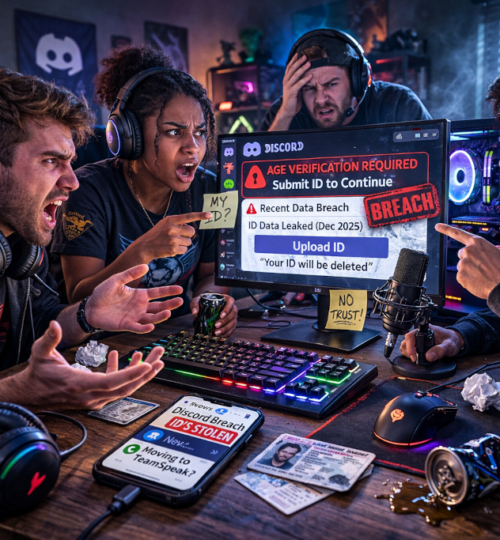

Discord is preparing to roll out a global age verification system beginning in March 2026 that will require some users to verify their age in order to unlock certain features. On paper, the move is framed as a safety upgrade. In practice, it is landing in a climate of distrust, and that context matters. The core of the backlash is not simply about inconvenience. It is about timing.
Only a few months ago, Discord confirmed that it experienced a data breach involving a third party customer support vendor. The incident was widely reported and traced back to compromised credentials belonging to an external support partner. Through that breach, unauthorized access was gained to certain customer support tickets and attachments.
Among those attachments were documents that users had submitted during support interactions. In some cases, those included government issued IDs that had been uploaded for verification purposes. Discord stated at the time that the exposure was limited and that it had taken steps to secure systems and notify affected users. Still, the optics were damaging. For many in the community, the memory is still fresh.
Now, in early 2026, Discord is asking users to once again trust the platform with sensitive identification data. Even though the age verification system is technically separate from that earlier breach, the two events are now linked in the public mind. And that is driving much of the pushback.
What Discord Is Changing
Under the new system, accounts will default to what Discord calls a teen appropriate experience unless the platform is reasonably confident the user is an adult. That confidence is based on internal age inference systems that analyze account signals such as usage patterns and metadata.
If Discord cannot determine a user’s age with high confidence, that user may be prompted to verify. Verification options include:
- A short facial age estimation scan, processed on device, with Discord stating that biometric data is not stored.
- Submission of a government issued ID through a third party verification partner.
Discord says that most users will not need to go through this process because automated inference will cover the majority of accounts. The company also states that ID data is deleted after verification and that it does not retain full identity documents.
From a compliance standpoint, Discord argues that this is necessary. Governments in the United Kingdom, European Union, Australia, and parts of North America are tightening online safety regulations, particularly around protecting minors from explicit content and unsafe interactions. Platforms are increasingly expected to demonstrate proactive age assurance measures.
From a policy perspective, Discord is positioning this as modernization. From a community perspective, it feels like déjà vu.
The Breach That Changed the Conversation
The earlier breach involving a third party support vendor has become central to the current debate. In that incident, attackers accessed support tickets and attachments through compromised credentials tied to the vendor’s systems. Discord stated that fewer than 200 users were directly impacted, but among those affected were individuals who had submitted personal documents during support cases.
Even if the number was relatively small, the symbolism was large. Users had been told that ID documents submitted for support verification would not be permanently stored and would be handled securely. The breach undermined that confidence. Whether the exposure occurred on Discord’s own infrastructure or within a partner’s environment makes little difference to users who saw personal documents compromised.
Now, when Discord says that age verification IDs will be deleted and securely handled, many users hear echoes of previous assurances. That is the core of the backlash. It is not simply about privacy in the abstract. It is about recent, concrete precedent.
What Happens If You Do Not Verify
Under the new policy, users who do not verify when prompted will remain in the restricted teen default state. That means:
- Access to age gated servers and channels may be blocked.
- Mature content will remain blurred or unavailable.
- Direct messaging settings will default to stricter filters.
- Certain community features may be limited.
For users who rely on Discord as their primary hub for gaming communities, content creation, modding groups, and competitive coordination, these restrictions are not trivial. The practical effect is that users may feel pressured to verify if they want full platform functionality. That is where the tension sharpens.
Community Reaction
Across social platforms and gaming forums, the response has been intense. Privacy focused users argue that Discord is expanding data collection at a time when trust is already fragile. Others say the platform is applying a global solution to a patchwork of regional regulations, effectively imposing stricter requirements even in places where local law does not mandate it.
Many are asking a simple question: If a third party vendor was compromised recently, why should users feel confident that new verification partners will be immune to similar risks?
Discord emphasizes that facial age estimation is processed locally and that identity verification is handled by specialized compliance partners. It also maintains that only age confirmation is returned to Discord, not full ID data.
But after a breach involving support ticket attachments that included sensitive documents, assurances alone are not enough for a segment of the user base. Some have begun canceling Nitro subscriptions in protest. Others are migrating entire communities.
The TeamSpeak 6 Effect
One of the most visible consequences has been a renewed interest in TeamSpeak 6. For years, TeamSpeak had been overshadowed by Discord’s rise. Now it is experiencing what many are calling a revival.
Reports indicate a significant influx of new users creating accounts and spinning up servers. In certain regions, server capacity has reportedly been strained due to increased demand. Hosting providers tied to TeamSpeak infrastructure have had to scale resources to accommodate growth.
TeamSpeak’s appeal in this moment is straightforward:
- No mandatory ID verification.
- Greater control over server hosting and data.
- A model that historically emphasized user managed infrastructure rather than centralized identity enforcement.
TeamSpeak 6 has modernized its interface and added features that narrow the gap with Discord, including improved text chat integration, enhanced media sharing, and updated mobile support. While it still lacks some of Discord’s ecosystem advantages such as massive discoverability and integrated bot frameworks, it offers something that matters deeply right now: perceived autonomy.
It is important to note that TeamSpeak is not automatically more secure. Any online platform carries risk. But perception drives migration, and right now, perception favors platforms that are not asking for government IDs.
The Regulatory Pressure Discord Faces
To understand the other side of the equation, it is important to acknowledge the broader regulatory landscape. Governments worldwide are increasing pressure on platforms to protect minors and prevent exposure to harmful content. Age verification mandates are becoming more common, and platforms that fail to comply risk fines or operational restrictions.
Discord is not acting in a vacuum. The company likely sees age verification as inevitable. From its perspective, building a global system ensures consistent compliance and simplifies enforcement across jurisdictions.
But implementation timing matters. Rolling out a sweeping ID based verification system shortly after a third party data breach involving sensitive documents creates a credibility challenge.
A Turning Point for Gaming Communities
For gaming communities, Discord has been the default communication layer for nearly a decade. From competitive leagues to indie mod teams to massive multiplayer guilds, Discord became infrastructure. Now that infrastructure is under scrutiny.
Some communities will verify and stay. Others will split, maintaining presence on Discord while rebuilding on alternatives. A smaller but vocal group will leave entirely, unwilling to trade anonymity for access.
Whether this migration becomes permanent depends on several factors: how aggressively Discord enforces verification, whether additional breaches occur, and whether alternatives can match Discord’s ease of use and feature depth. What is clear is that trust is the currency in play.
Discord’s age verification rollout is not just a technical update. It is a test of how much trust its user base is willing to extend after a recent breach involving sensitive support data. For a platform built on community and real time interaction, that trust is everything.
And right now, it is being renegotiated in real time.