
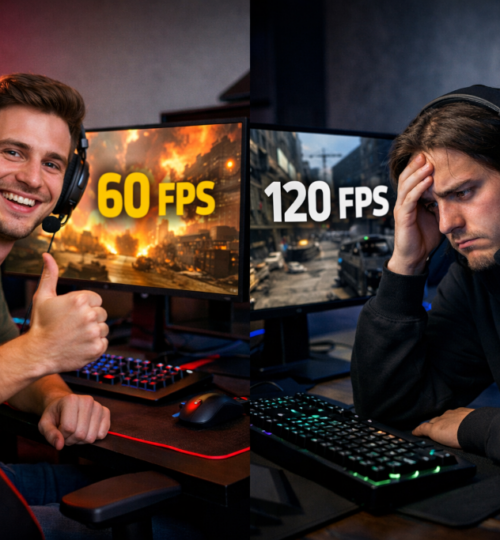
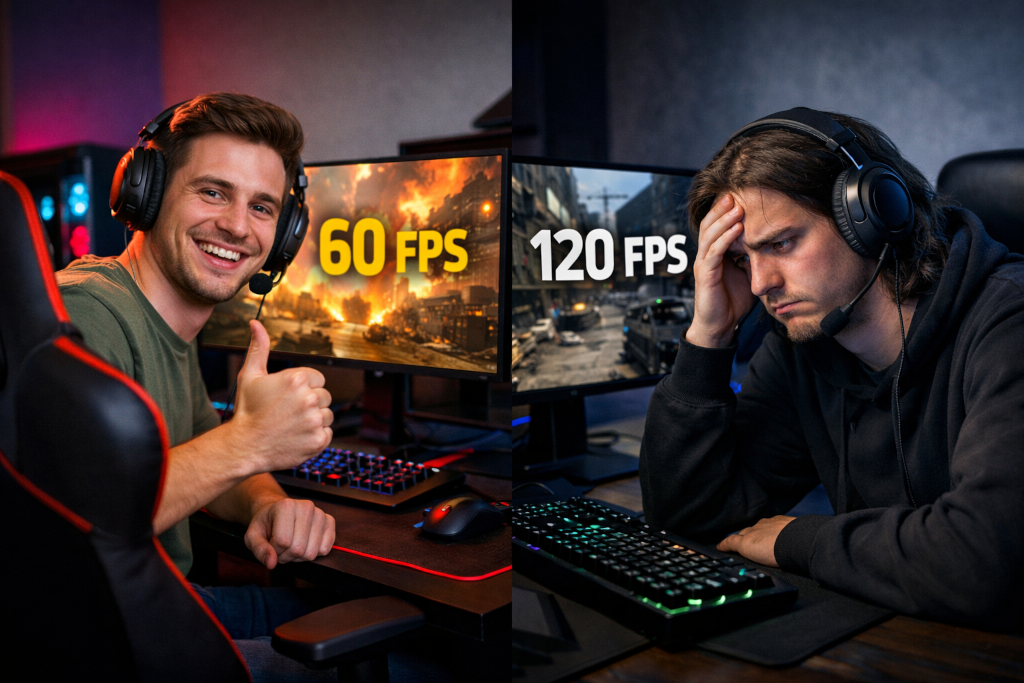
For years, higher frame rates have been treated as the gold standard of competitive gaming. The jump from 30 frames per second to 60 was transformative. The jump from 60 to 120, and even 240, became a badge of seriousness. Monitors advertised ever increasing refresh rates. Graphics cards were judged not only by visual fidelity but by how many frames they could push. In esports circles, more frames often meant more credibility.
And yet, there is a quiet reality that does not fit neatly into the marketing narrative. Some players genuinely prefer 60 frames per second. Not because their hardware cannot do more. Not because they do not understand the technical advantages. But because 60 feels better to them.
This is not a rejection of progress. It is an acknowledgment that performance is not purely numerical. It is experiential.
The Science of Frame Rate and Perception
At a technical level, the argument for higher frame rates is clear. A display refreshing at 120 Hz can show a new frame every 8.3 milliseconds. A 60 Hz display refreshes every 16.7 milliseconds. That difference reduces motion blur, lowers input latency, and creates smoother animation during rapid camera movement.
In fast paced competitive shooters and racing games, that reduction in latency can matter. It can mean the difference between reacting in time and reacting a fraction too late. Professional esports players often train on high refresh monitors precisely because of that edge.
However, the human visual system is not a simple measurement tool. It does not process frames as discrete units. It integrates motion over time, blends persistence of vision, and adapts to expected patterns. Once you pass a certain smoothness threshold, the subjective improvement between 60 and 120 can become subtle depending on the game and the player.
For some players, that threshold is right around 60.
Stability Over Speed
One of the most overlooked aspects of frame rate discussions is consistency. A locked and stable 60 frames per second can feel more comfortable than an unstable 120 that dips and spikes.
Frame pacing matters. If a game fluctuates between 120 and 85 in busy scenes, those drops can feel more distracting than a consistent 60 that never wavers. Micro stutter, uneven frame times, and background system load can create a sense of jitter that no refresh rate number can fix.
Many players who say 60 feels better are not saying 60 is technically superior. They are saying a stable experience feels better than a fluctuating one. In practical terms, a well optimized 60 FPS console title can feel smoother than a poorly optimized high frame rate PC port.
Consistency builds rhythm. And rhythm is everything in competitive play.
Muscle Memory and Temporal Calibration
Gamers are creatures of habit. Years of play at a specific frame rate can calibrate timing in subtle ways. When a player has spent thousands of hours on 60 FPS titles, their muscle memory adapts to that temporal cadence.
The brain learns how long an animation takes. It learns how quickly a character turns. It learns the feel of recoil patterns and aim adjustments. When that cadence shifts, even in a positive direction, the experience can feel unfamiliar.
At 120 FPS, animations complete over more visual increments. The game world may feel lighter or faster. For some, that feels amazing. For others, it feels slightly off. Not wrong. Just different.
There is also an interesting psychological factor. Some players associate 60 FPS with the golden era of certain competitive games. That frame rate becomes part of the identity of the experience. When everything from the physics to the animation timing was tuned around 60, doubling the frames can subtly change how the game feels, even if the underlying systems are the same.
Cinematic Expectations
Not all games are built for twitch reflexes. Narrative driven titles, third person adventures, and slower paced experiences often benefit more from visual cohesion than extreme responsiveness.
Film has trained audiences to perceive 24 frames per second as cinematic. Television and many streaming formats commonly use 30. For decades, visual storytelling has been associated with lower frame rates.
When a single player adventure runs at 60, it often strikes a balance between smoothness and visual weight. At 120, especially with motion smoothing effects disabled, the world can feel hyper real in a way that some players describe as less immersive.
This phenomenon is sometimes called the soap opera effect in television. High frame rate motion can feel clinical. In games, that hyper clarity can break the illusion of a crafted world for certain players.
This does not make 120 inferior. It simply means that perception of realism and immersion is subjective.
Hardware, Heat, and Noise
There is also a practical side to this conversation. Running a system at 120 frames per second demands more from the hardware. Graphics cards work harder. Fans spin faster. Power consumption rises.
On high end gaming rigs with robust cooling, this may not matter. But many players are building balanced systems. They are managing thermals in compact cases. They are gaming in warm rooms. They are conscious of energy usage.
Capping a game at 60 FPS can significantly reduce GPU load. It can lower temperatures and noise. It can create a quieter, more comfortable gaming environment.
For some players, that tradeoff is worth it. A silent, stable 60 can feel better than a roaring 120.
Console Legacy and Optimization
The console ecosystem has shaped expectations for decades. For much of gaming history, 30 FPS was standard. The shift to 60 on many modern console titles was celebrated as a major leap.
Game engines, animation systems, and even controller response curves have often been tuned around 30 or 60 as baseline targets. When developers build a title with 60 as the intended performance mode, the entire experience can feel cohesive at that rate.
Higher frame rate modes sometimes require compromises. Reduced resolution. Simplified lighting. Fewer environmental effects. For some players, the visual tradeoffs are not worth the extra frames.
In those cases, 60 can feel more complete. Not because it is smoother. But because the game was designed around it.
Diminishing Returns and Individual Sensitivity
Not every player perceives motion the same way. Some people are extremely sensitive to differences in frame rate. They can instantly tell the difference between 90 and 120. Others struggle to notice changes above 60 unless they are side by side.
Visual acuity, attention focus, and even fatigue levels influence perception. After long gaming sessions, some players report that ultra high frame rates feel more mentally taxing. The constant rapid motion can create a sense of overstimulation.
This is not universally true. Many competitive players feel more relaxed at higher frame rates because of reduced blur and clearer tracking. But the variability between individuals is real.
There is no universal comfort setting for the human brain.
Competitive Integrity and Fairness
In competitive scenes, especially grassroots communities, hardware disparities can influence accessibility. Not every player has a high refresh monitor or a system capable of stable 120 or 240 FPS.
When a community standard gravitates around 60, the barrier to entry is lower. It creates a level playing field that does not depend on premium hardware.
Some competitive titles even lock frame rates in tournament settings to ensure consistency across setups. While esports at the highest level often embraces high refresh rates, there is a long tradition of competitive integrity built around shared limitations.
For certain communities, 60 represents common ground.
The Myth of Always Better
Technology marketing thrives on bigger numbers. Higher refresh rates. Higher resolutions. Higher bandwidth. These improvements are real and measurable.
But measurable is not always synonymous with preferable.
The leap from 30 to 60 fundamentally changed how games felt. Input lag dropped dramatically. Motion became fluid. The leap from 60 to 120 is meaningful, but it exists in a space of refinement rather than revolution.
For some players, that refinement enhances everything. For others, it offers marginal gains at the cost of stability, heat, visual fidelity, or familiarity.
Gaming is not only about competitive optimization. It is also about comfort, immersion, and identity.
Finding Your Personal Baseline
The most honest answer to the frame rate debate is experimentation. Lock a game at 60 for a week. Then unlock it and push higher if your hardware allows. Pay attention not just to visual smoothness, but to fatigue, consistency, and overall enjoyment.
Ask simple questions. Are you performing better? Are you more relaxed? Is the system quieter? Is the image quality noticeably reduced at higher frame rates?
For some players, the answer will clearly favor 120. For others, 60 will feel like home.
Neither answer is wrong.
A Community Perspective
As gaming communities evolve, especially those rebuilding around legacy competition and shared history, it is important to remember that performance is personal. The goal is not to enforce a single technical ideal. It is to create spaces where players can compete and connect comfortably.
Whether someone is running a modern rig at high refresh or a modest system locked at 60, what matters most is stability, fairness, and the shared experience of play.
The conversation about frame rate often gets reduced to numbers on a benchmark chart. But the real conversation is about feel. About rhythm. About how a game lives in your hands.
And for some players, even in a world racing toward ever higher refresh rates, 60 frames per second still feels just right.