
[article-disclaimer]
The handheld gaming PC space has evolved from curiosity to battleground in just a few short years. What began as a bold experiment has matured into a serious category with real performance, real competition, and real pressure on traditional gaming ecosystems. Following CES 2026, that pressure has intensified.
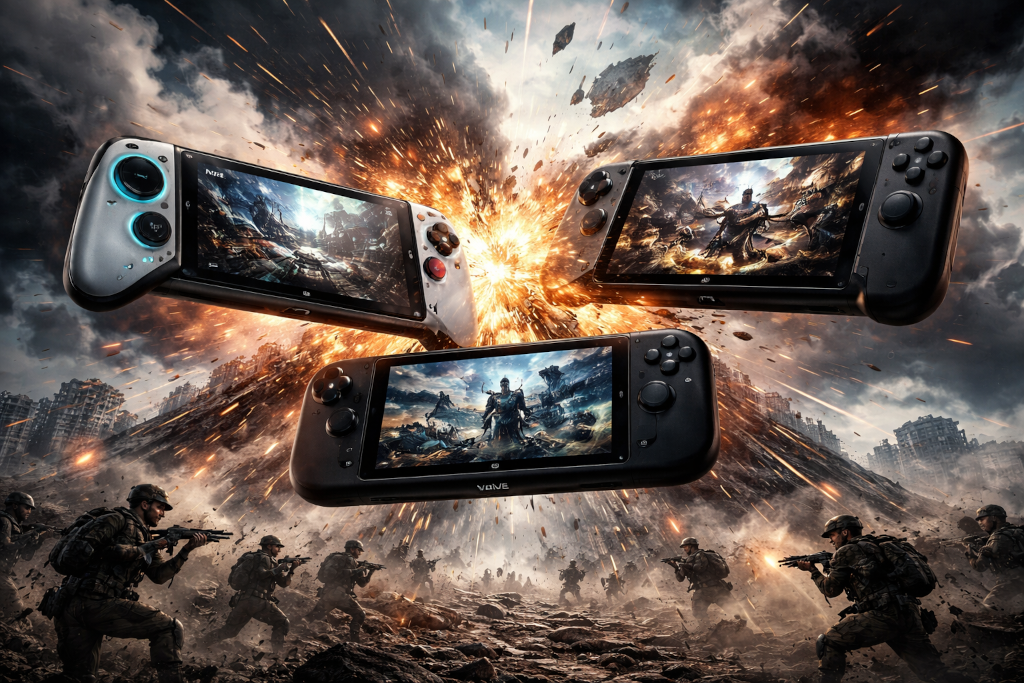
Two devices stand at the center of the latest escalation: the MSI Claw A8 and the Lenovo Legion Go 2. Both are powered by Intel’s next generation Panther Lake architecture and both aim squarely at the same goal. They want to redefine what a Windows handheld can deliver while directly challenging the dominance of Valve’s Steam Deck.
The handheld arms race is no longer theoretical. It is happening right now.
MSI Claw A8
MSI entered the handheld market with ambition, and the Claw A8 represents a refined second attempt built on lessons learned. The most important upgrade is under the hood. Intel’s Panther Lake platform brings a hybrid core design that improves efficiency while increasing GPU throughput. That matters in a device that lives and dies by thermals and battery constraints.
The Claw A8 is expected to ship with high speed LPDDR5X memory and a fast NVMe Gen 4 SSD. Storage options push into the multi terabyte range, which is increasingly important as modern AAA games regularly exceed 80 GB. The display targets a sweet spot for handhelds: around 8 inches, high refresh rate, and a resolution that balances sharpness with performance overhead.
What sets the Claw A8 apart is MSI’s tuning philosophy. Instead of chasing raw peak power alone, the A8 appears designed around sustained performance. That means smarter thermal curves, improved vapor chamber cooling, and better firmware level power management. Early demonstrations suggest more stable frame rates at moderate wattage compared to first generation Intel based handhelds.
Battery life remains the eternal question. Panther Lake’s efficiency gains are promising, but Windows remains a heavier operating environment than a custom Linux based solution. MSI’s answer seems to focus on adjustable TDP profiles that let players choose between performance and longevity on the fly.
In practical terms, the Claw A8 is targeting players who want full Windows compatibility without compromise. Anti cheat systems, launchers outside of Steam, mod tools, and productivity applications all run natively. That flexibility is part of its appeal.
Lenovo Legion Go 2
Lenovo’s Legion Go 2 builds on one of the most distinctive designs in the space. The first Legion Go differentiated itself with detachable controllers and a built in kickstand, blurring the line between handheld and tabletop device. The second generation refines that formula while adopting Intel’s Panther Lake silicon.
The Legion Go 2 emphasizes versatility. Its detachable controller system allows multiple play styles, from handheld grip to tabletop multiplayer setups. A large, high resolution display continues to be one of Lenovo’s defining features. Expect a bright, high refresh panel designed for both esports titles and cinematic single player experiences.
Underneath, Panther Lake brings improved integrated graphics and stronger AI acceleration blocks. While AI cores may not directly impact frame rates today, they are increasingly relevant for features like dynamic resolution scaling, upscaling technologies, and power management optimization.
Lenovo’s cooling solution appears more aggressive than before, with redesigned airflow paths and higher wattage support in docked or plugged in scenarios. That matters for users who treat the Legion Go 2 as a hybrid between handheld and compact gaming PC.
Software remains a critical piece. Lenovo’s Legion Space interface attempts to streamline Windows into a console like launcher experience. While Windows 11 continues to improve touch and controller navigation, dedicated front end layers are still necessary for a smooth handheld experience. Lenovo’s challenge is ensuring that this layer enhances rather than complicates the experience.
Intel Panther Lake and the Shift in Power
Panther Lake is central to this moment. Intel’s architecture focuses on efficiency per watt, improved integrated graphics, and heterogeneous core management. In a handheld context, this translates into three tangible benefits:
- Higher sustained frame rates at lower wattage
- Better battery efficiency during lighter workloads
- Improved thermal behavior under prolonged gaming sessions
Integrated graphics have reached a point where many modern titles can run at medium settings at playable frame rates without a discrete GPU. That changes expectations. Handheld PCs are no longer novelty devices that run indie games well. They are increasingly capable of handling mainstream releases with smart settings adjustments.
Compared to earlier Intel attempts in handhelds, Panther Lake appears far more competitive against AMD’s RDNA based integrated graphics. This narrows a gap that previously gave AMD powered devices a clear advantage.
For the first time, Intel based handhelds are not seen as experimental alternatives. They are legitimate contenders.
Pressure on the Steam Deck
The Steam Deck, especially in its OLED revision, remains a benchmark for handheld PC gaming. Valve’s custom APU and SteamOS deliver a tightly integrated experience. Proton compatibility has matured, and for many players the Deck simply works.
So where does the pressure come from?
First, raw hardware upgrades. Newer Windows handhelds are pushing higher refresh displays, faster memory, and potentially stronger peak GPU performance.
Second, ecosystem flexibility. While SteamOS supports many Windows games through compatibility layers, native Windows handhelds remove that abstraction entirely. For competitive players using anti cheat protected titles, native Windows can be a decisive advantage.
Third, market fragmentation. Multiple manufacturers iterating annually create rapid hardware cycles. Valve has taken a measured approach, focusing on refinement rather than frequent hardware refreshes. That strategy builds stability but risks losing performance leadership.
However, the Steam Deck still holds major strengths. Its operating system is optimized for handheld use. Battery efficiency is often better under comparable loads. And its price to performance ratio has historically been strong.
The competition is not about replacing the Steam Deck overnight. It is about forcing Valve to respond.
Display Wars and Ergonomics
The hardware conversation often focuses on silicon, but display and ergonomics are equally important.
Higher refresh rate panels in the 120 Hz range are becoming common. While not every game will hit those frame rates, smoother UI navigation and esports titles benefit. Resolution choices remain strategic. A 1080p panel may look sharper, but it also increases GPU load. Some manufacturers balance this with dynamic resolution scaling or aggressive upscaling.
Ergonomics matter just as much. Handheld PCs are heavier than traditional consoles like the Nintendo Switch. Comfort during long sessions is critical. Grip contouring, button travel, and stick tension can determine whether a device feels premium or fatiguing.
MSI and Lenovo both appear to be refining grip design and weight distribution. Detachable controllers add flexibility but also introduce potential durability concerns. Integrated designs may feel sturdier but less adaptable.
There is no single correct solution. The market is experimenting in real time.
Windows vs Custom OS
One of the quiet battles in this arms race is not hardware at all. It is software philosophy.
Windows offers universal compatibility but was not originally designed for small screen controller driven navigation. Manufacturers layer custom interfaces on top to approximate a console like feel.
SteamOS, by contrast, is purpose built around controller input and a gaming first mindset. Its limitation is reliance on compatibility layers for Windows games.
As Intel powered Windows handhelds grow more powerful, they emphasize flexibility over specialization. The question becomes whether players value seamless console style simplicity or full PC freedom more.
Different segments of the community answer that question differently.
The Bigger Picture
What we are witnessing is not just a product comparison. It is a shift in how PC gaming is consumed.
Desktop rigs remain unmatched for peak performance. But handheld PCs allow players to carry full libraries anywhere. Cloud saves, cross progression, and portable SSD expansion make the ecosystem more fluid than ever.
The MSI Claw A8 and Lenovo Legion Go 2 represent acceleration in this trend. Intel’s Panther Lake architecture adds another serious competitor to a field once dominated by AMD.
For players, this competition is healthy. It drives innovation in cooling design, battery chemistry, display technology, and firmware optimization. For manufacturers, the stakes are higher. Margins in hardware are thin. Differentiation must be meaningful. For Valve, the message is clear. The Steam Deck is no longer alone.
Final Thoughts
The handheld arms race of 2026 is defined by refinement rather than novelty. MSI and Lenovo are not simply building smaller laptops with controllers attached. They are engineering devices around power efficiency, thermal sustainability, and user experience.
Intel’s Panther Lake architecture signals that integrated graphics performance is entering a new phase. Windows handhelds are closing gaps that once seemed structural.
The Steam Deck remains a formidable player, especially for those who value a curated ecosystem. But pressure is mounting from every direction.
For gamers rebuilding communities, revisiting old leaderboards, and embracing both nostalgia and innovation, this new generation of handhelds represents something exciting. The PC ecosystem is becoming more portable without sacrificing identity.
The arms race continues. And this time, it feels sustainable.