

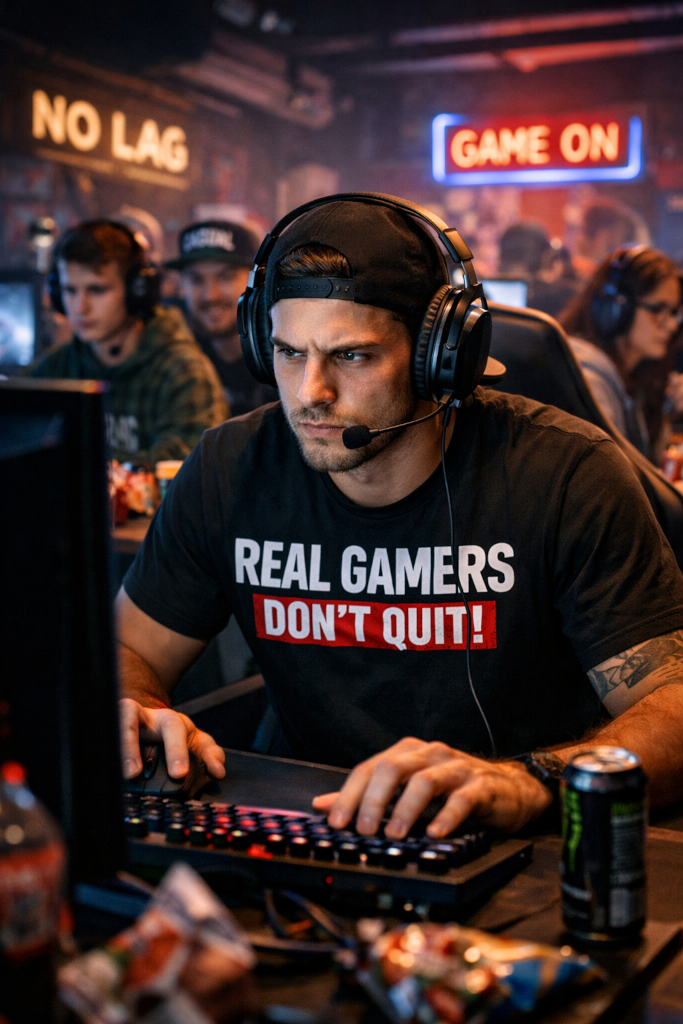
There was a time when being a gamer was a niche identity. You had to seek it out. You bought physical copies, read manuals, joined forums, memorized server IPs, and learned game systems without handholding. That shared effort created a sense of belonging, but it also planted the seeds for something less healthy. Over time, that sense of identity hardened into a gatekeeping mindset often summarized by one phrase: “real gamer.”
At first glance, the idea seems harmless. It suggests dedication, experience, and passion. But in practice, the “real gamer” mentality has become one of the most corrosive forces in modern gaming culture. It divides players, discourages newcomers, and distorts what gaming is actually about. As gaming continues to evolve across platforms, genres, and audiences, clinging to this mentality is holding the medium back.
This is not an attack on competitive play, deep mechanics, or mastery. Those things matter. The issue is not skill or commitment. The issue is when people use a narrow definition of legitimacy to decide who belongs and who does not.
Where the “Real Gamer” Idea Came From
The roots of the “real gamer” mindset lie in scarcity. Early gaming communities were small, fragmented, and often technical. Access to games, hardware, and information was limited. Learning a game required time, patience, and sometimes failure without guidance. In that environment, knowledge became social currency.
Knowing obscure mechanics, hidden shortcuts, or advanced strategies carried weight. Communities formed around shared expertise, and that expertise became part of personal identity. If you put in the work, you earned respect. That sense of earned belonging is not inherently bad.
The problem emerged when the gaming audience exploded.
As consoles became mainstream, PCs became more accessible, and mobile gaming reached billions of people, the old identity felt threatened. What was once a niche hobby became a dominant form of entertainment. For some long-time players, that shift felt like dilution. The response was not to adapt, but to draw lines.
Those lines often sounded like this: real gamers play on PC, real gamers do not use aim assist, real gamers play on the hardest difficulty, real gamers avoid mobile games, real gamers hate casuals, real gamers only respect certain genres.
None of these definitions were universal, but they all served the same purpose. They created an in-group and an out-group.
Gatekeeping Disguised as Passion
One of the most damaging aspects of the “real gamer” mentality is how it disguises exclusion as enthusiasm. People often defend gatekeeping by saying they care about quality, integrity, or the soul of gaming. On the surface, that sounds reasonable. But when you look closer, it often turns into dismissal rather than discussion.
A new player asks a basic question and is told to “git gud” instead of being helped. Someone enjoys a popular or accessible game and is mocked for having bad taste. A player prefers story, accessibility options, or cooperative modes and is labeled as not serious enough.
This behavior does not protect gaming culture. It shrinks it.
Healthy communities grow by teaching, mentoring, and welcoming curiosity. Unhealthy communities test newcomers like they are applying for membership in a private club. The irony is that many of the people enforcing these standards benefited from others who helped them learn when they were starting out.
Skill Is Not a Moral Trait
A core flaw in “real gamer” thinking is the assumption that skill equals worth. Being better at a game is treated not just as a technical achievement, but as a personal virtue. Losing becomes shameful. Winning becomes proof of legitimacy.
This mindset creates toxic dynamics, especially in competitive environments. Instead of seeing losses as learning opportunities, players see them as threats to identity. Instead of improving through collaboration, they lash out at teammates, accuse others of cheating, or blame systems designed to make games playable for broader audiences.
Skill matters in competition, but it does not define someone’s value as a participant in a hobby. No one demands that movie fans prove they understand cinematography before enjoying a film. No one tells music listeners they are not “real” fans because they cannot play an instrument.
Gaming is one of the few entertainment spaces where enjoyment is routinely policed.
The Platform Wars Problem
The “real gamer” mentality also fuels endless platform wars. PC versus console. Keyboard and mouse versus controller. Frame rate debates. Resolution debates. Input debates.
These arguments rarely improve anyone’s experience. Instead, they reinforce tribalism. People stop discussing games and start defending hardware choices as if they were moral positions.
The reality is simple. Different platforms serve different needs. Accessibility, cost, physical comfort, social context, and personal preference all play a role. A parent gaming on a console in the living room, a student on a budget gaming on a laptop, and a competitive player on a high-end PC are not in conflict with one another. They are all engaging with the same medium in ways that fit their lives.
When platform loyalty turns into identity policing, the conversation stops being about games and starts being about status.
How This Mentality Hurts Communities
For community-driven sites, forums, and Discord servers, the “real gamer” mindset is especially destructive. New members are the lifeblood of any community. Without them, discussion stagnates, activity drops, and the space slowly fades away.
Gatekeeping drives away exactly the people communities need most. New players bring questions, fresh perspectives, and enthusiasm. Casual players often become invested over time. Competitive players often start casually. When people feel unwelcome, they leave before they ever have the chance to grow.
This is particularly damaging for legacy gaming communities trying to rebuild. Reviving old leaderboards, historical stats, and classic competition relies on interest and participation. That interest does not come from telling people they do not belong. It comes from inviting them to explore gaming history and culture without judgment.
Nostalgia Without Elitism
There is nothing wrong with loving older games, classic mechanics, or legacy competitive scenes. Preserving gaming history matters. Bringing back old ladders, stats, and match data can be valuable for archival reasons and community storytelling.
The problem arises when nostalgia turns into superiority.
Older does not automatically mean better. Harder does not automatically mean deeper. Modern quality-of-life features are not evidence of weakness. They are responses to broader audiences and evolving expectations.
Respecting gaming history should involve sharing it, not weaponizing it.
The Accessibility Question
One area where “real gamer” thinking causes real harm is accessibility. Features like aim assist, difficulty sliders, colorblind modes, control remapping, and narrative modes are often mocked as making games too easy.
In reality, accessibility does not remove challenge. It removes unnecessary barriers.
Players with disabilities, injuries, limited time, or different learning styles deserve to enjoy games without being shamed. A feature that helps one player does not invalidate another player’s achievements. Turning off accessibility options is always an option. Denying their legitimacy is not.
A hobby that only welcomes the physically able, time-rich, and socially confident is not strong. It is fragile.
What Being a Gamer Actually Means
At its core, gaming is about interaction. It is about problem-solving, storytelling, competition, cooperation, and exploration. It is about choosing how you want to engage with a system designed for play.
Being a gamer does not require approval from anyone else. It does not require mastery of specific genres or adherence to unwritten rules. It requires only participation and interest.
Some players chase rankings and stats. Others chase stories. Some play alone. Others play socially. Some love retro games. Others only play new releases. None of these paths are more legitimate than the others.
Building Healthier Gaming Spaces
If gaming communities want to survive and grow, especially independent ones, they need to actively reject “real gamer” gatekeeping. That does not mean abandoning standards, competition, or deep discussion. It means shifting the focus from exclusion to engagement.
Encourage questions instead of mocking them. Share knowledge instead of hoarding it. Celebrate improvement instead of only perfection. Recognize that different players value different aspects of gaming.
Strong communities are not defined by how high the barrier to entry is. They are defined by how many people want to stay.
The Future of Gaming Culture
Gaming is no longer a single culture. It is a network of overlapping communities, histories, platforms, and play styles. Trying to enforce a single definition of legitimacy is not just outdated. It is counterproductive.
The “real gamer” mentality is rooted in fear of change. But gaming has always changed. From arcades to home consoles, from LAN parties to online play, from boxed copies to digital libraries, adaptation has always been part of the medium.
Those who embrace that evolution help shape the future. Those who resist it often find themselves talking only to people who already agree with them.
If gaming is going to remain creative, competitive, and communal, it needs fewer gatekeepers and more hosts.
The question is not who qualifies as a real gamer. The question is whether gaming spaces are real communities, or just echo chambers guarding a shrinking definition of belonging.