
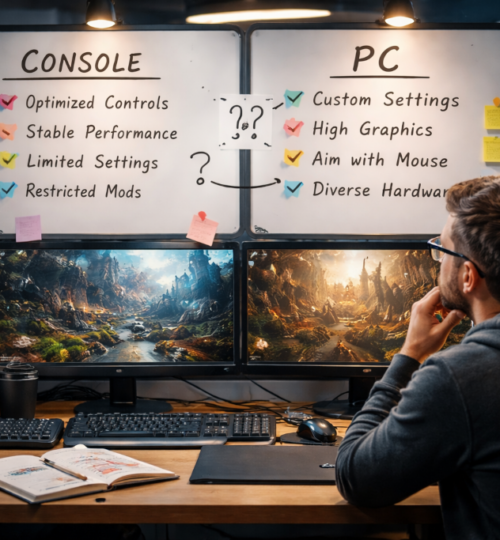
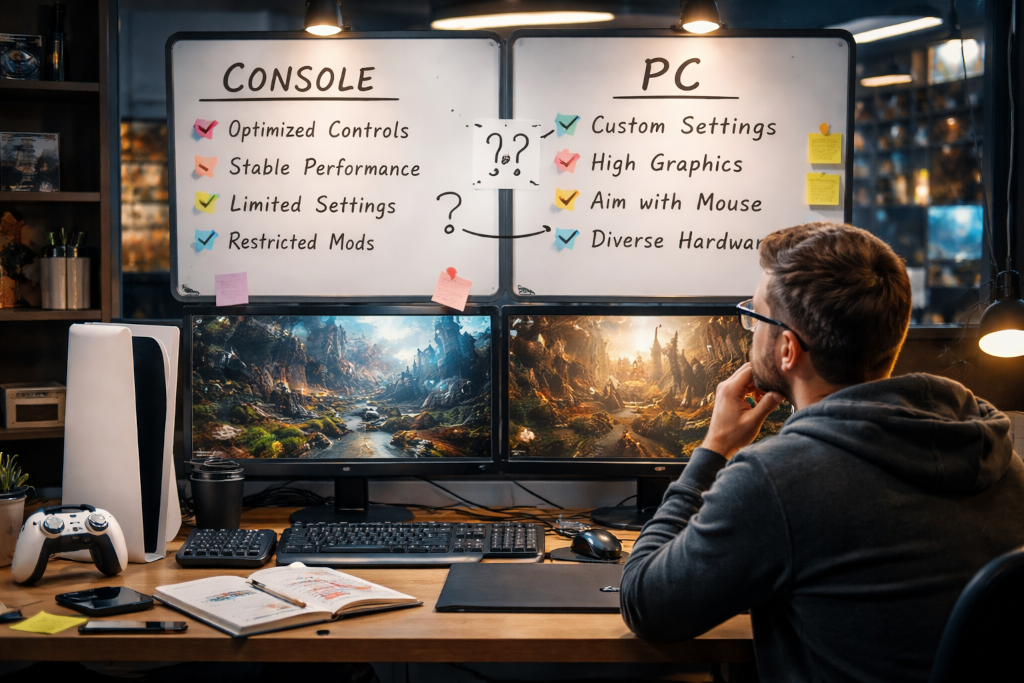
For decades, PC and console gaming followed largely separate paths. Consoles offered fixed hardware, standardized performance, and simplicity. PCs offered flexibility, raw power, and deep customization. Today, those paths overlap more than ever. Most major releases ship simultaneously on PC and multiple consoles, often with cross-play, shared progression, and identical content goals.
That convergence creates a challenge that developers must solve with care. Design for consoles too aggressively and PC players feel constrained by simplified systems and locked settings. Design for PC first and consoles can suffer from performance issues, awkward controls, or feature cuts. Balancing both platforms without compromising either requires careful technical planning, intentional design decisions, and an understanding of what players on each platform actually value.
This balance is not accidental. It is the result of evolving tools, smarter engines, and lessons learned from years of high-profile successes and failures.
Understanding the Core Differences
Before any balancing can happen, developers must account for the fundamental differences between PC and console ecosystems.
Consoles offer a controlled environment. Every unit of a given model shares the same CPU, GPU, memory limits, and storage behavior. This allows developers to optimize aggressively. Performance targets are known in advance, and testing scenarios are predictable.
PCs, by contrast, exist across an enormous spectrum. A single game might run on everything from an entry-level laptop to a high-end enthusiast rig. Hardware configurations vary wildly in processing power, graphics capability, memory speed, storage type, and even operating system behavior.
Controls differ as well. Consoles are built around controllers as the primary input method. PCs support controllers, keyboard and mouse, custom keybindings, and in some cases specialized hardware.
Balancing these realities starts with acknowledging that parity does not mean sameness. The goal is functional equivalence, not identical experiences.
Designing Systems That Scale
One of the most important strategies developers use is scalable design. This means building core systems that function across a wide performance range without breaking.
Graphics pipelines are a prime example. A modern engine might support multiple lighting models, texture resolutions, shadow qualities, and post-processing layers. On consoles, these settings are often fixed or limited to a small number of presets. On PC, players may have access to fine-grained controls that allow them to tune performance and visual fidelity to their hardware.
Crucially, these options are not bolted on late in development. They are planned early so that art assets, shaders, and memory budgets can scale cleanly. When scaling is treated as a core feature instead of an afterthought, neither platform feels compromised.
Gameplay systems also benefit from scalability. AI complexity, simulation detail, and physics calculations can often be adjusted dynamically. This allows developers to maintain consistent behavior while adjusting processing cost behind the scenes.
Control Schemes Without Compromise
Controls are one of the most visible areas where poor balance can ruin a game for one audience or the other.
A common mistake in the past was designing entirely around a controller and then mapping those controls directly to keyboard and mouse. This often resulted in awkward PC experiences with excessive menu navigation, limited hotkeys, or artificial constraints on aiming and camera movement.
Modern developers avoid this by designing input abstraction layers. Instead of hard-coding actions to specific buttons, they define actions in a system that can be mapped differently depending on input device. This allows mouse users to benefit from precision aiming and rapid camera control, while controller users retain analog movement and comfortable ergonomics.
Interface design follows the same principle. Text size, menu layout, and navigation speed are adjusted so they work at a couch distance on a television and at a desk with a monitor. Good UI design recognizes that PC players expect faster interaction and deeper configuration, while console players value clarity and accessibility.
Performance Targets and Expectations
Performance expectations differ sharply between platforms, and developers must account for this from the outset.
Console players generally expect stable frame rates and consistent performance. A locked target such as 30 or 60 frames per second is often preferred over fluctuating performance, even if that means lowering resolution or visual effects.
PC players tend to value flexibility. Some prioritize maximum frame rates for competitive play. Others prefer ultra-high visual fidelity at lower frame rates. Developers accommodate this by exposing options that allow players to make those trade-offs themselves.
Internally, developers use extensive profiling tools to identify bottlenecks on each platform. Optimizations for consoles might focus on memory access patterns or fixed GPU behavior. On PC, optimization often centers around reducing CPU overhead, minimizing shader compilation stutter, and supporting a wide range of drivers.
The key is not forcing one platform’s expectations onto the other. Performance targets are chosen per platform, not universally imposed.
Feature Parity Versus Feature Equality
A major source of tension in cross-platform development is the concept of parity. Players often expect feature parity across platforms, but parity does not require identical implementation.
For example, graphical mods are a staple of PC gaming. Consoles, due to security and platform restrictions, may not support them in the same way. Developers can still offer parity by supporting official mod tools or curated content where possible, while ensuring core gameplay features remain equivalent.
Similarly, PC versions might support ultra-wide monitors, higher frame rate caps, or advanced graphical effects that consoles cannot reasonably support. This does not inherently ruin the console experience as long as those features are enhancements rather than necessities.
Problems arise when features are removed or simplified globally to accommodate the lowest common denominator. Successful developers resist this by building platform-specific enhancements rather than universal limitations.
Cross-Play and Competitive Balance
As cross-play becomes more common, balancing console and PC experiences becomes even more complex.
Keyboard and mouse offer clear advantages in certain genres, especially competitive shooters and strategy games. Developers address this in several ways. Input-based matchmaking can separate players by control method rather than platform. Aim assist can be tuned to help controller users without overwhelming skill differences. Competitive modes may offer opt-in cross-play rather than forcing mixed lobbies.
The goal is fairness without segregation. Players should feel that losses come from skill differences, not hardware advantages.
From a design standpoint, this requires extensive data analysis and live tuning. Developers monitor player performance metrics across platforms and adjust systems accordingly. This ongoing balance work is now a permanent part of modern game development.
Engine Technology and Tooling
Modern engines play a major role in making balance possible. Engines now provide platform-specific rendering paths, memory management systems, and debugging tools that allow developers to target consoles and PCs with precision.
Build systems can generate platform-optimized binaries from shared codebases. Asset pipelines can automatically generate multiple quality tiers from a single source. Testing frameworks simulate performance conditions across hardware profiles.
These tools reduce the need for drastic compromises. Instead of building separate versions of a game, developers can maintain a unified vision with platform-specific execution.
However, tools alone do not guarantee success. Teams must still make disciplined decisions about scope, optimization, and feature creep.
Lessons From Past Missteps
The industry has learned valuable lessons from projects that struggled with balance.
Games that launched with poorly optimized PC ports often suffered from stuttering, input lag, or missing features. Conversely, games that pushed PC-centric designs onto consoles sometimes faced performance instability or unwieldy interfaces.
In many cases, the root cause was late platform consideration. When console or PC support is treated as an afterthought, compromises become unavoidable.
Today, most major studios plan for multi-platform development from day one. Platform specialists are involved early. Performance budgets are established per platform. Design reviews explicitly consider how systems will feel on different hardware.
These practices do not eliminate risk, but they dramatically reduce it.
Respecting Player Expectations
At the heart of successful balance is respect for the player.
PC players expect options, transparency, and control. Console players expect polish, consistency, and ease of use. Neither expectation is unreasonable. Problems arise when developers assume that one audience will simply tolerate the other’s priorities.
Clear communication helps. Detailed settings menus, performance mode descriptions, and patch notes signal that developers understand their audience. Ongoing updates demonstrate commitment to improvement rather than abandonment.
When players feel heard, they are more forgiving of technical limitations. When they feel ignored, even small issues become major grievances.
The Future of Platform Balance
As hardware continues to converge, the line between console and PC will blur further. Consoles increasingly resemble specialized PCs, while PCs adopt more standardized APIs and hardware features.
This convergence makes balance easier in some ways and more demanding in others. Shared architectures reduce technical barriers, but player expectations remain distinct.
Developers who succeed will be those who treat platform balance as an ongoing process rather than a one-time task. The goal is not to erase differences but to respect them.
A well-balanced game does not ask players to accept less. It gives each platform the best version of the experience it can reasonably deliver.
Closing Thoughts
Balancing console and PC development without ruining either is one of the defining challenges of modern game creation. It requires technical expertise, thoughtful design, and a deep understanding of player expectations.
When done well, players rarely notice the effort involved. The game simply feels right, regardless of where it is played. That invisibility is the true mark of success.
As cross-platform releases become the norm rather than the exception, this balance will only grow more important. Developers who master it will shape the future of gaming across every screen.