
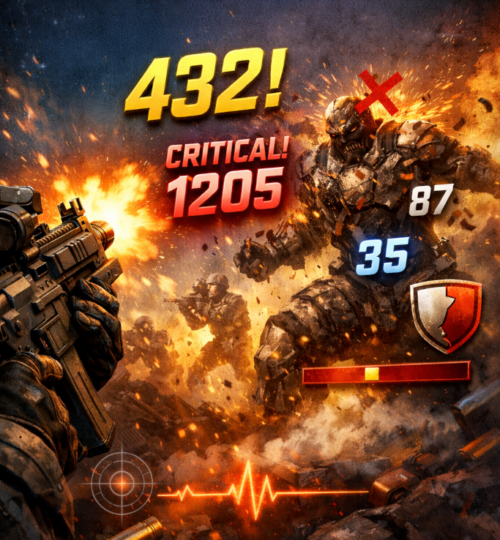
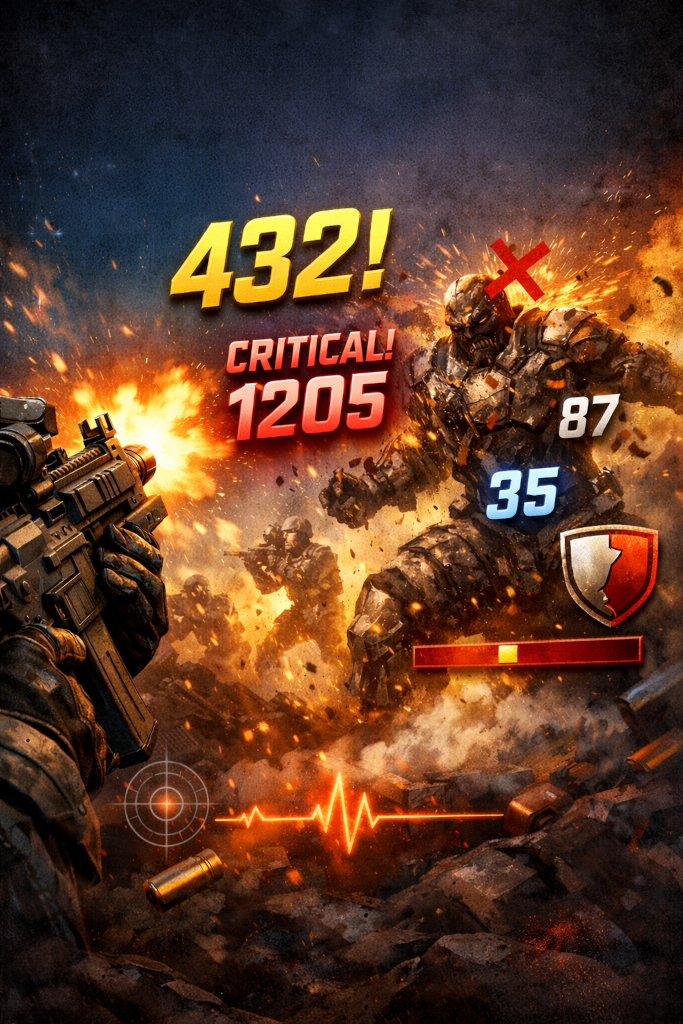
In modern games, very few things feel as immediately satisfying as landing a hit. Whether it is the crack of a headshot, the thud of a melee strike, or a cascade of numbers erupting from an enemy, hit feedback sits at the core of how combat feels. Long before players analyze balance, mechanics, or meta strategies, they feel the game. That feeling is not accidental. It is the result of layered design choices rooted in psychology, sensory perception, and player learning.
Hit feedback and damage numbers are often treated as surface level features, cosmetic flourishes that can be toggled on or off in a settings menu. In reality, they are fundamental communication tools. They teach players how the game works, reinforce skillful play, and help transform abstract systems like health and damage into something instantly readable. Understanding how these systems work sheds light on why some games feel tight and responsive while others feel flat or frustrating, even when the underlying mechanics are similar.
Why Hit Feedback Exists at All
At its most basic level, hit feedback answers a simple question: did my action matter? In the chaos of combat, players need immediate confirmation that an input resulted in an effect. Without that confirmation, uncertainty creeps in. Was the shot on target? Did the ability activate? Did the enemy resist it?
Early games solved this problem in very direct ways. Enemies flashed, sprites blinked, or simple sound effects played. As games evolved, so did expectations. Players came to rely on multiple signals at once, often without consciously noticing them. A modern hit typically combines visual, audio, and sometimes tactile cues to remove all ambiguity.
This is not about realism. In real life, you do not see floating numbers when you punch something. Games use exaggerated feedback because clarity matters more than realism when players are making split second decisions. The brain processes clear, repeated signals faster than subtle ones, especially under stress.
The Role of Damage Numbers as Information
Damage numbers are one of the clearest examples of abstraction in game design. They turn hidden math into visible feedback. Every time a number appears, it communicates several things at once. It tells the player that damage was dealt, how much was dealt, and often how that damage compares to previous hits.
This comparison is critical. Players are pattern seeking by nature. When they see larger numbers after changing weapons, upgrading skills, or landing a critical hit, they learn what works. When numbers are smaller or inconsistent, they learn what does not.
Numbers also help bridge the gap between moment to moment action and long term progression. A new player might not understand armor values, damage multipliers, or resistances, but they can understand that 120 is better than 60. Over time, these visible cues teach the underlying system without a tutorial ever explaining it directly.
In competitive contexts, damage numbers serve another purpose. They allow players to evaluate risk. If an enemy takes less damage than expected, that information can change how aggressively a player engages. In team based games, it can inform callouts and coordination, even if the communication is informal.
Critical Hits and the Power of Contrast
Not all numbers are equal. Designers often emphasize certain hits through color, size, motion, or timing. Critical hits might appear in bold colors, larger fonts, or with extra effects like screen shake or unique sounds. This contrast is deliberate.
The human brain is wired to notice changes and anomalies. When a hit stands out visually or aurally, it creates a stronger memory imprint. Players begin to associate certain actions with higher reward. Headshots, backstabs, perfect timing windows, or weak point hits all benefit from exaggerated feedback.
This reinforcement loop is a cornerstone of skill based play. The game is not just telling the player that they succeeded. It is telling them why. Over time, this leads to mastery as players internalize which behaviors consistently produce better outcomes.
Sound Design as Invisible Feedback
While damage numbers are obvious, sound design often does just as much work, sometimes more. A clean hit sound, a satisfying crunch, or a sharp metallic ring can convey success faster than any visual element. Sound has the advantage of not requiring the player to look directly at a specific point on the screen.
Many games layer hit sounds to convey information. A shield hit might sound dull or muted, while a flesh hit sounds sharper. Armor breaking might trigger a unique cue. Even subtle pitch shifts can indicate higher damage without the player consciously noticing.
Sound also plays a major role in perceived responsiveness. A weapon can feel powerful even if its actual damage output is modest, as long as the audio feedback suggests impact. Conversely, weak or delayed sounds can make even strong weapons feel unsatisfying.
Visual Effects and the Illusion of Impact
Visual feedback extends far beyond numbers. Hit markers, particle effects, screen shake, enemy reactions, and animation timing all contribute to the illusion of impact. Importantly, this illusion often matters more than mechanical accuracy.
Enemy flinch animations are a good example. When an enemy visibly reacts to a hit, players feel like they are exerting control. Even minor stagger effects can make combat feel more dynamic and fair. Without these reactions, enemies can feel sponge like or unresponsive, even if the damage numbers are high.
Screen effects like brief flashes, camera shake, or motion blur must be used carefully. Too much can be disorienting or fatiguing, while too little can make hits feel weightless. Good design finds a balance that enhances impact without overwhelming the senses.
Cognitive Load and Readability
One of the biggest challenges with hit feedback is avoiding clutter. Modern games can easily overwhelm players with floating numbers, status icons, damage types, and visual effects all happening at once. When feedback becomes noise, it stops being useful.
Good systems prioritize readability. Damage numbers might stack, fade quickly, or group together. Colors are chosen to distinguish friend from foe or normal damage from special effects. Font choices and animations are tuned so information can be absorbed at a glance.
This is especially important in fast paced or competitive environments. Players should never have to stop and parse information mid fight. The feedback should be intuitive enough that it registers subconsciously.
Accessibility also plays a role here. Options to adjust number size, color contrast, or toggle certain effects help ensure that feedback works for a wide range of players. What is clear for one person may be unreadable for another.
Feedback as a Tool for Balance Perception
Interestingly, hit feedback can shape how players perceive balance, sometimes more than actual statistics. A weapon that deals consistent, readable damage often feels more reliable than one that occasionally spikes higher but offers weaker feedback.
This perception matters. Players gravitate toward options that feel good, not just those that are mathematically optimal. Developers can subtly guide player behavior by tuning feedback alongside numbers. A slightly underpowered weapon can still be popular if it feels impactful, while an overpowered one might be ignored if it feels dull.
In competitive scenes, this can influence meta development. Community discussion often centers on what feels broken or weak, and those feelings are shaped by feedback as much as data.
The Emotional Layer of Combat
Beyond mechanics and information, hit feedback taps into emotion. There is a primal satisfaction in seeing clear proof of success. This is not manipulation in a negative sense. It is acknowledgment.
Games that nail this aspect often create memorable moments. The perfect shot that deletes an enemy. The clutch hit that turns a fight. The final blow accompanied by a distinctive sound or visual flourish. These moments stick because the game marks them as important.
When feedback is absent or muted, those moments lose their punch. Combat becomes transactional rather than expressive. For a medium built on interaction, that is a significant loss.
When Less Is More
It is worth noting that not all games benefit from heavy damage numbers. Some genres intentionally minimize or remove them to support a different experience. Horror games, immersive sims, or highly realistic shooters may rely more on animation and sound to maintain tension or immersion.
Even in these cases, the principle remains the same. The game must still communicate outcomes clearly. The method changes, but the need does not. A well designed system chooses the right level of abstraction for its goals.
Looking Forward
As games continue to evolve, hit feedback systems are becoming more customizable and adaptive. Players increasingly expect options that let them tailor feedback to their preferences, whether that means minimalist displays or full data readouts.
There is also growing interest in dynamic feedback that responds to context, skill level, or player behavior. Smarter systems could emphasize learning for new players while reducing visual noise for experienced ones.
What remains constant is the underlying science. Human perception, learning, and emotion will always shape how combat feels. Damage numbers and hit feedback are not superficial features. They are the language games use to talk to players in the middle of action.
Understanding that language helps explain why certain games stand the test of time. When feedback is clear, responsive, and satisfying, players feel connected to their actions. And when players feel that connection, they keep coming back, not just for competition, but for the simple joy of landing a hit that feels right