
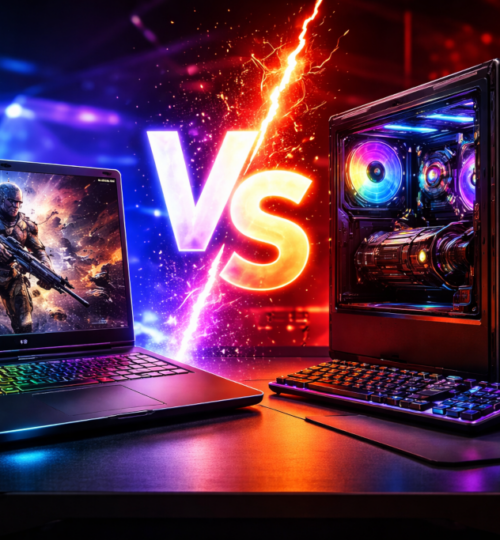
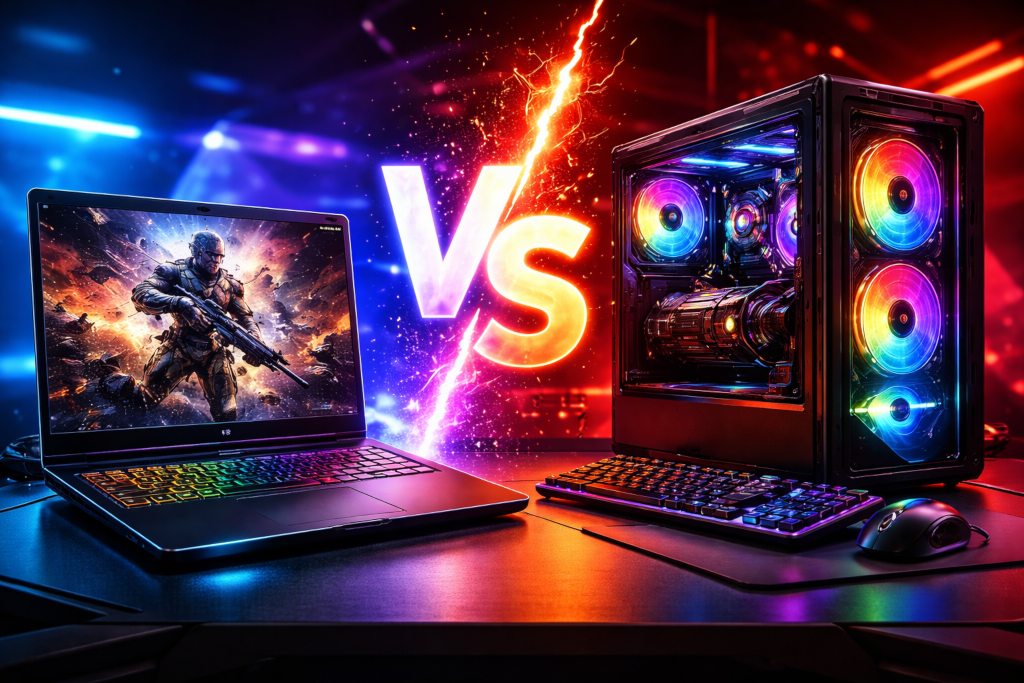
For decades, the image of a serious PC gamer was almost always the same: a desk, a large monitor, a mechanical keyboard, and a powerful desktop tower humming away beneath the table. Desktop systems dominated the competitive and enthusiast side of gaming because they offered raw performance, upgrade flexibility, and thermal headroom that portable devices simply could not match.
Over the last several years, that traditional picture has started to evolve. Gaming laptops have become far more capable than their early predecessors. High refresh rate displays, desktop-class GPUs adapted for mobile use, faster memory, and advanced cooling solutions have pushed portable systems closer to the performance territory once reserved exclusively for desktops.
But despite these improvements, the conversation about gaming laptops versus desktop gaming PCs remains far from settled. Each platform brings advantages and limitations that affect how games run, how systems age, and how players experience their hardware over time.
Understanding where each option excels helps gamers make smarter decisions based on their needs rather than marketing claims.
Performance: The Desktop Advantage Still Exists
When discussing gaming hardware, performance remains the first topic most players care about. In this area, desktop PCs still hold a clear advantage.
Desktop components operate with fewer physical limitations. A full size graphics card has access to larger cooling systems, higher power limits, and more physical space for components. This allows GPUs and CPUs in desktops to sustain higher clock speeds for longer periods without thermal throttling.
Gaming laptops use mobile versions of graphics cards and processors. Even when the chip name matches a desktop model, the mobile version typically operates under tighter power constraints. These limits are necessary to manage heat, battery life, and physical space inside a thin chassis.
For example, a laptop GPU labeled similarly to a desktop GPU may perform significantly lower in sustained workloads due to lower power draw and thermal limits. Modern laptops narrow this gap compared to the past, but the difference remains noticeable in demanding games or when targeting very high frame rates.
In esports titles where players pursue 144 Hz, 240 Hz, or even higher refresh rates, desktops often maintain those frame rates more consistently. Competitive players frequently prioritize stability and minimal frame time variation, which is easier to achieve with the cooling capacity and power delivery of a desktop system.
Portability: Where Laptops Win Easily
The most obvious advantage of gaming laptops is mobility. A desktop setup is effectively stationary. Even compact systems still require a monitor, keyboard, mouse, and power source. Moving a desktop gaming station between locations can quickly turn into a small project involving cables, peripherals, and careful packing.
Gaming laptops compress that entire ecosystem into a single device. For students, travelers, or players who split time between multiple locations, the ability to carry an entire gaming system in a backpack is a powerful advantage.
Portable gaming setups have also become more relevant in modern life. Many players attend LAN events, visit friends for gaming sessions, or want the option to move between rooms or locations without dismantling their setup.
For people who live in smaller apartments or shared spaces, a gaming laptop can function as both a gaming system and a general purpose computer without requiring a permanent desk arrangement.
Upgradeability: The Desktop’s Long Term Strength
One of the biggest differences between desktops and laptops appears over time rather than on day one. Desktop systems are modular by design. Components such as graphics cards, processors, memory, storage drives, and power supplies can be replaced or upgraded individually. A player might upgrade a GPU after several years while keeping the rest of the system intact.
This modular design dramatically extends the lifespan of desktop machines. A well maintained desktop can evolve over multiple hardware generations through targeted upgrades.
Gaming laptops are far more limited in this regard. Most laptops allow memory and storage upgrades, but the core components such as the CPU and GPU are usually soldered directly to the motherboard.
Once those components begin to fall behind modern game requirements, replacing the entire laptop becomes the only option. For gamers who want a system that can grow with them over time, desktops offer a far more flexible path.
Cooling and Thermal Design
Cooling is one of the most important factors affecting gaming performance. Desktop PCs benefit from large air coolers, liquid cooling loops, and spacious cases designed to maximize airflow. Larger fans move more air while producing less noise. This allows desktop components to run cooler under heavy workloads.
Gaming laptops face the challenge of fitting powerful hardware into a much smaller physical space. Engineers rely on heat pipes, vapor chambers, compact fans, and carefully designed airflow channels to manage heat.
While modern cooling designs are impressive, physics still imposes limits. Under sustained gaming sessions, laptops often reach higher temperatures than desktops running similar hardware.
Higher temperatures can lead to thermal throttling, where components automatically reduce their speed to prevent overheating. This does not mean gaming laptops perform poorly, but it does mean desktops have a thermal advantage that contributes to their consistent performance during long gaming sessions.
Display Technology and External Setup
Another difference between gaming laptops and desktops lies in display flexibility. Desktop systems allow players to choose their monitor independently from their computer. This opens the door to ultra wide displays, high refresh rate monitors, HDR panels, and multi monitor setups tailored to the user’s preferences.
Competitive players often invest heavily in specialized monitors with very high refresh rates and extremely low input latency.
Gaming laptops include their own built in display. Many modern models feature excellent screens with refresh rates ranging from 120 Hz to 240 Hz or higher. However, the screen size and resolution are fixed by the laptop’s design.
That said, laptops can connect to external monitors, which allows them to function as hybrid systems when used at a desk. Some players use their gaming laptop as the core system while docking it to a monitor, keyboard, and mouse when they want a more traditional gaming setup.
Price and Value
Price comparisons between gaming laptops and desktops can be complicated.
A desktop system usually provides more raw performance for the same price because components are not constrained by compact engineering requirements. Desktop graphics cards and processors are also easier to manufacture at higher performance levels due to fewer thermal restrictions.
Gaming laptops often include the cost of portability, compact cooling design, and integrated displays in their pricing.
However, the total cost of a desktop setup may include additional peripherals such as a monitor, keyboard, mouse, and sometimes speakers or headphones. These items narrow the price difference between platforms.
For players starting from scratch without any peripherals, the price gap may not be as large as it first appears.
Noise and Power Consumption
Desktop systems generally operate more quietly under heavy gaming loads due to larger fans and better airflow. Laptop cooling fans must spin at higher speeds to move enough air through a small chassis. This can result in noticeable fan noise during demanding games.
Power consumption also differs significantly. Desktops draw more power from the wall due to higher performance components and power supplies.
Laptops are designed to operate efficiently while also running on battery power. Even though gaming sessions typically occur while plugged in, the energy efficiency design still influences how components behave.
Use Cases: When Each Platform Makes Sense
Choosing between a gaming laptop and a desktop often depends less on raw specifications and more on how a player plans to use the system.
A desktop PC makes the most sense for players who:
- Want maximum gaming performance
- Plan to upgrade components over time
- Play competitive titles where consistent high frame rates matter
- Have a dedicated gaming space
A gaming laptop makes more sense for players who:
- Need portability for school, work, or travel
- Have limited desk space
- Want an all in one gaming and productivity machine
- Attend LAN events or game in multiple locations
Neither platform is universally better. Each one fits different lifestyles and gaming habits.
What Could Improve in Gaming Laptops
Gaming laptops have improved dramatically, but there are still areas where innovation could close the gap with desktop systems.
Better Cooling Efficiency
Thermal management remains the biggest challenge for portable gaming hardware. Improvements in vapor chamber design, new materials, and more efficient fan systems could allow mobile components to operate closer to their maximum potential.
Modular Components
Some manufacturers have experimented with modular laptop designs that allow GPU or CPU upgrades. If this approach becomes more practical and widespread, it could significantly extend the lifespan of gaming laptops.
Battery Technology
While gaming laptops are typically used while plugged in during gameplay, stronger battery technology could allow players to enjoy longer sessions away from power outlets.
External GPU Integration
External GPU enclosures already exist, but they remain niche due to cost and bandwidth limitations. Faster connection standards and improved compatibility could make external GPUs a more viable upgrade path for laptop users.
The Hybrid Future of Gaming Hardware
One interesting trend in recent years is the rise of hybrid gaming setups.
Many players now use gaming laptops as portable systems that connect to full desktop style setups when they are at home. A laptop plugged into a dock, monitor, keyboard, and mouse can function almost like a desktop replacement.
At the same time, compact desktop systems are becoming smaller and more portable than traditional towers. Mini ITX builds and small form factor cases are blurring the line between mobility and desktop power.
Cloud gaming and streaming technologies may also influence how future gaming hardware evolves, though local hardware performance still dominates serious competitive gaming.
Final Thoughts
Gaming laptops and desktop gaming PCs represent two different solutions to the same goal: running modern games as smoothly and reliably as possible.
Desktops continue to dominate in raw performance, cooling capacity, and long term upgrade potential. They remain the preferred platform for enthusiasts who want full control over their hardware.
Gaming laptops, on the other hand, have evolved into surprisingly powerful machines that bring serious gaming performance into a portable format. For many players, the convenience of mobility outweighs the remaining performance gap.
The best choice ultimately depends on how someone games, where they game, and what they expect from their hardware over the next several years.
For some players, nothing replaces the power and flexibility of a well built desktop tower. For others, the ability to carry their gaming world with them wherever they go makes a gaming laptop the perfect fit.