
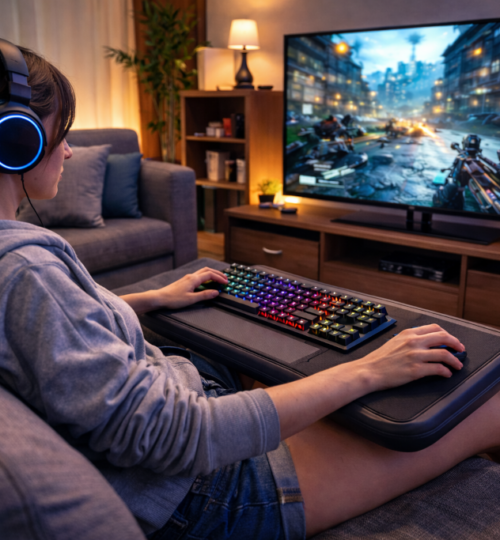
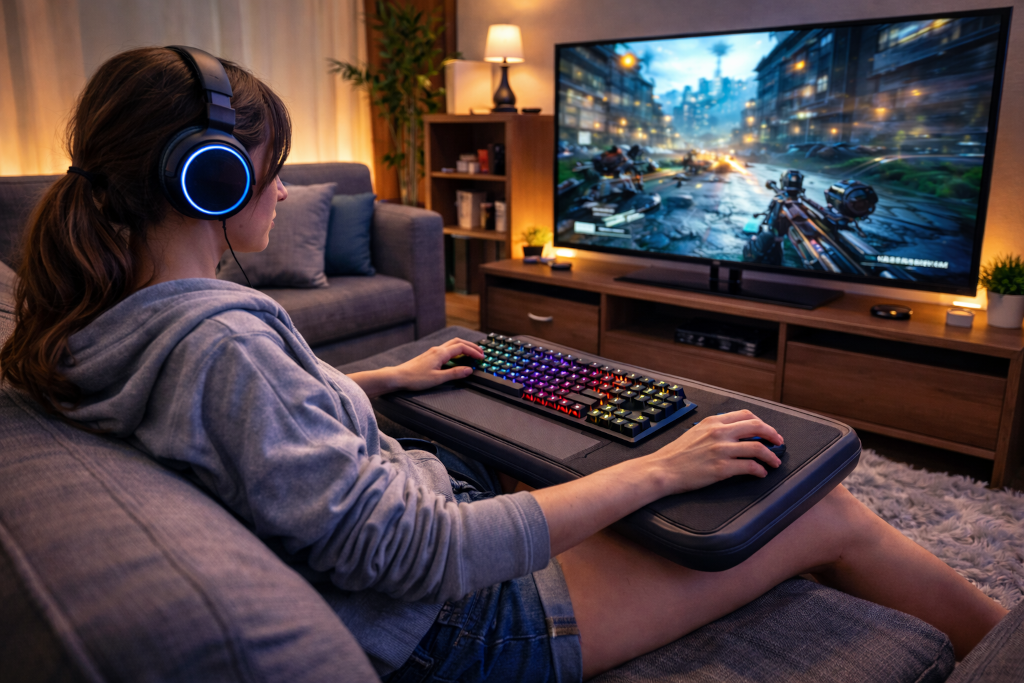
For decades, the gaming PC has lived in one place. A desk. A chair. A keyboard and mouse positioned with surgical precision. The glow of a monitor at arm’s length. That setup defined PC gaming culture and for many players it still does. But something has been shifting.
The line between console convenience and PC performance is getting thinner every year. Hardware is becoming smaller and quieter. Operating systems are leaning into controller-first interfaces. Graphics cards are powerful enough to drive 4K televisions without compromise. Wireless peripherals are faster and more reliable than ever. More players are asking a simple question.
Can a gaming PC feel as natural on the couch as a console? The answer is increasingly yes. And that shift is creating a new category of build philosophy that focuses on comfort, aesthetics, acoustics, and interface design just as much as raw performance.
Let’s break down what makes a PC truly living-room ready in 2026.
The Rise of the Console-Style PC
The idea of putting a PC under a television is not new. Home theater PCs have existed for years. What is new is that modern hardware no longer feels like a compromise when used this way.
Mini ITX motherboards have matured. Compact power supplies deliver serious wattage. Efficient GPUs provide high frame rates without sounding like a jet engine. SSD storage has removed mechanical noise entirely from many systems.
Manufacturers are responding with cases that look more like console hardware than traditional towers. Low profile enclosures designed to sit horizontally. Clean front panels with subtle lighting. Black, white, or brushed metal finishes that blend into entertainment centers instead of dominating them. The goal is not just performance. It is harmony with the room.
Small Form Factor Without Sacrifice
For years, shrinking a PC meant giving up thermals or GPU clearance. That is less true now.
Several hardware trends make compact living-room builds more viable:
- GPUs with more efficient architectures that produce less heat per frame
- SFX and SFX-L power supplies that provide 750W to 1000W in tiny footprints
- Improved case airflow engineering
- Widespread adoption of NVMe storage
- Lower profile CPU coolers and more compact AIO liquid cooling solutions
This means you can realistically build a machine capable of 1440p high refresh or even 4K gaming in a chassis small enough to sit beside a console.
That said, tradeoffs still exist. Cable management becomes more critical. Airflow planning requires precision. Component compatibility must be double-checked. Living-room builds reward patience and research. But when done correctly, they deliver something powerful. A PC that feels intentional in a shared space rather than intrusive.
Acoustics Matter More Than Ever
At a desk, a little fan noise blends into the background. On a couch during a quiet scene in a single-player campaign, that same noise becomes distracting. Living-room PCs prioritize silence.
This trend has led to:
- Larger diameter case fans that spin slower
- Semi-passive GPU cooling modes
- Power supplies with zero RPM fan modes
- Sound-dampened case panels
- Smart fan curves configured in BIOS or software
The best couch builds are barely audible during media playback and remain controlled under load. That acoustic restraint makes the system feel premium rather than experimental.
For competitive players used to headphones, this may not seem critical. But in a shared household environment, acoustics can determine whether a PC belongs in the living room long term.
Controllers First, Not as an Afterthought
The hardware story is only half the equation. Interface matters just as much. A PC connected to a television that still expects a mouse and keyboard for navigation does not feel console-like. It feels awkward. Platforms have recognized this.
Steam Big Picture Mode has evolved significantly and Valve’s broader interface philosophy continues to prioritize controller navigation. Large readable fonts. Grid-based menus. Quick access to library, settings, and downloads without touching a mouse.
Windows itself has improved gamepad compatibility, though it still assumes desktop behavior in many areas. Third-party tools allow auto-launching into full-screen launcher environments to minimize exposure to the traditional desktop.
Meanwhile, wireless controller standards have matured. The Xbox Wireless Controller integrates natively with Windows. DualSense support on PC has expanded across multiple titles. Bluetooth latency has dropped. Dedicated 2.4 GHz dongles offer console-level responsiveness. The result is simple. You can power on your PC, grab a controller, and never reach for a keyboard unless you choose to. That shift changes the psychology of PC gaming in the living room.
4K Televisions Are No Longer a Bottleneck
A decade ago, connecting a PC to a TV often meant input lag, poor scaling, and limited refresh rates. Modern televisions have changed the equation. HDMI 2.1 support enables 4K at 120Hz on compatible panels. Variable refresh rate technology reduces tearing. Game modes lower input latency significantly. OLED panels deliver exceptional contrast that pairs beautifully with modern HDR capable GPUs.
PC hardware has also kept pace. Mid-to-high tier graphics cards can push strong frame rates at 1440p and respectable performance at 4K with upscaling technologies such as DLSS and FSR. Living-room PC builds are no longer limited to cinematic single-player experiences. They can support competitive titles at high refresh rates if the display allows it.
The key is research. Not all HDMI ports are equal. Not all TVs support full bandwidth. Cable quality matters. But once configured correctly, the experience rivals dedicated consoles.
Storage and Media Integration
A living-room PC is often more than a gaming machine. It becomes a media hub. Large NVMe drives handle game libraries with minimal loading times. Secondary SATA SSDs or large capacity HDDs can store video libraries. Streaming services run natively through browsers or apps.
Some users integrate media center software for local content. Others rely on built-in streaming platforms on their TV and reserve the PC purely for gaming. The flexibility is the point. A well-configured system can transition from competitive multiplayer to streaming a documentary in seconds.
For communities rebuilding around shared nostalgia and modern play, that versatility is appealing. A single machine that connects legacy titles, current releases, and social interaction in one space.
The traditional RGB-heavy tower has its audience. But in shared living spaces, subtlety often wins.
Living-room builds trend toward:
- Minimal RGB or single-color lighting
- Clean cable routing behind entertainment units
- Compact wireless keyboards for occasional input
- Hidden USB hubs for controllers and accessories
Some builders choose cases that resemble AV receivers. Others mount small form factor systems behind the television using VESA mounts. The goal is integration rather than dominance.
When done thoughtfully, guests may not even notice there is a full gaming PC in the room.
Software Automation and Boot Experience
Console convenience is not just about hardware. It is about immediacy.
Many couch-focused PC users configure:
- Auto-login on boot
- Auto-launch into Steam Big Picture or similar interface
- Sleep and wake via controller input
- Custom power plans that balance responsiveness and efficiency
The difference between a system that boots into a cluttered desktop and one that boots directly into a controller-friendly launcher is enormous.
Small software tweaks close the gap between PC complexity and console simplicity.
Where the PC Still Wins
Even in a living-room format, the PC retains its strengths.
- Mod support
- Adjustable graphics settings
- Multi-store access
- Backward compatibility
- Flexible communication tools such as Discord
- Upgrade paths over time
That last point matters. Consoles eventually age out. A PC can be refreshed component by component. A new GPU. More storage. A CPU upgrade when the socket allows it.
For communities that remember tracking leaderboards and tuning performance, that level of control feels natural.
Potential Pitfalls
Couch builds are not flawless.
- Windows updates can interrupt the experience
- Some games still assume keyboard input for certain menus
- Anti-cheat software may behave unpredictably on unusual configurations
- HDMI handshake issues can occur when switching inputs
- Large game downloads compete with other household bandwidth
None of these are deal breakers, but they require awareness.
Building a living-room PC is less about copying a console and more about adapting PC flexibility to a new environment.
The Social Layer
The living room is a shared space. That changes how gaming feels. Instead of isolating at a desk, players sit beside friends or family. Split-screen may be rare, but co-op sessions and local multiplayer are resurging in popularity. Party games, indie titles, and competitive fighters benefit from physical proximity.
Voice chat through platforms like Discord remains available, but the atmosphere shifts. The PC becomes a centerpiece rather than a workstation. For gaming communities trying to rebuild identity, that shift toward shared physical space can be powerful. It reconnects gaming with the social roots that predate always-online matchmaking.
Is It Worth It?
If your PC is already powerful, the cost of becoming living-room ready may be minimal. A long HDMI 2.1 cable. A wireless controller. A compact keyboard for occasional input.
If you are building from scratch, small form factor components may cost slightly more. Case selection becomes more critical. Cooling strategy requires planning. But the payoff is significant.
You get the openness of PC gaming with the comfort of a couch. You get performance headroom beyond most consoles. You maintain access to legacy titles and modern releases alike. Most importantly, you reshape where and how you experience games.
Final Thoughts
The idea that PC gaming belongs only at a desk is fading. Hardware efficiency, better UI design, improved controller support, and high-performance televisions have converged at the right moment. The living-room PC is no longer an experiment. It is a viable, polished option.
Whether you are revisiting classic competitive titles from years past or diving into the latest release, the environment matters. Comfort matters. Accessibility matters. A gaming PC that feels at home in the living room does not just expand your setup. It expands your definition of what PC gaming can be. So ask yourself.
Is your build ready for the couch?