
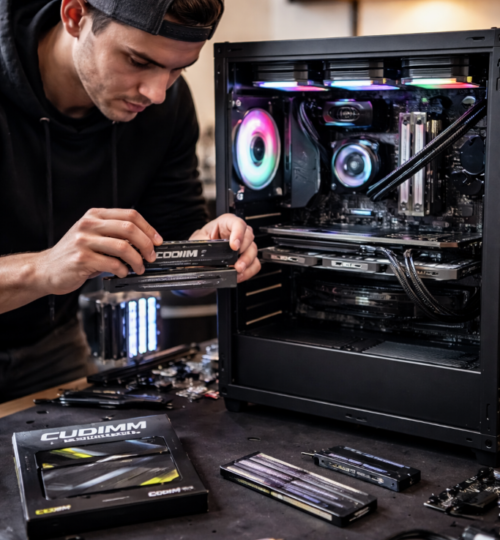
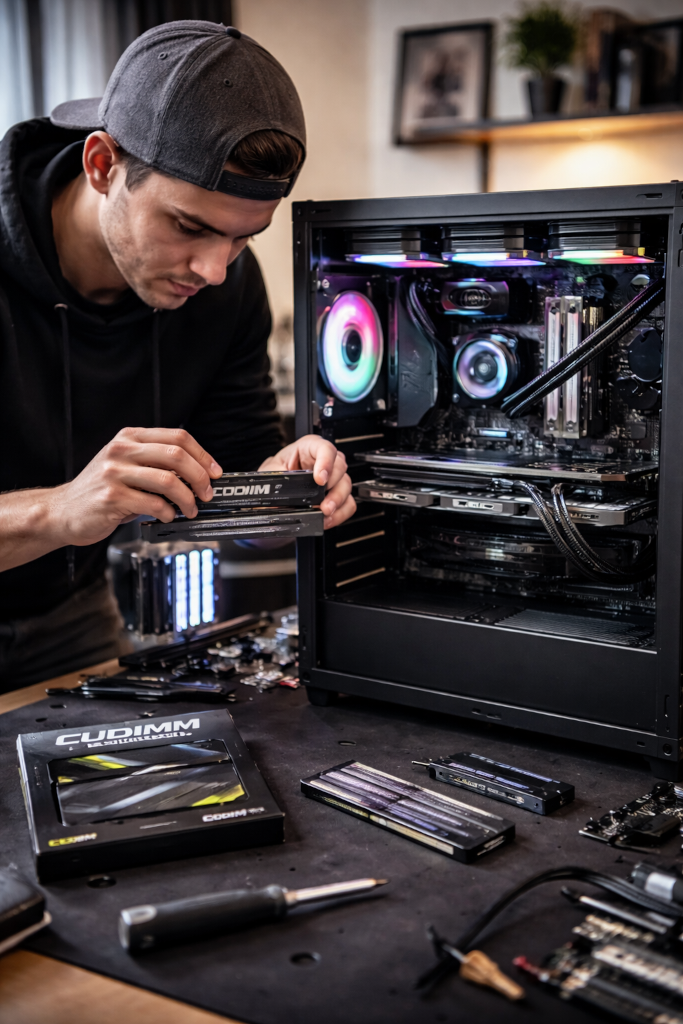
The PC hardware space rarely stands still, but every so often a shift arrives that feels less like an upgrade and more like a crossroads. The emergence of CUDIMM memory is one of those moments. For builders, competitive players, and everyday enthusiasts alike, the question is not just what this new standard offers, but whether it is worth stepping into early.
If you have been around long enough to remember transitions like DDR2 to DDR3 or the more recent jump to DDR5, you already know how these shifts tend to play out. Early adopters gain access to new performance ceilings, but they also accept the risks that come with immature platforms, higher prices, and evolving compatibility. CUDIMM sits squarely in that familiar space, but with a few twists that make it worth examining more closely.
What CUDIMM Actually Is
CUDIMM stands for Clocked Unbuffered Dual Inline Memory Module. At a glance, that may not sound dramatically different from the UDIMMs most consumer systems already use, but the key difference lies in how the memory handles signal integrity.
Traditional unbuffered memory sends signals directly between the CPU’s memory controller and the DRAM chips. As speeds increase, maintaining clean, stable signaling becomes more difficult. This is where CUDIMM steps in. It introduces a clock driver on the module itself, helping regulate and stabilize the signal before it reaches the memory chips.
In simple terms, CUDIMM is designed to allow higher memory speeds with improved reliability, especially as we push further into the limits of what DDR5 can handle.
Why This Transition Is Happening Now
The push toward CUDIMM is not happening in isolation. It is tied directly to the broader trajectory of modern CPUs and memory demands.
Current generation processors from both major manufacturers continue to increase core counts and rely more heavily on fast memory access to keep those cores fed with data. At the same time, workloads have changed. Gaming is no longer just about rendering frames. Background processes, streaming, asset loading, and simulation layers all compete for memory bandwidth.
DDR5 already introduced higher frequencies and improved efficiency compared to DDR4, but it also exposed new challenges. As speeds climbed, stability margins shrank. Manufacturers needed a way to maintain performance gains without sacrificing reliability, especially for mainstream users who are not manually tuning voltages and timings.
CUDIMM represents a response to that pressure. It is less about reinventing memory and more about reinforcing the foundation that current and future speeds depend on.
Real World Impact for Gamers
For many readers, the most important question is simple. Will this actually make your games run better? The answer depends heavily on the type of games you play and the system you are running.
In CPU bound scenarios, faster and more stable memory can lead to measurable gains. Competitive titles, large scale simulations, and open world games that rely on streaming assets can all benefit from improved memory performance. Reduced latency and higher bandwidth can translate into smoother frame pacing and fewer stutters, especially in moments where the system is under heavy load.
However, the difference is not always dramatic. In GPU bound situations, where your graphics card is the limiting factor, memory improvements may have little visible impact. You might see better benchmark numbers, but not a noticeable change in how the game feels.
There is also the question of consistency. One of the more subtle benefits of improved signal integrity is reduced instability at high speeds. That can mean fewer crashes, fewer memory related errors, and a more predictable system overall. For competitive players, consistency often matters more than peak performance.
Platform Requirements and Compatibility
This is where things start to get complicated. CUDIMM is not a drop in upgrade for existing systems. It requires support from both the motherboard and the CPU. That means new chipsets, updated BIOS support, and in many cases entirely new builds.
Early adoption cycles often come with fragmented compatibility. Some boards support certain speeds better than others. Some BIOS versions introduce instability before later updates smooth things out. Memory kits themselves may vary widely in quality and performance.
If you are used to building systems, none of this will come as a surprise. It is the same pattern we have seen with every major memory transition. The difference here is that CUDIMM adds another layer of complexity due to the onboard clock driver.
For users who prefer stable, predictable setups, this is an important consideration. Waiting for the ecosystem to mature can save a lot of time and frustration.
Cost Versus Benefit
New technology almost always arrives with a premium attached, and CUDIMM is no exception. Early kits are likely to cost more than standard DDR5 modules, especially at higher speeds. Motherboards that support the new standard may also carry higher price tags, particularly in the first wave of releases.
This raises a familiar question. Are you paying for real world performance, or are you paying for access to the cutting edge?
For some users, the answer is clear. Enthusiasts who enjoy pushing hardware to its limits, benchmarking systems, or experimenting with new platforms will find value in early adoption. The experience itself is part of the appeal.
For others, the equation looks different. If your current system runs your games well and meets your needs, the marginal gains offered by a new memory standard may not justify the cost of a full platform upgrade.
Overclocking and Headroom
One area where CUDIMM could make a more noticeable difference is overclocking.
By improving signal stability, the onboard clock driver can potentially allow for higher frequencies with less manual tuning. This could lower the barrier to entry for users who want to experiment with memory overclocking without diving deep into advanced settings.
At the same time, it may also expand the ceiling for experienced overclockers. More stable signaling means more room to push frequencies higher before encountering errors.
That said, overclocking is always dependent on multiple factors. CPU memory controllers, motherboard quality, cooling, and even silicon variation all play a role. CUDIMM does not eliminate those variables, but it may help reduce one of the key limitations.
The Risk of Early Adoption
Every new standard comes with a period of uncertainty, and CUDIMM is no different. Firmware updates can change performance characteristics. Compatibility lists can evolve. Early hardware revisions may have quirks that are later resolved.
There is also the broader industry question. How quickly will CUDIMM become the default? Will it remain a niche option for high speed kits, or will it replace traditional UDIMMs entirely over time?
History suggests that transitions take time. DDR4 remained relevant long after DDR5 launched. It is likely that both traditional DDR5 and CUDIMM will coexist for a while, giving users flexibility in how and when they upgrade.
Who Should Consider Upgrading Now
Early adoption makes the most sense for a specific type of user. If you are already planning a new build around the latest CPU platforms, it may be worth considering CUDIMM as part of that setup. The incremental cost may be easier to justify when you are upgrading multiple components anyway.
If you are an enthusiast who enjoys staying on the cutting edge, the appeal is obvious. New technology brings new opportunities to explore performance limits and experiment with configurations.
Content creators and users with memory intensive workloads may also see more tangible benefits. Tasks that rely heavily on bandwidth and stability can make better use of faster memory systems.
Who Should Wait
For many users, waiting is the more practical choice. If your current system is stable and performs well, there is little urgency to upgrade. The benefits of CUDIMM are real, but they are not transformative for most gaming scenarios.
Waiting allows prices to stabilize, compatibility to improve, and the technology to mature. It also provides a clearer picture of how the standard will be adopted across future platforms.
There is value in letting the early adopters work through the growing pains while you observe from a distance.
The Bigger Picture
The introduction of CUDIMM is part of a broader trend in PC hardware. As we approach the physical limits of traditional designs, manufacturers are looking for new ways to extract performance without compromising stability.
This often means adding complexity. On module components like clock drivers are one example. Advanced power management systems, new packaging techniques, and tighter integration between components are others.
For users, this creates a balancing act. More advanced hardware can deliver better performance, but it can also introduce new variables that affect reliability and compatibility.
Understanding where you fall on that spectrum is key to making the right upgrade decision.
Final Thoughts
CUDIMM is not a revolution in the way that entirely new memory generations can be, but it represents an important step forward in how we manage increasing speeds and performance demands.
For some, it will be an exciting opportunity to push their systems further than before. For others, it will be a signal that the next wave of hardware is on the horizon, even if they are not ready to jump in yet.
As with most transitions in the PC space, timing matters. The best upgrade is not always the newest one. It is the one that fits your system, your budget, and the way you actually use your hardware.
For now, CUDIMM is a glimpse of where memory is heading. Whether you choose to adopt it today or wait for tomorrow, it is another reminder that the platform we build on is always evolving.