A Landmark Year for One of Gaming’s Oldest Community Traditions
QuakeCon 2026 is shaping up to be more than another annual gathering. It is a milestone moment for one of PC gaming’s most enduring community institutions. The event is scheduled for August 6-9, 2026, at the Gaylord Texan Resort & Convention Center in Grapevine, Texas, bringing the Bring Your Own Computer experience back to the center of the celebration. Bethesda’s official event page frames the 2026 convention as a 30-year anniversary celebration built around 24/7 BYOC gaming, tournaments, freeplay, meetups, tabletop gaming, contests, giveaways, and the kind of in-person chaos that helped define early online multiplayer culture.
For veteran players, QuakeCon is not just another gaming convention on the calendar. It is one of the clearest surviving links between the garage LAN party era and the modern esports ecosystem. Before ranked playlists, battle passes, Discord communities, franchised leagues, and automated matchmaking, competitive gaming lived through servers, forums, clans, ladders, local meetups, and players willing to drag heavy rigs across state lines just to test themselves against people they knew only by handles.
That is what makes QuakeCon 2026 especially interesting for a legacy multiplayer community like ours. This is not simply nostalgia. It is a reminder that competitive gaming was built by players before it was packaged by publishers.
Why QuakeCon Still Matters in 2026
In a gaming industry increasingly shaped by digital showcases, influencer previews, closed betas, and algorithm-driven discovery, QuakeCon remains stubbornly physical. Its core identity still revolves around people bringing their own machines, sitting in rows, sharing the same room, and playing deep into the night. That alone makes it unusual in 2026.
Modern gaming is more connected than ever, but it is also more fragmented. Players jump between platforms, storefronts, launchers, subscriptions, live-service seasons, and social apps. Communities can rise fast, but they can also disappear just as quickly when a game shuts down, a platform changes policy, or a publisher moves on. QuakeCon’s lasting power comes from the opposite model. It has always been tied to people first, games second, and announcements third.
That does not mean the games are unimportant. Quake, DOOM, Wolfenstein, and the broader id Software legacy are central to the event’s identity. But QuakeCon became legendary because it treated players as participants, not just spectators. The BYOC floor was not a side attraction. It was the heart of the show.
For a competitive gaming community founded in the early 2000s, that distinction matters. Many of us remember when clans had websites, matches had forum threads, disputes had admins, and reputations were built one scrim at a time. QuakeCon belongs to that same lineage.
The 30th Anniversary Factor
The 2026 edition carries extra weight because Bethesda is positioning it around three decades of QuakeCon history. The official site specifically highlights “30 years of QuakeCon” and promises anniversary energy, throwback vibes, and a major BYOC focus. Even more notable, id Software founding members John Carmack, John Romero, Adrian Carmack, and Tom Hall are listed as special guests for the celebration.
That guest list is not a small footnote. For long-time PC players, those names are tied to the DNA of first-person shooters, modding culture, deathmatch, and the idea that technical excellence could reshape how games feel. Quake did not just influence shooters as a genre. It influenced online competition, 3D acceleration, server culture, speedrunning, machinima, map-making, and the basic expectation that PC games could be extended and mastered by communities.
The anniversary also lands at a time when the industry is still debating what long-term game preservation should look like. Live-service shutdowns, disappearing digital libraries, and changing ownership rules have made players more aware of how fragile modern access can be. QuakeCon’s celebration of LAN culture feels almost defiant in that context. It points back to a time when ownership, local play, dedicated communities, and technical tinkering were not niche values. They were normal.
The BYOC Hall Is the Main Event
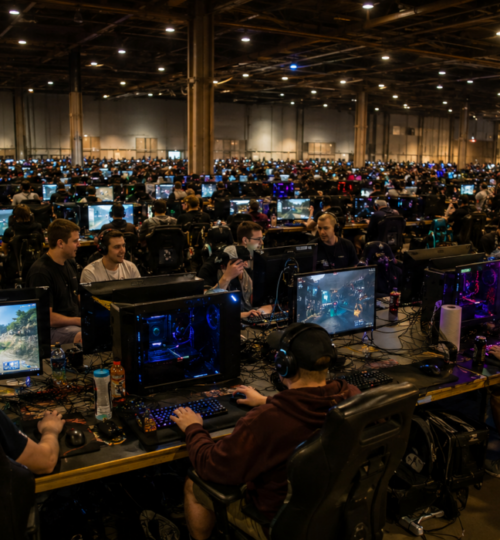
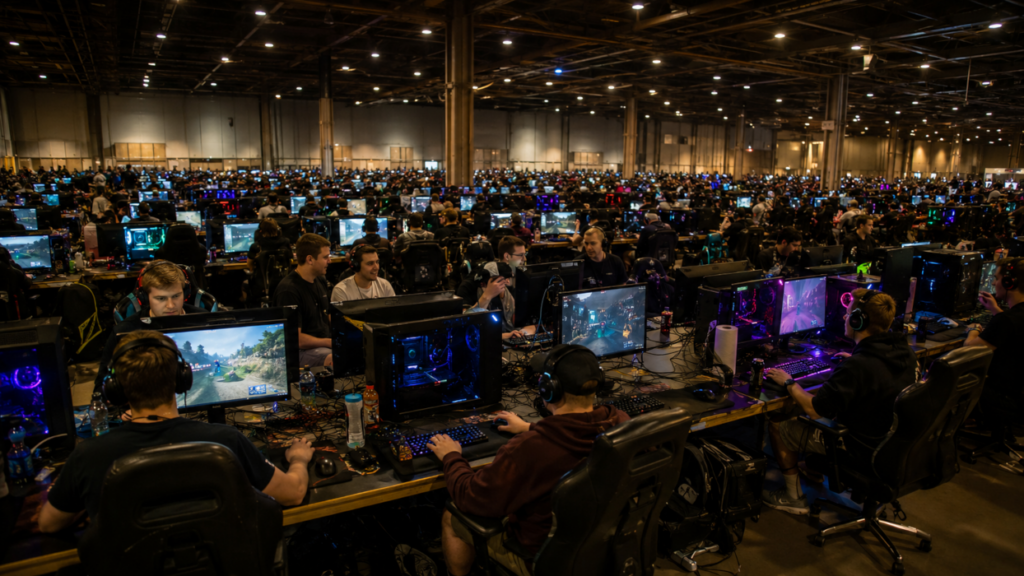
The official QuakeCon 2026 page emphasizes that the BYOC hall will run 24/7 across the event weekend. That matters because BYOC is the format that separates QuakeCon from a standard expo. Many conventions are built around booths, trailers, panels, and merch. QuakeCon’s core promise is simpler and more powerful: bring your setup, sit with other players, and play.
Ticket information confirms several BYOC tiers, including Elite BYOC, Group BYOC, and Standard BYOC. Elite BYOC includes four days of 24/7 event access, a larger 72-inch by 24-inch table space, priority equipment check-in, a monitor loan, official BYOC apparel, and a fan ticket for a plus one at the time of purchase. Group and Standard BYOC options also include four days of 24/7 access, with Group BYOC designed to help squads sit together and Standard BYOC providing the core LAN seat experience.
That focus on seating, table space, power rules, equipment check-in, and group placement might sound mundane to outsiders. To LAN veterans, it is the whole ballgame. A good LAN is logistics disguised as culture. Power, space, cable management, seating blocks, gear security, sleep deprivation, food runs, and the ability to stay near your squad all shape the experience.
Bethesda appears to understand that group coordination is a major pain point. For 2026, Group BYOC includes improved purchase waves for different group sizes, with larger groups receiving dedicated handling and seating request rules. That may not sound flashy, but for clans, teams, and long-running friend groups, it could make the difference between a scattered convention trip and a true squad weekend.
Fan Tickets Open the Door Beyond the Hardcore LAN Crowd
Not everyone attending QuakeCon 2026 needs to haul a tower, monitor, keyboard, mouse, headset, and enough cables to summon an electrician. Fan tickets are designed for attendees who want access without bringing a PC. According to the official ticket page, Fan Ticket holders can access daily event activities from 9:00 AM to 1:00 AM, join tabletop activities, tour the BYOC hall, sign up for tournaments, and participate in meetups, contests, giveaways, and other event features.
That is important for the future of events like QuakeCon. The original LAN generation is older now. Many still game heavily, but not everyone can commit to a full rig-hauling weekend. At the same time, younger players may know Quake more as history than as a current competitive obsession. Fan access gives those players a way into the culture without requiring them to fully commit to the BYOC tradition on day one.
For community growth, that kind of bridge matters. A strong gaming community needs veterans, but it also needs first-timers who can walk in, understand the vibe, and feel welcome enough to come back.
Artist Alley, Makerspace, and the Wider Gaming Culture
QuakeCon 2026 is not only about matches and hardware. Bethesda has also confirmed the return of Artist Alley, along with a new Makerspace. The Artist Alley is intended to showcase artists, illustrators, crafters, and creators, while the Makerspace is described as a hands-on area for workshops and classes built around creative skills, design, DIY projects, and game-inspired art.
That addition fits the broader reality of gaming communities in 2026. Competitive scenes do not survive on match results alone. They survive through identity. Logos, team graphics, memes, highlight edits, custom controllers, desk setups, cosplay, fan art, stream overlays, server banners, and community-made tools all help turn a game into a culture.
The creative side of QuakeCon is especially fitting because id Software’s legacy has always been technical and community-driven. Mods, maps, custom servers, configs, and player-made content were never just extras. They were part of how players expressed mastery. A Makerspace feels like a modern version of that same impulse.
What Competitive Players Should Watch For
At the time of writing, the confirmed public details focus heavily on the event structure, BYOC experience, anniversary celebration, ticketing, special guests, and community programming. It is reasonable to expect tournaments and competitive activities because the official site lists tournaments among the BYOC hall features and Fan Ticket activities. However, specific game lineups, brackets, prize details, and full schedules should be treated as pending until Bethesda or QuakeCon publishes final programming.
For competitive players, the most important thing to watch is not only whether Quake itself receives spotlight treatment, but how the event balances old-school arena shooter culture with the modern Bethesda and id Software ecosystem. QuakeCon has long had a complicated identity. It is named after Quake, built on Quake culture, and spiritually tied to arena FPS competition. Yet over time, it has also become a broader Bethesda and id celebration, with DOOM, Fallout, The Elder Scrolls, Wolfenstein, and other franchises orbiting the event.
That tension is part of the conversation every year. Some fans want QuakeCon to remain fiercely Quake-centered. Others accept it as a broader community gathering with Quake in its foundation. For 2026, the 30th anniversary framing gives Bethesda a rare chance to honor both sides: celebrate the roots while making the event accessible to a larger modern audience.
The LAN Party as a Competitive Memory Machine
For communities like ours, QuakeCon 2026 is also a reminder of something easy to lose in the modern ranked-play grind. Competition is not only about matchmaking systems, visible ranks, seasonal rewards, or esports broadcasts. It is also about memory.
Players remember the rival who talked trash for months before finally losing in a bracket. They remember the teammate who carried a comeback at 3:00 AM. They remember the busted chair, the overheated PC, the last-second defuse, the server crash, the admin ruling, the clan banner, the forum post after the match, and the feeling that a small corner of the internet belonged to them.
That is what LAN events preserve. They turn usernames back into people. They give online history a physical location. QuakeCon’s endurance proves that even in an era of cloud saves and digital everything, players still crave spaces where community feels real. The technology changed. The hunger did not.
Why This Event Deserves Attention Beyond Quake Fans
Even if someone has never played Quake competitively, QuakeCon 2026 is worth watching because it represents a larger question facing multiplayer gaming: who owns the culture?
Publishers own the IP. Platforms own the storefronts. Services own the accounts. Algorithms increasingly shape what players see, buy, and play. But events like QuakeCon show that the soul of gaming still lives in communities that gather, compete, create, argue, rebuild, and remember.
That is especially relevant for revived legacy hubs. When a community comes back after years away, it is not simply restoring pages, profiles, ladders, or old records. It is restoring continuity. It is telling players that their history mattered, that their teams mattered, and that the competitive identity they helped build was not disposable.
QuakeCon 2026 is operating on that same emotional frequency. It is not just selling access to a convention hall. It is asking players to return to a shared ritual.
Final Thoughts: QuakeCon 2026 Looks Like a Celebration of What Built Us
QuakeCon 2026 arrives at a perfect moment for reflection. The industry is larger than ever, but many players feel less ownership over the spaces they inhabit. Games are more advanced, but communities can feel more temporary. Esports is more professional, but sometimes less personal. In that environment, a 30-year celebration built around BYOC gaming feels almost radical.
From August 6-9, the Gaylord Texan in Grapevine will host more than a convention. It will host a living piece of multiplayer history. The presence of id Software’s founding figures adds weight, the 24/7 BYOC hall keeps the old flame alive, and the expanded community features suggest QuakeCon still understands that gaming culture is bigger than announcements.
For veterans, QuakeCon 2026 is a chance to reconnect with the roots of competitive PC gaming. For newer players, it is a chance to see where much of today’s online multiplayer culture came from. For legacy communities rebuilding their own place in the scene, it is a reminder that history is not dead weight. Sometimes history is the ladder back up.