
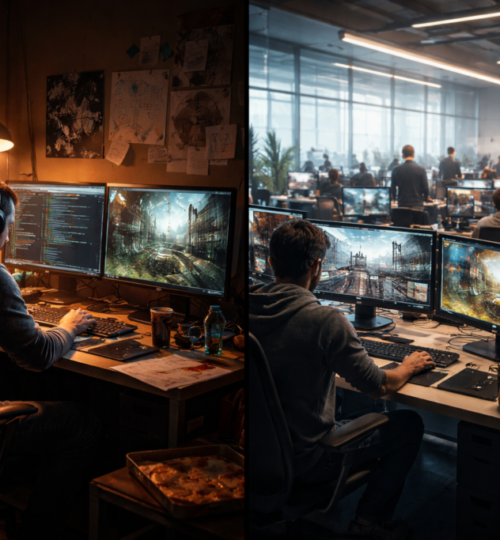
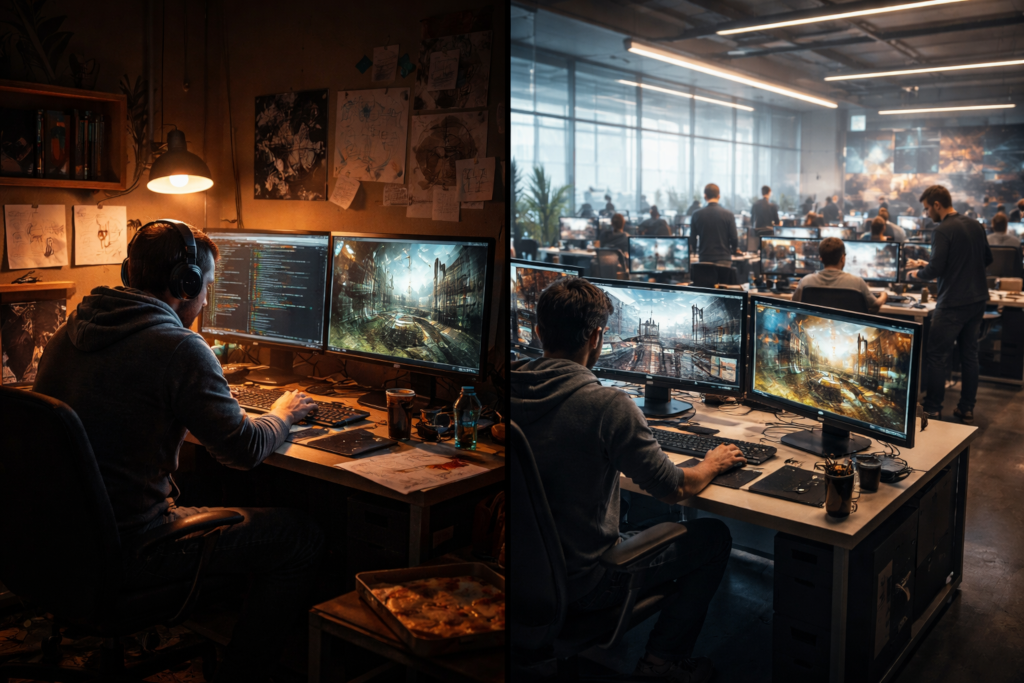
The gaming industry in 2026 sits at a fascinating crossroads. On one side are mega-corporations with billion-dollar budgets, global marketing machines, and access to cutting-edge technology. On the other are indie studios, often small teams or even solo developers, driven by creative vision and a willingness to take risks that larger companies often avoid.
For a community like ours, rooted in the competitive gaming culture of the early 2000s, this tension feels familiar. We came up in an era where innovation often came from modders, grassroots communities, and small studios experimenting with ideas before they were polished into mainstream hits. Now, as the industry continues to evolve, the battle for creative control is shaping not just what games get made, but how players experience them.
The Rise of Indie Powerhouses
Indie studios are no longer the underdogs they once were. Over the past decade, the tools for game development have become more accessible. Engines like Unity and Unreal Engine have lowered technical barriers, while digital distribution platforms have eliminated the need for physical publishing deals.
In 2026, indie developers are not just surviving, they are thriving. Many have built loyal communities through platforms like Discord, Patreon, and direct storefronts. These studios can iterate quickly, respond to player feedback in real time, and maintain a level of transparency that large corporations struggle to replicate.
What makes indie studios particularly powerful is their ability to take creative risks. They are not bound by shareholder expectations or quarterly earnings reports. This freedom has led to the rise of unique gameplay mechanics, experimental storytelling, and niche competitive experiences that would never pass a corporate greenlight process.
For competitive gamers, this has resulted in a surge of new arenas to explore. Smaller studios are building tightly focused multiplayer experiences that prioritize mechanics and skill expression over mass appeal. In many cases, these games echo the spirit of early esports titles, where gameplay depth mattered more than visual spectacle.
The Corporate Machine and Its Strengths
Mega-corporations still dominate the industry in terms of revenue, reach, and infrastructure. They have the resources to develop massive live service ecosystems, maintain global server networks, and support games for years after release.
In 2026, corporate publishers are doubling down on data-driven design. Player engagement metrics, retention curves, and monetization models heavily influence development decisions. This approach has led to highly polished experiences that are optimized for long-term player retention.
There are clear advantages to this model. Large studios can deliver technical excellence at a scale that indie developers often cannot match. From advanced graphics to seamless cross-platform integration, these companies push the boundaries of what is technically possible.
For esports, corporate backing can mean stability. Organized leagues, sponsorship deals, and global tournaments require significant financial investment. Without corporate infrastructure, many of the largest competitive scenes would not exist in their current form.
However, this strength comes with trade-offs.
Creative Risk vs Predictable Profit
At the heart of the conflict between indie studios and mega-corporations is a fundamental difference in priorities.
Indie developers often prioritize creative expression. They are willing to experiment, fail, and iterate. This leads to innovation, but also inconsistency. Not every indie game succeeds, and some ideas never fully realize their potential.
Corporate studios, on the other hand, prioritize predictability. They rely on established franchises, proven mechanics, and monetization systems that have demonstrated success. This reduces risk but can lead to creative stagnation.
In 2026, players are increasingly aware of this divide. Many gamers are seeking experiences that feel fresh and authentic, while others prefer the reliability and polish of established franchises.
This tension is particularly visible in multiplayer gaming. Indie studios are introducing new competitive formats, unconventional mechanics, and community-driven balancing systems. Meanwhile, corporate titles often refine existing formulas, focusing on incremental improvements rather than radical change.
The result is a fragmented landscape where innovation and stability coexist, but rarely intersect.
Live Service Models and Creative Constraints
One of the defining trends of modern gaming is the dominance of live service models. Mega-corporations have embraced this approach, turning games into ongoing platforms rather than one-time releases.
While live service games can provide continuous content and long-term engagement, they also impose constraints on creativity. Developers must prioritize content pipelines, seasonal updates, and monetization strategies. This can limit the ability to experiment with core gameplay systems.
Indie studios are approaching live service differently. Many are adopting lighter models that focus on community engagement rather than aggressive monetization. Some rely on early access to fund development, allowing players to shape the game as it evolves.
For competitive communities, this distinction matters. Corporate live service games often feel like curated experiences, where changes are carefully controlled. Indie live service games, by contrast, can feel more organic, with rapid updates and direct developer interaction.
This difference can influence player loyalty. Gamers who value stability may gravitate toward corporate titles, while those who enjoy being part of a game’s evolution may prefer indie projects.
The Role of Community in Shaping Games
In 2004, communities like ours played a central role in shaping competitive gaming. Players organized tournaments, created ladders, and built ecosystems around the games they loved.
That spirit is returning in 2026, largely driven by indie developers.
Indie studios often treat their communities as collaborators rather than consumers. Feedback loops are shorter, communication is more direct, and players have a tangible impact on development decisions.
This approach aligns closely with the values of legacy esports communities. It creates a sense of ownership and investment that is difficult to replicate in corporate environments.
Mega-corporations are attempting to bridge this gap. Many have expanded their community management teams and introduced more transparent development roadmaps. However, the scale of these organizations can make genuine interaction challenging.
For players, the difference is noticeable. Engaging with an indie developer can feel like a conversation. Engaging with a corporate publisher often feels like participating in a managed ecosystem.
Monetization and Player Trust
Monetization remains one of the most contentious issues in the industry. Corporate studios have refined their strategies to maximize revenue through battle passes, cosmetic stores, and in some cases, more controversial systems.
These models can create friction with players, especially when monetization feels intrusive or impacts gameplay balance.
Indie studios typically adopt simpler approaches. Many rely on upfront purchases, optional cosmetic items, or community support platforms. While this can limit revenue potential, it often builds stronger trust with players.
In 2026, trust is becoming a key differentiator. Players are more informed than ever and are quick to identify practices that feel exploitative. Indie studios that prioritize fairness and transparency can build loyal followings, even without massive marketing budgets.
At the same time, corporate studios are under pressure to evolve. Some have begun experimenting with more player-friendly monetization models, recognizing that long-term engagement depends on maintaining trust.
Technology, AI, and the Future of Development
Advancements in technology are reshaping the balance between indie studios and mega-corporations. Tools powered by artificial intelligence are enabling smaller teams to achieve results that were once only possible with large budgets.
Procedural generation, AI-assisted design, and automated testing are leveling the playing field. Indie developers can create complex systems, generate content at scale, and optimize performance with fewer resources.
Mega-corporations, however, are leveraging these technologies at an even larger scale. They are integrating AI into analytics, player behavior modeling, and content creation pipelines. This allows them to fine-tune experiences with unprecedented precision.
The question is not whether technology will benefit one side over the other, but how each side chooses to use it.
Indie studios are using AI to enhance creativity and efficiency. Corporate studios are using it to optimize engagement and profitability. Both approaches have value, but they lead to different types of experiences.
Esports Implications: Grassroots vs Global Stage
For a community built around competitive gaming, the implications of this divide are significant.
Indie titles are revitalizing grassroots competition. Smaller games with dedicated communities are fostering environments where skill and strategy take center stage. These scenes often feel more accessible and less commercialized.
Corporate titles continue to dominate the global stage. Major tournaments, professional leagues, and international events are driven by the resources of large publishers. These ecosystems offer opportunities for players to compete at the highest level, but they are also tightly controlled.
In 2026, we are seeing a hybrid model emerge. Some indie games are gaining enough traction to support organized competition, while some corporate titles are opening up to community-driven events.
This convergence could redefine esports. It creates a space where innovation and scale can coexist, offering players more diverse competitive experiences.
The Player’s Role in the Balance of Power
Ultimately, the battle for creative control is not just between developers and corporations. Players play a crucial role in shaping the industry.
Every purchase, every hour spent in a game, and every piece of feedback contributes to the direction of development. In 2026, players have more influence than ever before.
Supporting indie games can encourage innovation and diversity. Engaging with corporate titles can sustain large-scale ecosystems and professional competition.
The key is awareness. Understanding the trade-offs between different types of games allows players to make informed choices about where they invest their time and money.
For veteran gamers, this moment feels like a return to form. The industry is once again being shaped by a combination of grassroots creativity and large-scale infrastructure.
Looking Ahead: A Coexistence Rather Than a Victory
The narrative of indie studios versus mega-corporations suggests a conflict, but the reality is more nuanced.
Both sides bring valuable contributions to the gaming ecosystem. Indie studios drive innovation, challenge conventions, and keep the industry fresh. Mega-corporations provide stability, scale, and the resources needed to sustain global communities.
In 2026, the future of gaming lies in the interaction between these forces. The most exciting developments are happening where creativity meets capability, where small teams push boundaries and larger organizations adapt to keep up.
For our community, this is an opportunity. As we rebuild and evolve, we can draw inspiration from both sides. We can embrace the creativity of indie developers while leveraging the structure and scale that defined our early years.
The battle for creative control is not about choosing one side over the other. It is about finding the balance that keeps gaming dynamic, competitive, and driven by the passion that brought us all here in the first place.