
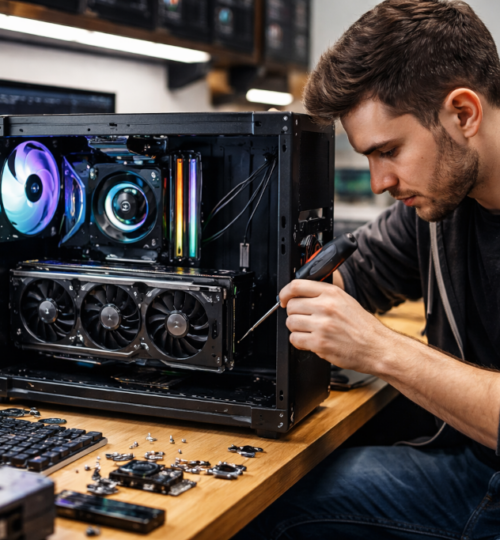
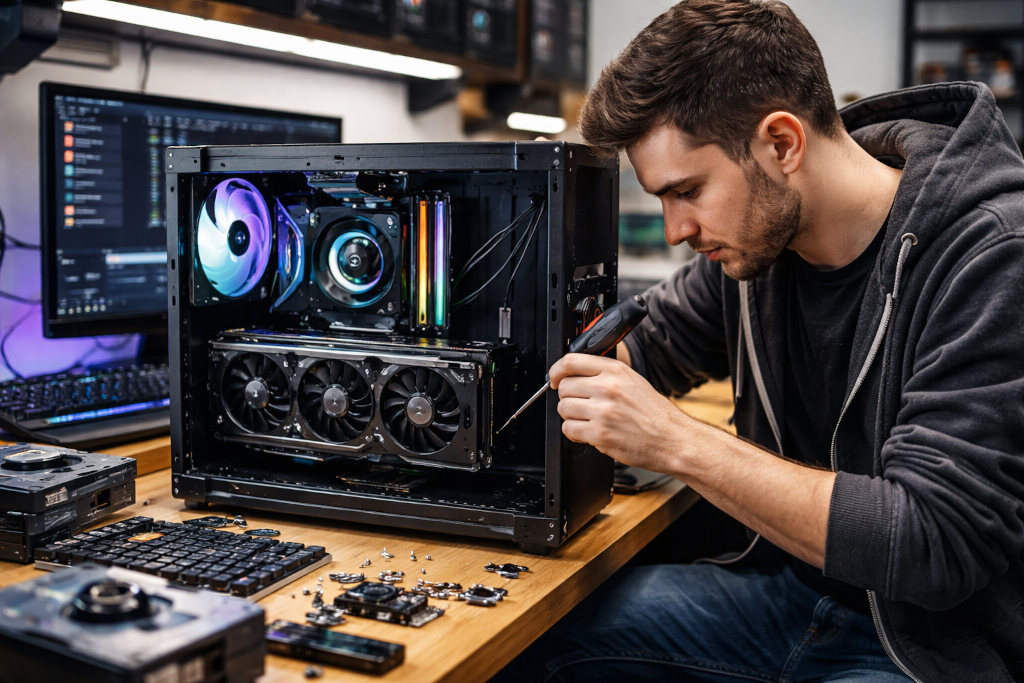
There was a time when building your own gaming PC was almost a rite of passage. It was how many players learned what powered their favorite games, how performance actually worked, and why one system could feel dramatically different from another even on the same title. Over the years, that hands-on culture has slowly faded into the background as pre-built systems became cheaper, more polished, and more aggressively marketed. Today, it is entirely possible to buy a powerful gaming PC without ever opening a case or touching a cable.
Convenience has its place, but something meaningful has been lost along the way. Building a gaming PC is not just about saving money or chasing higher frame rates. It is about control, understanding, and creating a machine that reflects how you actually play games. In an era of one-click purchases and sealed hardware, the art of building your own PC still matters more than ever.
When Gaming PCs Were Personal
In the earlier days of PC gaming, customization was not optional. Pre-built gaming systems were rare, expensive, or poorly optimized. If you wanted to play the latest titles smoothly, you learned quickly what a graphics card did, how much RAM mattered, and why airflow inside a case was not just a marketing term.
Every build told a story. Some systems were clearly designed for competitive shooters, with fast CPUs and modest storage. Others leaned into sprawling RPGs or mod-heavy games, prioritizing memory and disk space. Even mistakes became lessons. A noisy fan, an underpowered power supply, or a poorly ventilated case taught builders what to improve next time.
That personal relationship with hardware shaped how people approached games themselves. Players understood why certain settings affected performance. They knew the limits of their machines and how to push them responsibly. That knowledge created a deeper connection between the player and the platform.
The Rise of the Pre-Built PC
Pre-built gaming PCs did not replace custom builds overnight. Their rise was gradual and understandable. As hardware became more standardized and manufacturing scaled up, companies were able to deliver solid performance at competitive prices. For players who wanted to jump straight into gaming without troubleshooting or research, pre-builts solved a real problem.
Modern pre-built systems are often well-assembled, visually impressive, and backed by warranties that remove much of the risk. For new gamers or those with limited time, they can be a practical choice. There is nothing inherently wrong with buying a system that works out of the box.
The issue is not that pre-built PCs exist. The issue is that they often prioritize broad appeal over individual needs. They are designed to look good on a product page and hit a specific price point, not to reflect how one person actually uses their system.
Customization Is About Intent, Not Excess
One common misconception is that building your own gaming PC is about chasing the highest specs possible. In reality, customization is about intent. It is about making deliberate choices based on how you play, what you value, and where you want flexibility.
A competitive multiplayer player may benefit most from a strong CPU and high-refresh-rate performance, while a single-player enthusiast might prioritize a powerful GPU and immersive visuals. A content creator may need extra storage and memory, while a minimalist builder may focus on silence and efficiency.
Pre-built systems rarely optimize for these distinctions. They often include components that look impressive in a spec list but offer little real-world benefit for a specific user. Custom building allows you to redirect that budget toward what actually matters to you.
Understanding Your Hardware Changes How You Game
When you build your own PC, you naturally learn how its components interact. You see how CPU performance affects simulation-heavy games, how GPU power shapes resolution and visual quality, and how storage speeds influence load times. This understanding changes how you approach games.
Instead of blindly lowering settings when performance dips, you know which options are most impactful. You recognize when a game is CPU-bound versus GPU-bound. You can troubleshoot issues more confidently and make informed upgrades when the time comes.
That knowledge also fosters patience and realism. Not every game will run perfectly at maximum settings, and that is okay. Knowing why helps remove frustration and replaces it with problem-solving.
Longevity Through Smart Choices
One of the biggest advantages of a custom-built PC is longevity. Pre-built systems often use proprietary components, limited power supplies, or cases that restrict airflow and upgrades. They are designed to be used as-is until replacement.
A thoughtfully built PC is different. Choosing a quality power supply, a well-ventilated case, and a flexible motherboard creates a foundation that can evolve over time. Instead of replacing the entire system, you can upgrade a single component as games and technology change.
This approach is not just cost-effective. It reduces waste and extends the usable life of your hardware. It also keeps you engaged with your system, encouraging learning rather than disposal.
The Satisfaction of Building Something Yourself
There is an intangible satisfaction that comes from building your own gaming PC. It is the moment when the system boots for the first time, the BIOS screen appears, and you realize that everything works because you made it work.
That sense of ownership carries into everyday use. Troubleshooting becomes less intimidating. Maintenance feels manageable. Even cleaning dust or adjusting cables feels purposeful rather than annoying.
In a digital world where so much is abstracted and automated, building a PC is a rare chance to work with something tangible. It is a reminder that technology is not magic. It is a collection of parts working together, and you are capable of understanding it.
Learning Without Gatekeeping
One reason the art of PC building has faded is the perception that it is difficult or intimidating. While there is a learning curve, modern PC building is far more accessible than it once was. Components are standardized, documentation is widely available, and compatibility tools remove much of the guesswork.
The real barrier is often cultural. Too many conversations around PC building focus on extremes, whether it is chasing top-tier benchmarks or dismissing anything less as inferior. That mindset discourages newcomers.
Building a gaming PC does not require perfection. It requires curiosity and a willingness to learn. Mistakes are part of the process, and they are how knowledge sticks.
Why Custom Builds Still Matter for Gaming Communities
For gaming communities, especially those built around competition, creativity, and shared knowledge, custom PC building has deeper significance. It encourages self-reliance and technical literacy. It sparks conversations about performance, optimization, and design choices.
These discussions bring people together. They create shared experiences that go beyond the games themselves. When players understand their hardware, they are more likely to help others, share insights, and contribute meaningfully to a community.
That spirit mirrors the early days of online gaming hubs, when players exchanged tips, understanding, and enthusiasm rather than just consuming content.
Choosing Custom in a World of Convenience
Pre-built gaming PCs are not going away, and they should not. They serve an important role in making PC gaming accessible. But accessibility does not have to come at the cost of understanding or creativity.
Choosing to build your own gaming PC is choosing engagement over convenience. It is choosing to learn how your system works rather than accepting it as a black box. It is choosing a machine that fits you, not just one that looks good on a shelf.
In many ways, building a gaming PC is an extension of gaming itself. It rewards planning, experimentation, and problem-solving. It teaches patience and offers long-term satisfaction rather than instant gratification.
Bringing the Craft Back
The lost art of building your own gaming PC does not need to stay lost. It simply needs space to be valued again. Not as an elitist pursuit or a performance contest, but as a practical, empowering skill.
For those willing to invest the time, building a PC offers more than just a playable system. It offers understanding, flexibility, and a deeper connection to the games you love. In a landscape dominated by pre-built solutions, that kind of ownership is rare and worth preserving.
Gaming has always been about agency. About making choices, mastering systems, and shaping experiences. Building your own gaming PC is one of the few ways left to bring that philosophy into the hardware itself.