
Disclaimer: The views and opinions expressed in this article are solely those of the author. The mention of any products, services, or methods does not constitute an endorsement.
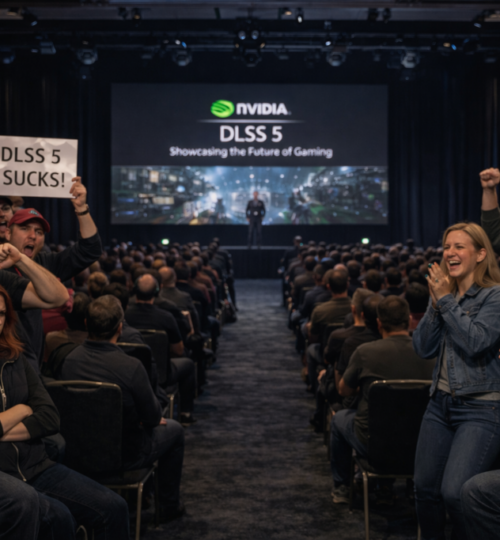
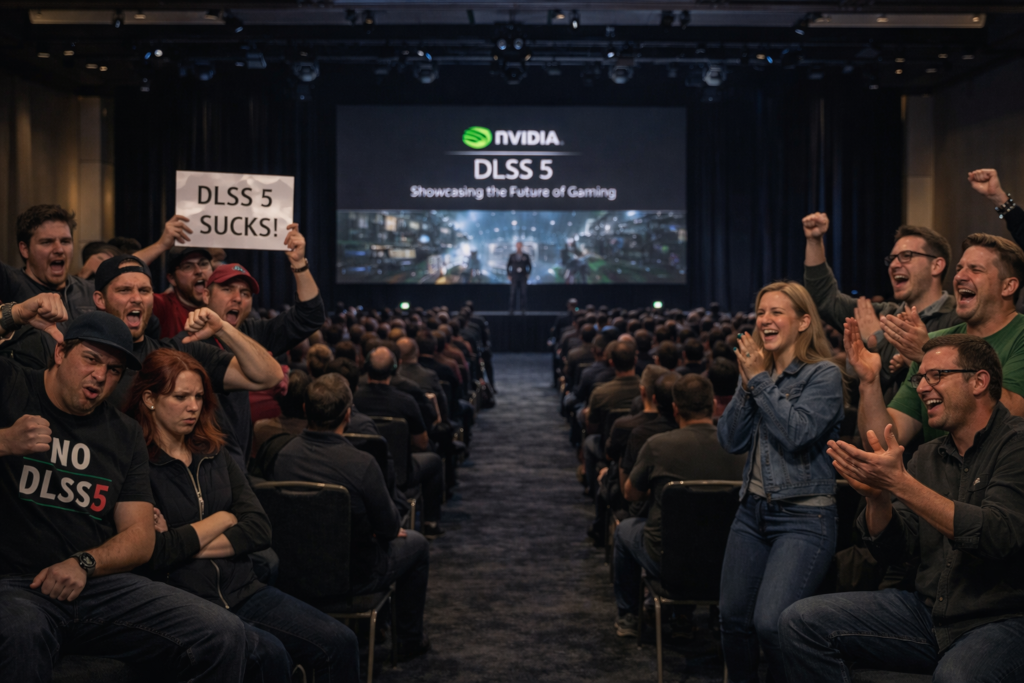
Nvidia’s reveal of DLSS 5 was supposed to be one of the biggest gaming-tech stories of the week. In a purely technical sense, it still is. The company is pitching DLSS 5 as a major leap forward in graphics, built around a new real-time neural rendering model that blends traditional rendering with generative AI to create more photorealistic lighting and materials.
But the reaction from gamers, artists, and even developers has been far messier than a standard hype cycle. Instead of celebration, much of the conversation has shifted toward discomfort.
From Performance Tool to AI-Driven Aesthetic
Earlier versions of DLSS were widely accepted because their purpose was clear. They focused on performance by upscaling lower-resolution images while maintaining visual fidelity. Players got smoother gameplay without sacrificing too much detail.
DLSS 5 changes that equation.
This time, Nvidia is openly leaning into generative AI and not just to improve performance, but to influence the final look of a game. That shift has fundamentally changed how people perceive the technology. What was once a performance enhancer is now being seen as something that may actively reshape a game’s visual identity.
The “Waxy” Look and the Uncanny Valley Problem
The biggest criticism isn’t about whether DLSS 5 works. It’s about how it looks.
Across multiple demos, players noticed a consistent visual pattern. Characters appeared smoother, more polished, and in some cases, subtly altered. Faces looked “beautified,” lighting felt overly processed, and the final image had a kind of glossy, artificial finish.
The result? A strong uncanny valley effect.
Instead of feeling more real, many scenes felt less natural. The comparisons being made online say it all with people likening DLSS 5 visuals to AI-generated images, Instagram filters, or even stylized meme content. That’s not the reaction Nvidia was likely hoping for.
When Every Game Starts Looking the Same
One of the most damaging criticisms is the idea of homogenization.
In Nvidia’s showcase, multiple games, each with their own unique art direction, began to look strangely similar when DLSS 5 was enabled. Different engines, different developers, different artistic goals… yet the output carried the same visual signature.
That’s a red flag in an industry built on identity.
Art direction is what makes one game feel distinct from another. When a technology starts to blur those differences, even unintentionally, it raises serious concerns about where things might be heading.
Nvidia’s Response: “You’re Misunderstanding It”
Nvidia CEO Jensen Huang has pushed back strongly against the backlash, stating that critics are “completely wrong” about DLSS 5.
According to Nvidia, the technology is not a simple filter layered on top of a finished frame. Instead, it operates at a deeper level that is working with geometry, textures, motion vectors, and material data to generate improved visuals in real time. Developers, Nvidia insists, retain full control over how the system is used.
There are sliders, masks, and tuning options. Effects can be applied selectively. The goal, Nvidia says, is not to replace artistic intent but to enhance it.
On paper, that sounds reassuring.
But the problem is that players aren’t judging the theory. They’re judging the results.
The Marketing Problem: Show, Don’t Tell
Even if Nvidia’s explanation is technically accurate, the rollout has created a perception problem.
The only thing the public has to go on is what was shown, and what was shown didn’t land well. If DLSS 5 can preserve artistic identity, the early demos didn’t prove it. Instead, they reinforced the exact fears Nvidia is trying to dismiss.
This is where the messaging breaks down.
You can explain a technology all day, but if the visual output feels off, no amount of technical detail will change that first impression. Right now, DLSS 5 feels less like a breakthrough and more like something that needs better demonstration.
Developers Are Split: Tech vs Art
The reaction inside the industry reflects a clear divide.
On one side are the technology-focused voices. Some developers and producers see DLSS 5 as an incredible tool as one that improves lighting, materials, and realism in ways that were previously too expensive for real-time rendering. From this perspective, the backlash is overblown, driven more by bias against AI than by the actual results.
On the other side are artists and developers who are deeply concerned.
For them, the issue isn’t technical capability. It’s artistic coherence. More detail does not automatically mean better visuals. Lighting, composition, and subtle imperfections are all part of intentional design. When those elements are overridden or exaggerated, the entire image can lose balance.
That’s why many critics argue that DLSS 5 doesn’t just enhance visuals. It risks flattening them.
The Unified Model Problem
One detail that keeps resurfacing in the discussion is how DLSS 5 is trained.
The system uses a single unified AI model rather than one tailored to individual games, characters, or styles. While this allows for consistency and scalability, it also helps explain why different games start to look alike under DLSS 5.
If everything is being processed through the same model, there’s a natural risk that everything starts to carry the same visual fingerprint.
Even with developer controls and tuning options, that underlying consistency may be difficult to fully escape.
The AI Context: Why This Feels Bigger Than Graphics
Part of the intensity behind the backlash has less to do with DLSS 5 itself and more to do with the broader context of AI in gaming.
Players are already dealing with rising hardware costs, GPU shortages, and a growing sense that AI is reshaping the industry in ways that don’t always benefit them. Nvidia, as one of the biggest players in the AI space, sits at the center of that frustration.
So when DLSS 5 arrives as a heavily AI-driven feature and the results feel questionable, it amplifies existing skepticism.
This isn’t just about graphics anymore. It’s about trust.
Is This Just a Rough First Impression?
It’s important to remember that DLSS 5 is still evolving.
Nvidia has indicated that what’s been shown so far is only an early look. Developers will have time to refine how the technology is used, and future implementations may look very different from the initial showcase.
There’s a real possibility that DLSS 5 becomes a powerful, flexible tool that enhances games without compromising their identity.
But that future hasn’t been demonstrated yet.
The Real Issue: What Players Actually See
At the end of the day, none of the technical arguments matter if the visuals don’t resonate.
Players don’t experience rendering pipelines. They experience the final image. And right now, that image is what’s driving the backlash. The consistent feedback is simple: something feels off.
That doesn’t mean DLSS 5 is doomed.
It does mean Nvidia has work to do.
Where Things Go From Here
If Nvidia wants to win people over, the path forward is clear.
Show more. Show better. Show restraint.
Demonstrate DLSS 5 in scenarios where it enhances rather than dominates. Highlight games that retain their unique identity. Prove that realism doesn’t have to come at the cost of artistic intent.
Because right now, DLSS 5 sits in a strange place.
It’s a fascinating technical achievement.
But until the visuals match the promise, the conversation will continue to be defined not by what the technology can do but by how it makes people feel.