
Disclaimer: The views and opinions expressed in this article are solely those of the author. The mention of any products, services, or methods does not constitute an endorsement.
The Next Arena Might Be Your Own Floor Plan
For decades, gaming has been trying to make virtual spaces feel more physical. We went from flat maps on CRT monitors, to physics-driven 3D worlds, to motion controls, to VR rooms where players swing swords in open air. Now, a quieter but potentially massive shift is happening: games are learning the shape of the player’s real room.
That is where lidar, depth sensing, passthrough cameras, spatial anchors, and room-mapping APIs come in. Instead of asking a player to imagine a dungeon, a sci-fi corridor, or a tactical arena on a screen, developers can scan the walls, floor, furniture, tables, couches, and corners of a real space, then build the game around it.
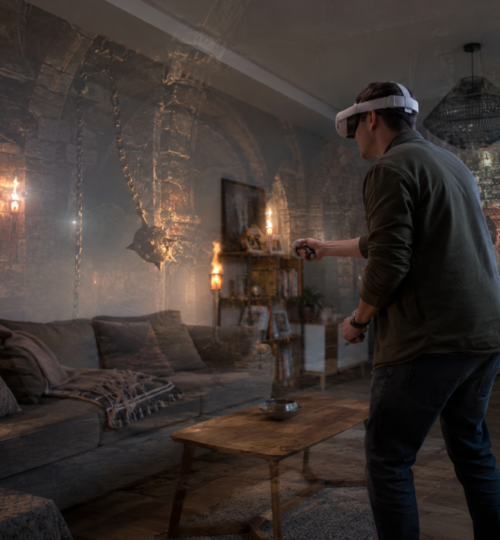
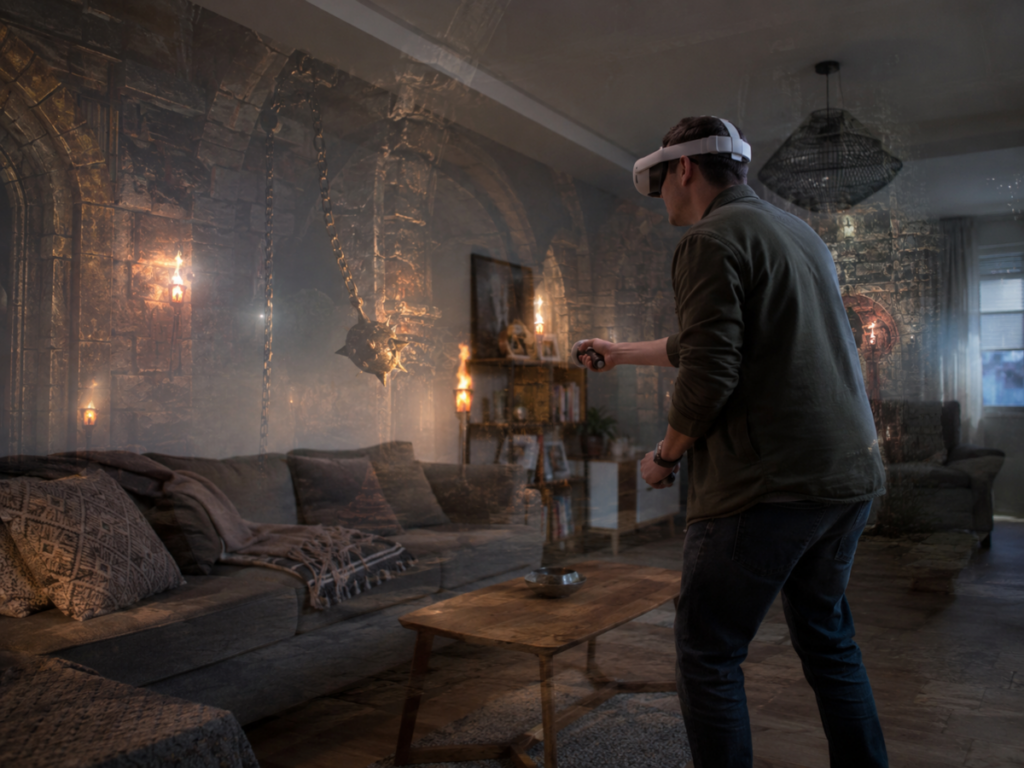
In plain English, your living room can become the dungeon. Not just visually. Structurally.
The couch can become a barricade. The hallway can become a monster spawn route. The coffee table can become an altar. The blank wall beside the TV can become a portal. The floor space between the recliner and the bookshelf can become a danger zone. This is the promise of room-aware mixed reality gaming: games that do not merely display content in your room, but actually understand the room as part of the level design.
For a legacy online multiplayer community like ours, that idea hits differently. Competitive gaming has always been about arenas, maps, terrain, angles, routes, control points, and player knowledge. Room-mapping technology introduces a strange new possibility: the next multiplayer map may not be built by a studio alone. It may be generated from the spaces players already live in.
What Lidar Actually Does for Games
Lidar stands for Light Detection and Ranging. In consumer devices, it is used to estimate distance by measuring how light interacts with the surrounding environment. In gaming and augmented reality, the important part is not the name. It is what the device can produce: depth information.
That depth information helps software understand where surfaces exist in three-dimensional space. Instead of guessing where a floor or wall might be based only on camera images, a lidar-equipped device can help create a more reliable spatial map of the room. Apple’s ARKit scene reconstruction, for example, can provide a polygonal mesh that estimates the shape of the physical environment, while Unity’s ARKit support describes this as mesh geometry representing the real world environment.
That mesh matters because games need geometry. A game engine does not just need to “see” your room like a camera. It needs surfaces that can be used for collision, occlusion, placement, navigation, and interaction. If a virtual rat runs under your real table, the game has to know where the table is. If a spell hits your real wall and splashes sparks across the surface, the game has to understand that the wall is there. If a monster is supposed to hide behind your couch, the system needs enough spatial awareness to treat the couch like cover.
This is the key difference between simple AR and room-aware mixed reality. Early AR often felt like stickers placed on the camera feed. Room-mapped gaming aims for something deeper. The virtual world reacts to your real space.
The APIs That Make the Room Playable
The reason this concept is becoming realistic is not just better sensors. It is the rise of developer APIs that expose room information in usable ways.
On Apple devices, ARKit supports scene reconstruction on lidar-capable hardware, allowing apps to work with real-world mesh data. Apple’s RoomPlan API goes even further for architectural-style scanning, helping generate structured room representations from supported iPhone and iPad devices. While RoomPlan is often discussed in the context of interior design, real estate, and floor planning, the underlying idea is very relevant to games: turn a messy physical room into data that software can reason about.
On Meta Quest hardware, mixed reality development has been moving in a similar direction. Meta’s Scene API is designed to capture and model room geometry such as walls, floors, and furniture for smart content placement. Meta also describes the Quest 3 Mesh API as giving developers access to a Scene Mesh, a triangle-based geometric representation of the physical world, generated through the headset’s Space Setup feature.
Unity and Unreal then sit in the middle as the engines many developers actually use. Unity’s AR Foundation can work with ARKit meshing through components like ARMeshManager, making room geometry part of a developer’s scene workflow.
For players, the technical stack is mostly invisible. You scan the room, define boundaries, grant permissions, and start the game. For developers, that scan can become the foundation for gameplay logic. That is where things get interesting.
From Living Room to Dungeon Layout
Imagine a fantasy dungeon crawler that begins by scanning your room. The system detects the open floor, walls, furniture, and major obstacles. It then builds a dungeon layout around what it finds.
Your couch becomes a collapsed stone barrier. The doorway becomes a gate to the next chamber. A bookshelf becomes a cursed archive. A dining table becomes a ritual platform. Dark corners become spawn points for crawling enemies. The wall behind your television becomes a sealed crypt door that only opens after you solve a puzzle.
The dungeon does not need to perfectly match your room visually. In fact, it probably should not. The real magic is mapping function, not appearance. The game can transform objects symbolically while preserving their physical boundaries. A real chair can become a pile of bones, but the player still knows not to walk through it. A real wall can become a mossy dungeon wall, but the game still understands it as an impassable surface.
This creates a new kind of immersion. The player is no longer standing in a generic rectangular play area. The level has personal geography. You know that the “treasure alcove” is where your desk actually sits. You know the “monster tunnel” is the hallway leading to the kitchen. You know the “healing shrine” is safely placed near the open space by the rug.
That familiarity can make the fantasy more powerful, not less. Games have always borrowed from memory. We remember maps because we learn their routes. Room-aware gaming gives every player a map they already know, then twists it into something new.
Why This Could Matter for Multiplayer
Room-mapped gaming sounds like a single-player novelty at first. But for competitive and multiplayer communities, the implications are bigger. One obvious use is asymmetric multiplayer. One player’s room becomes the dungeon, and remote players invade it as monsters, ghosts, or rival adventurers. The host knows the space physically. The remote players see a stylized version of the room as a game map. That creates a natural home-field advantage, which could become part of the design.
Another possibility is co-located multiplayer, where several players share the same physical room and see the same mixed reality objects anchored in place. Spatial anchors are important here because they allow virtual content to persist at specific real-world points. Meta’s mixed reality documentation highlights spatial anchors as a way to anchor virtual content to precise real-world points for persistent experiences.
For competitive design, though, room-generated maps create a massive challenge. That’s fairness. Traditional esports depends on standardized maps. Every player learns the same sightlines, timings, jumps, rotations, and choke points. Room-mapped games break that standard by making every play space different. That does not mean competition is impossible. It means the format has to change.
Instead of ranked symmetrical competition, room-aware multiplayer may be better suited to party competition, dungeon-master modes, challenge runs, speed clears, survival waves, or creator-driven map sharing. A player could scan a room, generate a dungeon, tune the difficulty, and challenge others to beat it remotely. The competitive layer becomes less like Counter-Strike and more like Trackmania, Mario Maker, or custom Warcraft III maps: player-generated spaces, community challenges, and leaderboard-driven mastery.
For a legacy community built around ladders, tournaments, and player history, that model is familiar in spirit. The tech is new, but the culture is old-school. Players have always wanted to test each other on strange maps, custom rules, and homegrown formats.
The Design Problem: Rooms Are Messy
The biggest strength of room-mapping is also its biggest problem. Real rooms are chaotic. A developer cannot assume every player has an open living room with clean walls and perfect lighting. Some players have small apartments. Some have pets. Some have reflective surfaces, glass tables, clutter, cables, low ceilings, uneven furniture, or roommates walking through the play area. A dungeon generator has to be flexible enough to build fun around imperfect geometry.
That means room-aware games need strong fallback systems. If the scan cannot identify enough usable space, the game should simplify the experience. If furniture detection is uncertain, the game should avoid placing critical objectives there. If the room is too small, the game can become a seated spellcasting game instead of a full movement dungeon crawler. If a hallway is detected, it can be used as atmosphere rather than required movement.
The best games in this space will not be the ones that simply say, “Scan your room and hope it works.” They will be the ones that design around uncertainty.
Good room-mapped design needs several layers:
- First, it needs safety-first placement. No enemy, pickup, or objective should encourage players to lunge into furniture, swing near fragile objects, or backpedal into a wall.
- Second, it needs readable boundaries. Players should always understand where they can move, where they cannot move, and what real objects are being represented as game objects.
- Third, it needs calibration that feels quick. The more time players spend scanning and fixing the room, the less likely they are to treat the game as something they can play casually.
- Fourth, it needs replayability. A room scan is cool once. The game becomes sticky when that same room can produce different encounters, modifiers, enemy paths, loot layouts, and challenge modes.
Privacy Is Part of the Game Design
Room-mapping also raises an issue that gaming communities cannot ignore… privacy. A room scan is not just abstract gameplay data. It can reveal the layout of someone’s home, the size of their room, furniture placement, and possibly sensitive personal context. Even if the app does not capture traditional video, spatial data can still be personal.
That means developers need to be clear about what is scanned, what is stored, what leaves the device, and what can be shared with other players. Players should not have to wonder whether their living room dungeon is being uploaded as a detailed model to a server.
The safest design is usually to process as much as possible locally, store only what is necessary, and make sharing explicit. If a player wants to share a generated dungeon with friends, the game can share an abstracted version rather than a faithful scan. Walls, obstacles, and play zones may be enough. The game does not need to tell strangers exactly what brand of couch you own or how your apartment is laid out.
For online communities, this matters. Trust is infrastructure. If room-aware gaming ever becomes a real multiplayer category, the winners will not only be the studios with the coolest tech. They will be the ones that respect players enough to keep the magic from feeling invasive.
The Hardware Gap
Another major hurdle is hardware access. Not every player has a lidar-capable iPhone or iPad. Not every headset supports the same level of mixed reality scene understanding. Even where APIs exist, capabilities vary across devices, operating systems, sensors, and platform rules.
This creates a fragmented design landscape. A developer may build an amazing lidar-powered experience on one ecosystem, then need a different approach for another. Some devices may provide dense mesh data. Others may provide planes, anchors, boundaries, or coarser room information. Some players may experience a full room-aware dungeon, while others get a simplified AR mode.
For mainstream adoption, developers will need scalable experiences. The game should be able to say: “Great, you have full room mesh support. Here is the advanced version.” But it should also work when the player only has basic plane detection or manual boundary setup.
That is not unusual in gaming. PC games have scaled across hardware for decades. Competitive players already understand settings, performance modes, and hardware tiers. Room-aware gaming may simply add a new kind of spec requirement: not just GPU, CPU, RAM, and refresh rate, but spatial sensing capability.
Why This Feels Like a Modding Revolution Waiting to Happen
The most exciting version of this future is not just studio-authored content. It is player-authored content. Room-mapping APIs could eventually let players create mixed reality arenas the same way old communities created custom maps, mods, server rules, and challenge ladders. A player could scan a basement and turn it into a horror survival map. Another could turn a garage into a sci-fi extraction zone. Someone else could build a boss fight around a long hallway and a staircase.
The key will be tooling. Players need editors that are understandable. They need ways to mark zones, assign themes, place spawn points, set hazards, and test routes. The scan can provide the foundation, but the community provides the creativity.
This is where legacy gaming culture has an advantage. Long before modern live-service pipelines, players kept games alive through custom content, clans, ladders, scrims, map packs, and forums. Room-mapped mixed reality could revive that same energy in a new form. A living room dungeon is not just a gimmick if players can build, share, challenge, remix, and compete around it.
The Dungeon Is Closer Than It Sounds
Room-mapped gaming is not fully mainstream yet. The tech is still uneven, the design rules are still being written, and most players have not experienced a truly great room-aware game. But the pieces are already here: lidar-enabled devices, ARKit scene reconstruction, RoomPlan-style scanning, Quest mixed reality scene APIs, spatial anchors, passthrough headsets, and game engines capable of turning mesh data into playable spaces.
The question is no longer whether a device can understand parts of your room. It can. The better question is what game designers will do with that understanding.
For competitive communities, the answer may not be traditional esports right away. It may start with challenge rooms, co-op survival, asymmetric raids, player-generated dungeons, mixed reality party games, and community-made arenas. Over time, the best ideas could harden into formats with rules, rankings, and serious competition.
That is how gaming has always evolved. The weird experiment becomes a mod. The mod becomes a mode. The mode becomes a scene.
One day, “map control” might not only mean locking down mid on a famous arena map. It might mean knowing that the safest healing route is between your couch and the kitchen doorway, while a skeleton patrol crawls out from under what used to be your coffee table.
The living room has always been where many of us played. Soon, it might be where the dungeon spawns.