
Disclaimer: The views and opinions expressed in this article are solely those of the author. The mention of any products, services, or methods does not constitute an endorsement.
For years, the competitive gaming keyboard formula barely changed. Pick a fast linear mechanical switch, reduce the actuation distance, raise the polling rate, shave a little latency from the firmware, and call the result an esports board. Cherry MX Speed Silver switches, for example, use a 1.2 mm pre-travel distance instead of the 2.0 mm found on a standard MX Red, but both still operate around the same basic idea: a switch crosses a physical electrical threshold, registers a press, then must return far enough to reset.
Hall-effect keyboards changed the part that mattered most. Instead of asking whether a key is simply on or off at a predetermined physical contact point, they measure how far the key is moving through its travel. That change turned actuation and reset from properties built into the switch into values that firmware could control, and competitive players quickly found that movement keys felt very different when they no longer had to cross fixed reset points. By 2026, adjustable actuation and Rapid Trigger are expected features across the performance end of the keyboard market, with Wooting, SteelSeries, Corsair, Keychron, and others building entire product lines around magnetic sensing.
Mechanical Switches Were Fast, but Their Geometry Was Fixed
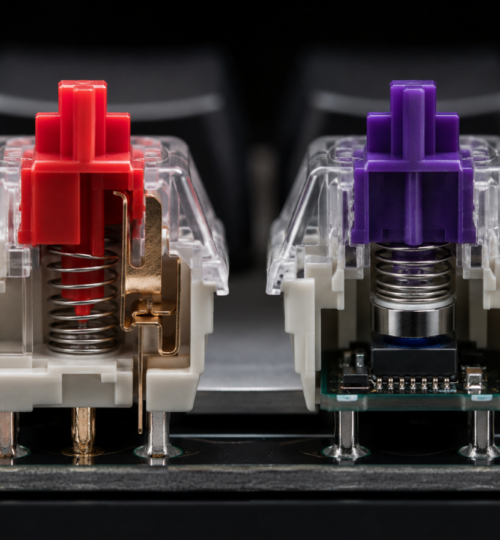
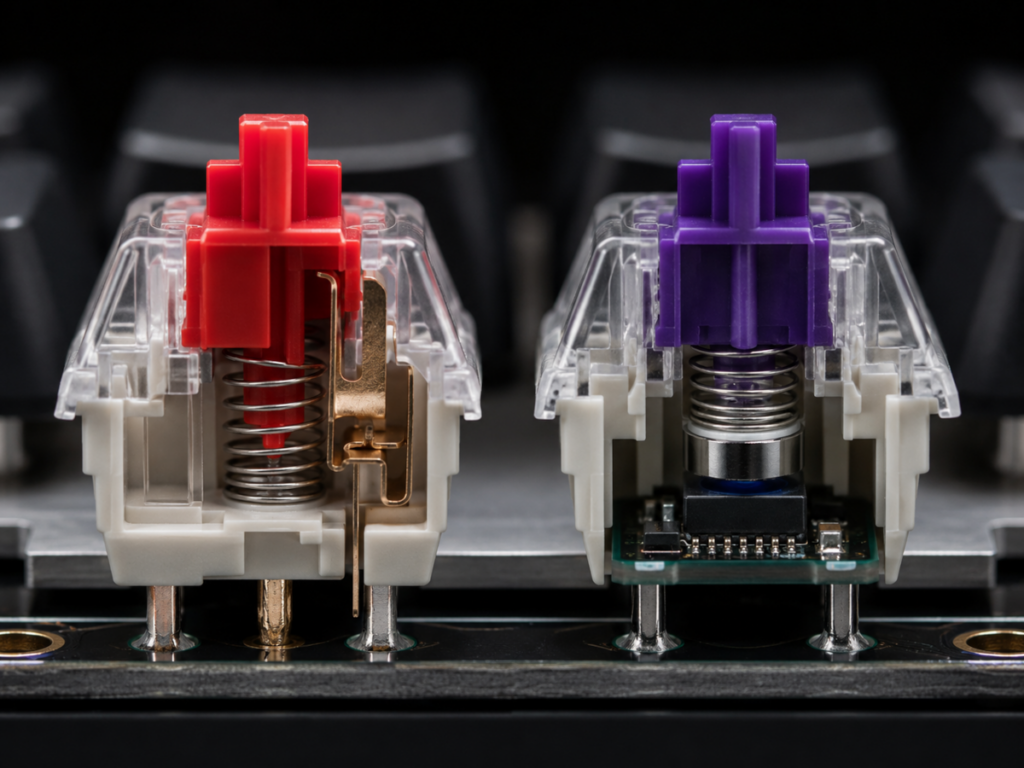
A conventional mechanical switch is an elegant device, and its longevity explains why it dominated gaming keyboards for so long. A Cherry MX Red uses a physical Gold Crosspoint contact system, with 2.0 mm of pre-travel and 4.0 mm of total travel, while the MX Speed Silver moves that actuation point upward to 1.2 mm with 3.4 mm of total travel. Cherry also specifies a typical bounce time below 1 ms for the current MX2A Red, a reminder that modern contact switches are already highly refined pieces of hardware rather than slow relics.
The limitation is that the physical switch decides where activation and reset happen. Designers can make a switch shallower, lighter, or faster, but once its contact geometry is built, the key still behaves around those fixed points. Firmware can debounce the signal and report it quickly, yet it cannot know that the key has moved upward by 0.2 mm unless the switch provides some form of continuous position data.
That distinction matters in games where movement is repeatedly started, stopped, and reversed. A player tapping A and D in a tactical shooter is not merely trying to make the first press happen quickly. The release matters just as much, because the game needs to receive the end of one movement input before the player can cleanly establish the next one. Traditional mechanical switches can be extremely responsive, but their reset behavior remains tied to switch travel.
Hall Effect Turns Every Key Into a Position Sensor
A Hall-effect sensor measures changes in a magnetic field. In a keyboard switch, a small magnet moves with the stem while a sensor on the PCB measures the changing magnetic field as the key travels, allowing the controller to estimate position without relying on a metal contact closing beneath the key. Texas Instruments describes linear Hall sensors as devices whose output varies with magnetic-field strength, which is why the same sensing principle can be used to track physical displacement.
That gives the keyboard a stream of positional information instead of a single electrical event. The firmware can decide that W should actuate at 0.4 mm, a utility key should wait until 2.0 mm, and another key should trigger a second action deeper in the stroke. SteelSeries’ current OmniPoint 3.0 implementation, for example, offers adjustable actuation from 0.1 to 4.0 mm, while Corsair’s MGX switches allow 0.4 to 3.6 mm adjustment in 0.1 mm steps. Keychron’s Q1 HE 8K lists a 0.1 to 3.35 mm actuation range and Rapid Trigger support.
This is the real reason magnetic keyboards moved beyond the old “faster switch” race. The switch stopped being a fixed instruction and became an input sensor that software could interpret.
Rapid Trigger Was the Feature That Made Players Care
Adjustable actuation existed before the modern Hall-effect boom. SteelSeries announced the original Apex Pro in May 2019 with magnetic OmniPoint switches that let players alter the point at which a key registered, at the time ranging from 0.4 to 3.6 mm. Wooting was developing its Hall-effect Lekker platform during the same period and introduced Rapid Trigger with the Wooting Two Lekker Edition project, then shipped the Wooting 60HE in 2022. Wooting credits rhythm-game players, followed by Valorant and Counter-Strike communities, with helping the feature spread into competitive gaming.
Rapid Trigger changes reset logic. On a fixed mechanical switch, the key normally has to rise past a defined reset position before it can be activated again. With continuous position sensing, firmware can reset the key as soon as upward movement exceeds a configured distance, then allow it to activate again when downward movement resumes. Wooting describes its implementation as dynamic activation and deactivation based on travel distance rather than fixed reset and actuation points.
The competitive value is easiest to feel on movement keys. In Counter-Strike or Valorant, a small reduction in unnecessary key travel can make repeated peeks, stops, and directional corrections feel more immediate, especially for players who already have tight movement timing. Rhythm games benefit for a similar reason: repeated presses can be registered without forcing the key through a large reset loop between every input.
Rapid Trigger also exposed why a single “actuation speed” number never told the full keyboard story. A board can activate at 0.1 mm and still feel bad if the reset behavior is sluggish, the scan implementation is weak, or the firmware adds inconsistency. Competitive keyboards became less about the switch’s printed actuation distance and more about the entire chain from sensor reading to firmware logic to USB report.
Adjustable Actuation Became a Per-Key Competitive Tool
Very shallow actuation sounds ideal until a player tries to type, rest a finger on a key, or use a densely packed cluster of abilities. A 0.1 mm setting can be so sensitive that tiny finger movements become unintended inputs. The advantage of Hall-effect hardware is therefore less about setting every key to the minimum and more about choosing different behavior for different jobs.
Movement keys can be tuned for short actuation and aggressive Rapid Trigger, while reload, interact, grenade, inventory, or push-to-talk keys can use deeper thresholds to reduce mistakes. Some boards also support multiple actions at different depths of the same press. Corsair markets dual-point actuation on its MGX platform, and Wooting’s software has long supported dynamic keystroke behavior that can assign actions to different stages of key travel.
That makes profiles meaningful in a way older gaming-keyboard software often was not. A profile is no longer just lighting, macros, and remaps. It can change the physical behavior of the keyboard for a specific game, then return to a deeper, calmer setup for normal typing.
8,000 Hz Polling Arrived, but Hall Effect Is More Than a Polling Rate
The next marketing battle moved to 8,000 Hz polling. A 1,000 Hz USB polling interval is 1 ms, while 8,000 Hz reduces the interval between reports to 0.125 ms. Wooting’s 80HE scans and reports at up to 8 kHz in Tachyon Mode, Corsair advertises 8,000 Hz hyper-polling on the K70 MAX, and Keychron’s Q1 HE 8K supports 8,000, 2,000, and 1,000 Hz operation.
Those numbers are real, but they should not be confused with total end-to-end input latency. The sensor has to be sampled, firmware has to process the state, the USB report has to reach the system, the game has to process the input, and a rendered frame still has to reach the display. Higher polling can reduce one part of that chain, but 8 kHz does not magically turn every keypress into a 0.125 ms action.
It can also create implementation tradeoffs. Wooting documents cases where some motherboard USB controllers can have startup compatibility problems with its 8 kHz USB Hi-Speed mode, with 1,000 Hz offered as a troubleshooting fallback. That does not make high polling undesirable, but it reinforces the broader point that firmware quality, USB behavior, scanning stability, and calibration matter as much as the headline rate.
The Competitive Feature Race Created a Rules Problem
Once keyboards could interpret motion continuously, manufacturers started adding features that went beyond faster activation and reset. Razer’s Snap Tap, SteelSeries’ Rapid Tap, Corsair’s FlashTap, and Wooting’s SOCD-style options can change how opposing directional inputs are resolved. These features are related to the same analog-input hardware trend, but they are not the same thing as Rapid Trigger.
Valve drew that line sharply in Counter-Strike 2 in August 2024. The company said hardware-assisted counter-strafing and other forms of movement or shooting input automation could be detected on Valve official servers and specifically warned players to disable features such as Snap Tap. Later updates added counter-strafe automation detection options for non-Valve servers as well.
That distinction remains important for competitive players. Rapid Trigger changes when an individual key activates or resets based on its own movement. SOCD or last-input-priority systems can resolve the relationship between two opposing keys on the player’s behalf, which is why tournament operators and game developers may treat them differently. Owning a Hall-effect keyboard does not create a rules problem by itself, but enabling every available firmware feature without checking the game’s policy can.
Magnetic Became a Platform, Not a Single Premium Switch
The first wave of Hall-effect gaming boards felt specialized. By 2026, the ecosystem looks much more like a platform category. Wooting offers full-size, 60-percent, and 80-percent Hall-effect boards; SteelSeries sells its Apex Pro Gen 3 family with OmniPoint 3.0 magnetic switches; Corsair has MGX; Keychron now sells multiple HE models, including an 8 kHz Q-series board.
Switch choice is expanding too, although compatibility is still less universal than with conventional MX-style hot-swap boards. Wooting’s current software can identify and calibrate a long list of third-party magnetic switches, while Keychron specifies that the Q1 HE 8K hot-swap system is compatible with its listed magnetic switch rather than ordinary mechanical switches. Magnetic field strength, polarity, travel geometry, sensor placement, and calibration all affect compatibility, so “hot-swappable” does not automatically mean that any Hall-effect switch will work in any HE PCB.
Hall sensing also introduces its own edge cases. Wooting warns that nearby magnetic objects or magnetized metal surfaces can distort Hall-sensor readings and cause unexpected analog input. These problems are unusual in normal setups, but they are a reminder that contactless sensing removes one class of limitations while creating another set of engineering concerns.
Mechanical Keyboards Still Have a Place
Magnetic switches did not erase the reasons people like conventional mechanical keyboards. Tactile and clicky switch feel, broad switch compatibility, simple hot-swap ecosystems, mature custom-keyboard parts, and straightforward behavior still matter. A player who mainly wants a specific typing feel or who does not care about adjustable reset behavior can use a high-quality mechanical board without giving up meaningful enjoyment or suddenly becoming uncompetitive.
There is also a technical wrinkle in calling Hall effect the only modern answer. Razer’s current Huntsman V3 Pro line uses analog optical sensing rather than Hall-effect magnetic sensors, yet it still provides adjustable actuation and Rapid Trigger because optical hardware can also track key travel without depending on a conventional metal contact. Razer’s August 2026 low-profile Huntsman V3 Pro TKL 8KHz continues that approach with 0.1 to 2.8 mm adjustable actuation and 8,000 Hz polling.
That makes Hall effect the dominant reference point for the current competitive-keyboard generation, but the deeper shift is continuous sensing. Competitive players stopped accepting a switch whose actuation and reset characteristics were permanently decided at the factory. Whether the sensor reads a magnet or a beam of light, the modern performance keyboard is increasingly defined by how precisely it can measure motion and how intelligently its firmware can turn that motion into a clean, legal game input.