
Back in the early days of the Global Warfighter League, our competition system used a traditional rank-based ladder. Players challenged others above them on the ladder in an effort to climb toward the top spot. For example, if the #5 ranked player defeated the #2 ranked player, they would take over the #2 position while the previous #2 player would move down the ladder to #3 (previous #3 becomes #4 and previous #4 becomes #5).
While that system worked well during the early era of online competition, modern esports has largely moved toward Elo-based rating systems instead. Elo provides a more accurate way to measure skill by adjusting player ratings after every match that is based on both the outcome and the strength of the opponent. This creates a more competitive, balanced, and fair environment for today’s evolving esports scene.
What is Elo
The Elo rating system was originally created by Hungarian-American physics professor and chess master Arpad Elo in the 1960s to measure player skill in competitive chess. Instead of relying on fixed ranks alone, Elo dynamically adjusts a player’s rating after every match based on the strength of their opponent and the outcome of the game. Defeating stronger opponents earns more points, while losses against lower-rated opponents carry greater penalties.
Today, Elo-style systems are widely used across competitive gaming and esports because they provide a more accurate reflection of player skill over time. Unlike static rank structures, Elo rewards consistency, adapts to improving players, and helps create fairer matchmaking and competitive ladders. For esports leagues, it offers a flexible and proven way to track performance in fast-moving competitive environments where player skill constantly evolves.
How the GWL Elo System Works
The GWL competition ladder uses an Elo-based rating system to measure competitive performance over time. Every Warfighter begins with a neutral rating of 1200 Elo when they first enlist in a a ladder operation. 1200 Elo is considered the baseline for competitive ladders.
Elo is not just a “points” system. It is a prediction system. The rating tries to estimate how likely one player is to beat another based on the difference between their ratings.
A player with 1200 Elo against another player with 1200 Elo is considered evenly matched. Each player is expected to have roughly a 50% chance to win.
A player with 1400 Elo against a player with 1200 Elo is expected to win more often because the rating gap suggests they have already proven stronger results on the ladder.
The Basic Formula
The GWL system uses the classic Elo formula:
New Elo = Current Elo + K × (Actual Result – Expected Result)
Where:
- Current Elo = the player’s rating before the match
- K = how strongly the match can affect the rating
- Actual Result = what actually happened
- Expected Result = what the system predicted would happen
The actual result is simple:
Win = 1
Loss = 0
Draw = 0.5
So if you win, the formula rewards you. If you lose, it subtracts points. If you draw, it adjusts both players based on whether the draw was expected or surprising.
How the System Predicts a Match
Before ratings change, the system calculates each player’s expected chance of winning.
The formula is:
Expected Score = 1 / (1 + 10 ^ ((Opponent Elo – Your Elo) / 400))
This creates a probability between 0 and 1.
For example, if both players are rated 1200:
- Expected Score = 0.50
- That means the match is considered even.
- If a 1400 player faces a 1200 player, the 1400 player is expected to win around 76% of the time.
That matters because Elo rewards unexpected results more than expected ones.
Why Upsets Matter More
If a highly rated player beats a lower rated player, the system says, “That was expected.” The winner still gains Elo, but not a huge amount.
If a lower rated player beats a higher rated player, the system says, “That was a major upset.” The lower rated player gains more Elo, and the higher rated player loses more.
That is what makes Elo useful. It does not only count wins. It weighs the strength of your opponent.
Beating a stronger opponent is worth more than beating someone the system already expected you to beat.
The K-Factor: Why New Players Move Faster
Global Warfighter League uses a dynamic K-factor.
For a player’s first few matches, their rating moves faster:
- First 5 matches: K = 64
- After 5 matches: K = 32
This means newer players can move toward their proper skill range more quickly. If someone joins at 1200 but is clearly much stronger, the system does not make them grind forever to climb. Their early wins move them faster.
After they have played enough matches, their rating stabilizes and moves at the standard rate.
This helps fight inaccurate early rankings and makes the ladder settle faster.
Imagine two new players:
- Player A: 1200 Elo
- Player B: 1200 Elo
Both are new, so both use:
K = 64
Since they are evenly rated, each is expected to score:
0.50
If Player A wins:
- Player A: 1200 + 64 × (1 – 0.50)
- Player A: 1200 + 32
- Player A: 1232
Player B loses:
- Player B: 1200 + 64 × (0 – 0.50)
- Player B: 1200 – 32
- Player B: 1168
Final result:
- Player A gains 32 Elo
- Player B loses 32 Elo
Now imagine both players have already played at least 5 matches.
They now use:
K = 32
If Player A beats Player B:
- Player A gains 16 Elo
- Player B loses 16 Elo
Final result:
- Player A: 1216
- Player B: 1184
The match still matters, but established ratings move more slowly than fresh ratings.
Now imagine:
- Player A: 1400 Elo
- Player B: 1200 Elo
Player A is expected to win. The system estimates Player A’s expected result at about:
0.76
If Player A wins with K = 32:
- Player A: 1400 + 32 × (1 – 0.76)
- Player A: 1400 + about 8
- Player A: 1408
Player B loses about 8 points:
- Player B: 1192
Because the higher rated player did what the system expected, the Elo movement is smaller.
Now use the same ratings:
- Player A: 1400 Elo
- Player B: 1200 Elo
But this time Player B wins. Player B was only expected to score about 0.24. So the win is a major upset.
With K = 32:
- Player B: 1200 + 32 × (1 – 0.24)
- Player B: 1200 + about 24
- Player B: 1224
Player A loses about 24 points:
- Player A: 1376
That is the heart of Elo: the more surprising the result, the bigger the movement.
Match Score vs Match Result
The current GWL Elo system cares about who won, lost, or drew. The exact score determines the result, but the margin of victory does not increase the Elo gain.
For example:
- Winning 1-0
- Winning 5-4
- Winning 10-0
All count as a win for Elo purposes. The score proves the outcome, but Elo is based on the win/loss/draw result rather than how badly someone won.
Auto-Match: How GWL Uses Elo for Matchmaking
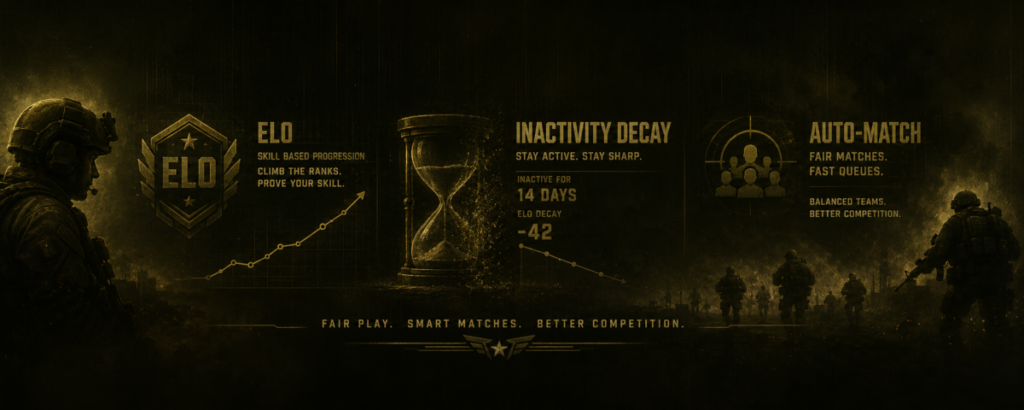
The Auto-match system is designed to streamline matchmaking by removing the friction of manual challenges. When a warfighter hits the “Auto-Match” button within an Operation Hub, the system launches an algorithmic sweep of the active roster. Instead of randomly pairing available participants, the engine dynamically queries the database, evaluating current Elo ratings alongside daily availability and activity to calculate the most optimal combat trajectory. This ensures that warfighters spend less time hunting for opponents and more time on the battlefield.
How heavily Elo influences the final matchup depends entirely on the search protocol the warfighter selects before initializing the search:
Strict Parity: The engine enforces a rigid Elo differential (e.g., prioritizing opponents strictly within 50 points of the user’s current rating). This guarantees a highly balanced and hyper-competitive match, though it may require more time to find a suitable opponent.
Expanded Search: The algorithm begins with strict Elo parameters but gradually widens the acceptable skill gap the longer the search runs. This ensures that a match is eventually found, striking a balance between competitive integrity and wait time.
Active Bounties: This protocol bypasses strict Elo restrictions almost entirely. It prioritizes immediate action over skill parity, directly targeting recently active warfighters to guarantee rapid engagement regardless of rank.
The automatch system compares players by Elo difference:
- Elo Difference = |Player A Elo – Player B Elo|
The vertical bars mean the system uses the absolute difference. It only cares how far apart two ratings are.
For example:
- Player A: 1240
- Player B: 1195
Difference = 45 Elo
That is a close matchup.
“Precision Matchmaking” mode is best for players who want the most balanced competitive fight possible and tries to find the fairest opponent first.
It searches for a player within:
- ±50 Elo
If nobody is available, it expands to:
- ±100 Elo
If no opponent exists within that range, the ‘precision’ search fails instead of forcing a bad match and fallbacks to the next tier “Rapid Matchmaking”.
“Rapid Matchmaking” is more flexible. This mode favors getting a match started over waiting for a perfect rating match.
It first searches within:
- ±200 Elo
If no opponent is available inside that range, the ‘rapid’ search fails and fallbacks to the next tier “Bounty Matchmaking”.
- If all 3 tiers fail, the system compares player availability. If that fails, the system picks a random target.
- If there are multiple targets within a matchmaking tier, the system compares availability and activity level between targets.
It’s important to note that once a player commits to using “Auto-match” by selecting the mode influence, the challenge will not ask for confirmation of your opponent and will initiate a challenge to the selected opponent. The selected user can decline the challenge initially or both players can agree to cancel the challenge in matchcoms. Declining a challenge does not carry a penalty.
Elo Decay for Inactivity
To maintain a highly competitive and accurate ladder, the Global Warfighter League utilizes an automated Elo decay system. Elo decay acts as an inactivity penalty designed to prevent “camping”. This is a scenario where a warfighter reaches a top rank and stops playing to protect their score. As mentioned above, competitors can decline challenges for whatever reason without penalty.
In a dynamic esports environment, a rating should reflect current combat readiness and skill. If a participant goes AWOL and does not compete in any official, ranked matches for a predetermined period by the ladder admin (such as 2 weeks or 30 days), the system begins to gradually reduce their Elo rating (Elo Decay). This ensures that the upper echelons of the ladder are always occupied by active competitors actively defending their positions.
Behind the scenes, this process runs automatically on a scheduled cycle. The infrastructure checks the timestamp of every warfighter’s last verified match against the current date. Once the inactivity threshold is breached, a mathematical decay formula is applied that is typically deducting a set number of points per week of continued absence.
To prevent complete rating obliteration for extended deployments or real-life breaks, the decay eventually halts at a baseline floor, ensuring a returning warfighter doesn’t have to start entirely from scratch. The moment a warfighter successfully enlists and completes a new match, the decay halts, and their rating resumes standard dynamic adjustments.
The default grace period is:
- 21 days
After that, inactive players can lose Elo. The actual grace period depends on the operation’s settings (set by the admin of the ladder).
The available decay styles are:
- Disabled (No Elo Decay)
- -5 Elo per day
- -25 Elo per week
- -50 Elo per week
This prevents top spots from being permanently held by players who stop competing. However, there is a safety net. Elo Decay will not push someone below the lowest active player on the ladder. The goal is not to punish people endlessly. The goal is to keep the ladder active and defended.
In simple terms, If you want to hold rank, you have to defend rank.
Rejoining and Elo Resets
The Global Warfighter League utilizes a persistent database architecture to ensure absolute competitive integrity and prevent leaderboard manipulation. If a warfighter voluntarily withdraws from an active operation, their service record is not deleted; instead, their current Elo rating, wins, losses and Elo decay landmark are completely frozen and held in the system. Should that player attempt to re-enlist within a strict 30-day cooldown period, the engine will automatically restore their previous Elo rating wins, losses and the Elo decay landmark. This ensures that players cannot abandon an operation to escape a dropping rank or artificially reset their standing back to the baseline 1200 Elo.
Furthermore, this 30-day memory lock strictly protects our initial match calibration system. To properly rank new combatants, the engine applies an accelerated Elo multiplier (K variable) during a player’s first five matches. The first 5 matches have a variable of 64 and after 5 matches it calibrates to 32. Because a withdrawn player’s exact match count is preserved alongside their rating, leaving and rejoining will not reset this calibration phase. If a player withdraws after three matches and returns within the 30-day window, they will resume exactly at match four with their historical stats fully intact. There are no free re-rolls on the GWL network, ensuring a fair, accurate, and highly competitive environment for all dedicated warfighters.
TLDR: If a player withdraws from an operation, their record is preserved with a 30 day cool down period. If the competitor rejoins the competition within 30 days, they keep their previous Elo and k variable.
If they wait 30 days or more, they can return with a fresh reset:
- 1200 Elo and K=64
- 0 wins
- 0 losses
This prevents players from rage-quitting and instantly resetting bad results, while still giving long-absent players a clean return path.
Summary
The GWL Elo system is built to reward meaningful wins, punish meaningful losses, and create better competitive matchmaking while penalizing inactivity.
It does not simply count total wins. It asks:
- Who did you beat?
- How strong were they?
- Were you expected to win?
- Was it an upset?
- How established is your rating?
- Are you actively defending your rank?
That gives the ladder more depth than a basic win/loss board.
A player who beats strong opponents will climb faster than someone who only farms easy matches. A player who stops competing can lose standing through decay. And new players can rise or fall quickly during their early calibration matches.
The result is a ladder that rewards activity, fair competition, and proven performance.