
Disclaimer: The views and opinions expressed in this article are solely those of the author. The mention of any products, services, or methods does not constitute an endorsement.
A new cave in Deep Rock Galactic can turn a familiar mining objective into a scramble for higher ground. A new planet in No Man’s Sky might offer a striking view but little reason to remain once its resources have been collected. Both environments are procedurally generated, yet the experiences they create can differ sharply. The difference points to a recurring design problem: generated variety is only as valuable as the play it creates.
Procedural generation allows developers to create more playable space and more possible arrangements than they could reasonably build by hand. It can also expose the limits of a game’s underlying systems when players repeatedly encounter different scenery wrapped around familiar tasks. The deciding factor is whether generated content changes what players can do, what they must consider, or how they interact with one another.
What Procedural Generation Actually Controls
Procedural content generation, or PCG, uses algorithms and defined rules to assemble elements of a game. Depending on the project, those elements might include terrain, room connections, enemy placement, loot, vegetation, or entire planetary surfaces. Developers still establish the building blocks and constraints, and the generator produces combinations within those boundaries. The technology can support tightly structured levels and enormous open worlds, though the engineering problems are different.
Many systems begin with a seed, a numerical value used to initialize pseudorandom generation. The same seed can reproduce a particular result when the game’s rules and version remain unchanged, making generated content possible to share or recreate. Other systems mix fixed, handcrafted locations with variable terrain or randomized placement. These systems may look unpredictable to the player even while following highly deliberate instructions.
The useful question is what a particular game asks its generator to accomplish. A roguelike needs encounters that remain readable while their arrangement changes; a survival sandbox needs terrain that supports building, travel, and resource gathering. A competitive map has another requirement entirely: variation cannot casually give one team an advantage before a match begins. A generator that works well for a dungeon crawl may be unsuitable for a tournament map, even if both produce technically playable spaces.
Spelunky: Unpredictable Levels, Dependable Rules
Spelunky generates fresh levels for repeated runs, but the behavior of its traps, enemies, and movement systems remains consistent. Players can learn what a shopkeeper will do, how a hazard activates, and which routes are physically possible. That knowledge is useful even when the next level looks unfamiliar. The tension comes from applying established skills to arrangements that cannot be memorized in advance.
During a 2011 Game Developers Conference talk, creator Derek Yu described assembling levels from specific room types while adding randomization within them, as reported in Game Developer’s account of the presentation. Handcrafted room patterns help keep the terrain intelligible, while their combinations create unexpected circumstances. A reward might require crossing a dangerous area, or a familiar enemy could become more threatening because of its position beside a trap. The player must decide how much risk a particular opportunity warrants.
That design makes procedural generation part of the skill system. Memorizing a level offers limited protection, but understanding interactions and conserving resources pays off repeatedly. Spelunky achieves this without demanding endless geographical scale. Its relatively small spaces generate difficult choices because positioning and timing have consequences. A missed jump or a badly judged detour can alter an entire run.
Deep Rock Galactic: Terrain That Changes the Team’s Job
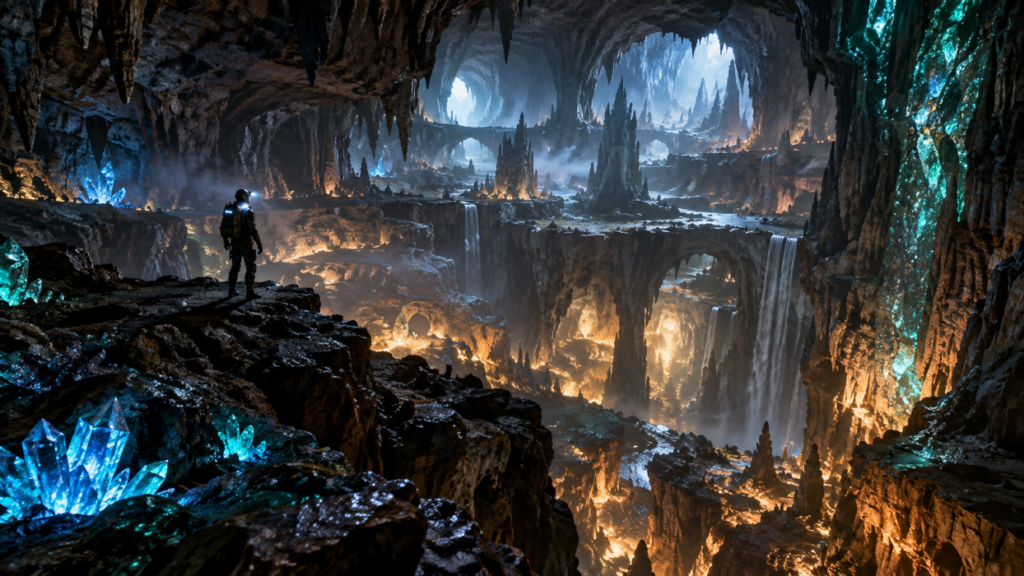
In Deep Rock Galactic, an unfamiliar cave can reshape a cooperative mission before the first firefight begins. A mineral deposit high above the floor calls for different movement tools than one tucked behind a narrow passage. A swarm entering a spacious cavern creates different pressures from the same enemies charging through a constricted tunnel. Procedural geography matters because the team must respond to it, often by changing a route or dividing responsibilities.
Ghost Ship Games explained the underlying system in a September 2024 developer post about cave generation. Its generator draws from more than 100 handcrafted room templates, many with their own internal variations, and connects or modifies them according to mission requirements. Rooms may be warped, mirrored, or overlapped to produce much larger caverns. The results vary, but they emerge from components the designers have already shaped.
The four classes make that changing terrain consequential. Scouts can reach distant positions with grappling hooks, Engineers build platforms, Drillers cut through rock, and Gunners establish routes across gaps with ziplines. Depending on a cave’s layout, the practical value of those abilities changes from one expedition to the next. The generator creates problems the game’s cooperative mechanics are equipped to solve. That relationship gives each new map a purpose beyond looking different.
Minecraft: A Generated World Players Can Rewrite
Minecraft benefits from a particularly strong connection between world generation and player agency. Mountains, rivers, cave networks, and resources arrive through procedural systems, but the player decides what becomes of them. A steep ridge might block an expedition, protect a settlement, or provide material for a construction project. The usefulness of a location changes as the player changes it, and the result is visible long after the initial discovery.
Mojang’s November 2021 Caves & Cliffs: Part II release illustrates how much generated terrain affects play. The official Java Edition 1.18 notes document expanded world heights, revised underground spaces, new cave types, and changed ore distribution. These were structural adjustments as well as visual ones. Exploration routes, mining decisions, and building opportunities all shifted with the terrain.
A world becomes personally memorable through what happens on its generated ground. The mountain where a group built a fortress has a history that another, equally dramatic mountain does not. On multiplayer servers, roads and settlements turn otherwise arbitrary geography into shared landmarks. Procedural generation supplies the starting conditions; building and collective activity give places their identities.
No Man’s Sky: Enormous Variety Has a Ceiling
No Man’s Sky operates at a scale few handcrafted projects could approach, generating a vast universe of planets with varying terrain, creatures, vegetation, and environmental conditions. The first encounters with unfamiliar worlds can be visually rewarding, particularly when unusual geography or weather changes the mood of exploration. Yet recognizable resource loops and repeated patterns can reduce the surprise of later discoveries. A large number of possible combinations does not necessarily produce the same number of distinct experiences.
Hello Games has continued adjusting the system rather than treating the original generation rules as finished. Its July 2024 Worlds Part I update expanded planetary diversity and revised elements such as clouds, water, environmental effects, and flora. Those changes broadened what players might encounter, while other game systems provide reasons to remain on a planet. Base building, exploration, and survival can make a location worth returning to after its initial novelty fades.
There is still a practical limit to what visual variation can accomplish. Two planets may look dramatically different while offering similar decisions about gathering resources and moving between objectives. Discoveries gain more lasting value when environmental differences affect tactics, construction, or available activities. At that scale, even small changes to movement, shelter, or resource access can do more for replayability than another set of visual combinations.
Starfield: The Cost of Reused Discoveries
Starfield places extensive handcrafted quests and locations inside a setting with more than a thousand explorable planets and moons. Its procedurally generated terrain helps support that scale, while many points of interest draw from a pool of designed locations. This approach can populate a wide universe efficiently, but repeated facilities become conspicuous when the same arrangement appears across distant worlds. The player’s expectation of discovery is difficult to sustain once the underlying template becomes obvious.
That criticism was present at launch in September 2023. In a TechCrunch review of Starfield, Devin Coldewey described encountering copies of the same facilities, with matching layouts and environmental details, on separate planets. The observation captures the difficulty of distributing a finite set of authored spaces across a much larger generated setting. A second visit to an identical installation offers little of the uncertainty that made the first interesting. Once a player recognizes the room sequence and object placement, the fiction of finding an unfamiliar place breaks down.
The repetition stood out partly because exploration had long been associated with Bethesda’s distinctive environmental design. In Skyrim and the Fallout series, wandering away from a quest can lead to a location with its own layout and story details. Starfield still offers substantial authored content, but its widely distributed points of interest can separate travel from the kind of surprising discovery players associate with those earlier games. That is a design tradeoff, not evidence that every procedurally supported location fails.
Bethesda has since changed elements of the experience. Its April 2026 Free Lanes update introduced free flight between planets within star systems, additional encounters, and more variety among planetary points of interest. These changes directly address aspects of travel and discovery that attracted criticism. Maintaining interest across a setting of that size remains difficult when the volume of explorable space outpaces the variety of events it contains.
Competitive Multiplayer Needs More Than Random Fairness
For competitive multiplayer, procedural variation creates an additional problem: an exciting map can still be an unfair one. Unequal spawn protection, travel times, sightlines, or access to elevated positions may favor one side before the first exchange of fire. The stakes differ from cooperative games, where players can work together to overcome an awkward environment. Ranked matches and tournaments need starting conditions that make performance reasonably comparable.
Fixed competitive maps support preparation in ways constantly regenerated spaces do not. Teams rehearse rotations, study sightlines, and develop tactics around known geometry. Players can also review a loss knowing that their opponents faced the same layout. Changing the map every round would introduce more surprises, but it could diminish the value of some forms of practiced coordination.
Controlled procedural maps could still have a place in organized play. A generator might enforce bounds on spawn distances, objective access, cover, and available routes, then reject layouts that fail specified tests. Researchers have explored related ideas: a 2024 paper in IEEE Transactions on Games describes using reinforcement learning and repeated simulations to adjust tile-based two-player levels toward balance goals. This is research on a defined model, rather than proof that an algorithm can guarantee fairness in a complex commercial shooter.
Tournament organizers could also validate generated maps ahead of time and publish or preserve their seeds, allowing every team to practice under equivalent conditions. That would retain variation across events while protecting competitive consistency within an event. Whether this improves a particular game depends on how much its competitive depth comes from mastering a stable map. Such a format would require clear rules about which seeds qualify and how much advance practice teams receive.
When Randomness Stops Producing New Decisions
A generator can assemble many distinct dungeon layouts while producing surprisingly few distinct fights. If the same enemies require the same responses and rewards rarely alter a build, changing corridor shapes may simply make the route to a familiar encounter longer. More permutations can disguise a shallow decision set for a while. Experienced players eventually learn which differences affect their strategy and which are cosmetic.
Procedural storytelling faces a similar challenge. A carefully placed body, damaged console, or abandoned camp can imply a specific event, but reusing the same details in unrelated locations may undermine that story. Systems that assemble such scenes need rules about where their components belong and what those components mean together. Otherwise the generator can distribute narrative clues without preserving the relationships that make them convincing.
This is also why randomness must be constrained by actual gameplay tests. A level may be reachable from start to finish and still produce tedious routes, awkward enemy placement, or long stretches without meaningful interaction. Automated checks can catch disconnected passages or inaccessible objectives, while simulation can expose some balance problems. Human playtesting is still needed to judge pacing, readability, and whether a sequence produces decisions worth making. A mathematically valid map can be perfectly forgettable.
Giving Generated Places a Reason to Matter
Successful procedural systems leave substantial work for designers. They require dependable components, rules for combining those components, and enough testing to expose combinations that are technically valid but unsatisfying. Designers also need to understand how players adapt after repeated sessions, when once-surprising formations become familiar patterns. A generator’s value should be measured against the experiences it sustains, rather than the number of outputs it can produce.
Long-running worlds complicate the work further. Updates to generation rules must account for old saves, established bases, and multiplayer settlements built under earlier versions. Players may have invested years in specific terrain or structures, making continuity part of the design problem. Changing the generator can refresh unexplored areas, but careless changes can also disturb places communities have already claimed as their own.
On a persistent multiplayer server, a generated canyon might become a trade route, a defensive boundary, or the site of a long-running rivalry. Its geometry matters initially because it shapes movement and visibility; later, its importance may come from the decisions people made there. Supporting that history requires more than generating terrain, especially when world updates risk altering routes and settlements. Systems that preserve player-built changes give communities a chance to turn algorithmic places into locations worth returning to.