
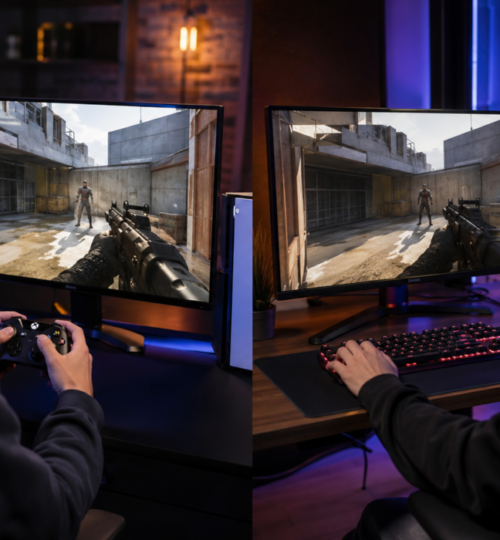
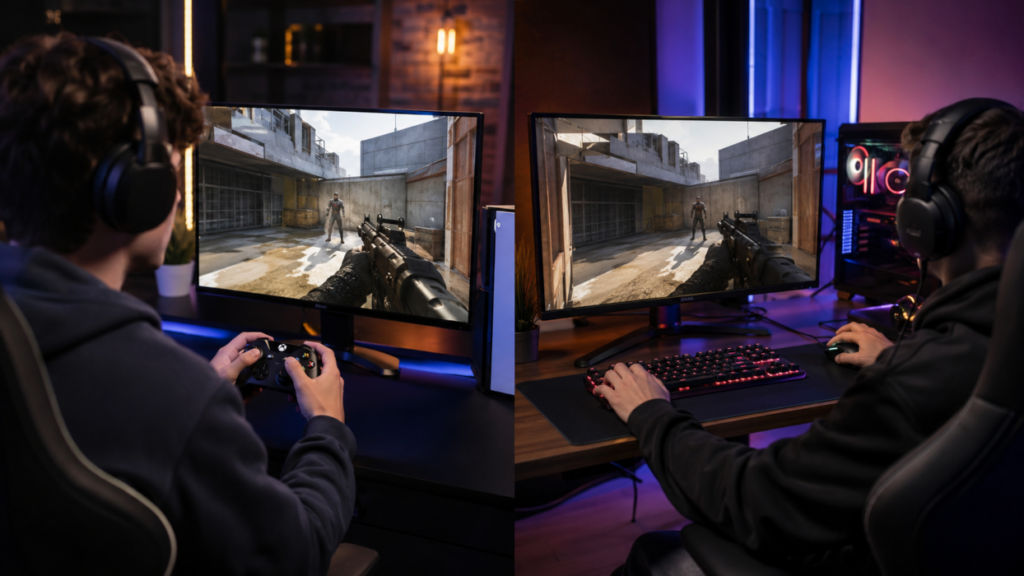
Cross-play solved one of multiplayer gaming’s oldest problems. Friends no longer need matching hardware to stay together, and publishers can combine several platform populations into healthier matchmaking pools. The tradeoff is now impossible to ignore. A thumbstick and a mouse do not aim the same way, yet both are expected to compete inside the same gunfight.
That mismatch has turned aim assist into one of the most bitter arguments in modern shooters. Mouse players see rotational tracking react faster than human hands can. Controller players point out that a small analog stick cannot match the speed, precision, and range of a mouse. Both sides are right, which is exactly why the argument refuses to die.
In 2026, developers are no longer treating aim assist as a simple on-or-off feature. The stronger studios are breaking it into separate systems, measuring performance by range and skill level, changing strength according to platform, and placing stricter rules around ranked play. The goal is not identical input behavior. That is impossible. The goal is competitive outcomes that do not make either side feel like the game is playing favorites.
Aim Assist Is Not One Mechanic
The phrase “aim assist” often gets used as though it describes a single invisible magnet. Most modern shooters combine several separate behaviors. Slowdown reduces reticle speed while the crosshair passes over or near a target. Rotational assistance helps the camera follow a moving opponent while the player is also moving or applying stick input. Adhesion can make the reticle feel resistant to leaving the target. Bullet magnetism changes where a shot may register relative to the visible crosshair. Some games also adjust assistance by weapon type, distance, zoom level, target movement, or whether the player is aiming from the hip.
That distinction matters. A controller may need slowdown to make small corrections possible, while overly responsive rotational assistance can dominate close-range tracking. A mouse may own long-range flicks and rapid target switching, while losing a point-blank strafe fight because software reacted to a direction change before the mouse player could.
The worst public debates compare total controller accuracy against total mouse accuracy without separating distance, weapon class, skill bracket, frame rate, and platform. Aggregate numbers can hide the actual problem. A system may look fair across an entire match while still producing ugly close-range encounters that feel automated.
Call of Duty Is Requiring More Player Participation
Call of Duty has spent years at the center of the input debate because its fast time-to-kill, aggressive movement, and heavy cross-platform population expose every weakness in the system. By the Black Ops 7 and Warzone cycle, the developers had moved toward a more conditional form of rotational assistance.
Black Ops 7 introduced a right-stick aiming requirement for maximum rotational aim-assist strength. Players who were not actively using the right stick, or were not tracking effectively, received a lower level of rotational help. Warzone inherited those changes with its Season 01 integration. The developers described the intent as creating a more competitive experience across inputs.
That is a meaningful design shift. Traditional rotational assistance could reward left-stick movement while the right stick did very little. A player could strafe and receive strong tracking response simply because movement activated the system. Requiring useful right-stick input does not remove assistance, but it asks the player to contribute more directly to the tracking process.
This approach attacks one of the most common mouse-player complaints without making controller aiming miserable. It also gives developers more tuning points. Maximum rotational strength, minimum strength, activation range, stick thresholds, and tracking quality can all be adjusted separately.
Call of Duty is also treating input manipulation as an anti-cheat issue rather than a balance quirk. A February 2026 RICOCHET update announced new detections for unauthorized third-party input-modification devices ahead of Ranked Play. That matters because devices that disguise mouse input as controller input can combine mouse precision with controller assistance. No balance model survives once the game cannot trust what input it is reading.
Apex Legends Uses Different Rules for Different Lobbies
Apex Legends made one of the industry’s clearest admissions in 2024. Respawn said its encounter data and player experience both indicated that aim assist was too strong in PC lobbies. The studio reduced controller-on-PC aim assist by 25 percent, reduced assistance for console players entering PC cross-play lobbies by 18 percent, and applied a 22 percent reduction for console performance mode in those PC lobbies. Console-only lobbies were left unchanged.
That model remains one of the smartest compromises available. Console players who stay inside console matchmaking keep a more generous assistance profile. The moment they join the more demanding PC pool, the game applies values intended for that environment.
Apex also gives private-match administrators an aim-assist override that forces PC values across the lobby. Competitive organizers need that kind of control. A tournament cannot claim consistent rules if one controller receives stronger assistance because it is connected through a console while another receives weaker assistance on PC.
The important lesson is that parity does not require one universal setting. It may require several settings tied to the competitive context. Public console play, mixed casual play, high-level ranked competition, and tournament matches do not have identical needs.
Respawn has also shown why frame rate belongs in the discussion. Earlier performance-mode tuning was designed to make high-frame-rate console aim assist feel more like the 60Hz mode. A system that updates or responds differently at 120 frames per second can create a hidden advantage even when the displayed strength value appears unchanged.
Halo Shows the Value of Weapon-Level Tuning
Halo has always mixed strong controller traditions with a serious mouse audience. Its long time-to-kill places a premium on sustained tracking, which makes input balance especially sensitive. Winning a fight often requires maintaining several accurate shots rather than landing one fast flick.
Halo Infinite has exposed aim-magnetism controls for both controller and keyboard-and-mouse settings, giving players clearer control over how assistance behaves. More importantly, Halo Studios has repeatedly tuned aim-assist angle, range, and falloff at the weapon level. In one ranked update preview, the studio reduced auto-aim angle and shortened both aim-assist range and falloff range for a weapon that was performing too comfortably outside its intended distance.
Weapon-level tuning is often better than cutting every controller value across the board. A shotgun, burst rifle, sniper rifle, and automatic sidearm create different input problems. Strong slowdown may be reasonable on one weapon and oppressive on another. A broad reduction can fix close-range tracking while accidentally making precision weapons frustrating for ordinary controller users.
This is where many balance discussions become too crude. Players ask whether aim assist should be “stronger” or “weaker,” but the better question is where, when, and on which weapon it becomes excessive.
Matchmaking Rules Can Do What Balance Values Cannot
Input-based matchmaking remains the cleanest competitive answer, but it comes with a cost. Splitting players by controller and mouse can increase queue times, widen skill gaps, and damage smaller regional populations. It can also separate friends who intentionally play together across devices.
A practical 2026 system needs layers. Casual playlists can prioritize fast queues and party access. Ranked modes can prefer input matching, then expand only after a defined wait. Tournament modes can lock input values and require declared devices. Console-only pools can preserve stronger controller settings, while mixed PC pools use reduced values.
The system should also display what happened. Players deserve to know whether a match is input-restricted, input-preferred, or fully mixed. Hidden rules create conspiracy theories. Clear rules let the community judge the actual design.
Studios already collect enormous amounts of combat data, but public communication often stops at vague claims about fairness. Better reporting would separate close-range accuracy, long-range accuracy, tracking duration, target-switch time, headshot rate, and encounter win rate by input and skill bracket. Raw accuracy alone is not enough. A low-skill controller player and a professional mouse player should not be blended into one number and presented as proof.
Ranked Play Needs Stricter Standards Than Casual Cross-Play
Casual multiplayer can tolerate some imbalance because social access matters. A group of friends should not be broken apart because one person owns a console and another owns a PC. Ranked play has a different job. It is supposed to measure performance under stable rules.
That means ranked systems should identify the active input at match start, block mid-match switching, detect spoofed devices, and disclose whether mixed-input matchmaking is active. Players using accessibility hardware should have a supported exception process rather than being forced into the same category as cheaters.
Competitive modes should also avoid quietly changing aim-assist values without patch-note detail. The community will discover the change through testing anyway. Secrecy only makes the reaction worse.
Tournament organizers need still more control. Private lobbies should offer fixed aim-assist profiles, device reporting, spectator-visible input indicators, and logs showing any input change. Apex’s ability to force PC aim-assist values across private matches is a strong example of the direction esports tools should take.
The Next Fight Is Input Authenticity
The balance argument is becoming inseparable from hardware verification. Mouse adapters, recoil scripts, programmable controllers, rapid-fire macros, and input-spoofing devices can all distort the data developers use to tune assistance.
A player using a mouse that reports itself as a controller is not part of the controller-versus-mouse debate. That player is bypassing the rules. The same applies to automated recoil control or scripts that manufacture stick movement to trigger rotational assistance.
Call of Duty’s 2026 push against unauthorized input-modification devices shows that publishers increasingly recognize the threat. Detection must be paired with careful enforcement, because false positives involving accessibility devices would be damaging. Still, leaving spoofing unchallenged poisons ranked statistics and makes legitimate controller players look stronger than they really are.
The next generation of cross-play systems will need to verify not only which device is connected, but whether the reported movement resembles authentic use. That likely means server-side behavioral detection, firmware partnerships, tournament inspection, and clearer device policies.
Perfect Parity Is the Wrong Target
A mouse and a controller will never produce the same mechanical experience. Mouse input offers rapid direction changes, broad movement space, and direct positional control. Controller input offers analog movement, consistent ergonomics, and a smaller aiming surface that usually needs software assistance.
Developers should stop promising equality through one magic percentage. Better balance comes from limiting rotational response, requiring meaningful right-stick participation, tuning assistance by range and weapon, scaling values for mixed lobbies, separating ranked rules from casual rules, and removing spoofed inputs from the data.
The strongest 2026 systems are not asking whether controller players deserve aim assist. They are measuring how much assistance is needed, where it should stop, and how much of each gunfight must still come from the player.