

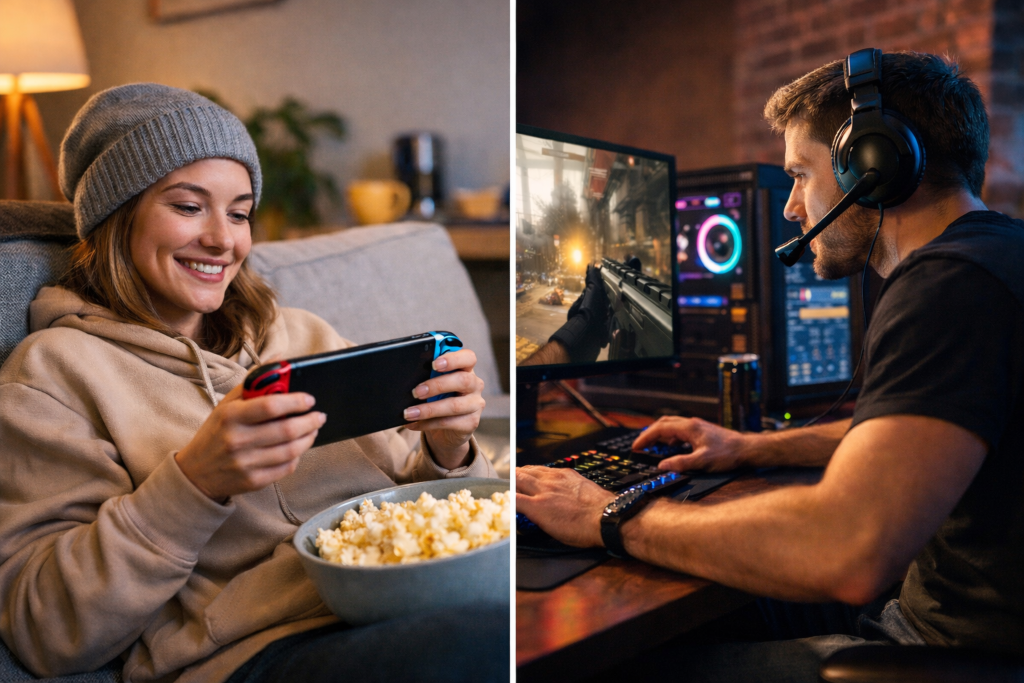
Few debates in gaming have lasted as long or burned as brightly as the supposed divide between “casual” and “hardcore” players. The argument appears in comment sections, social media threads, and gaming forums almost every week. One side claims games are becoming too easy, too simplified, or too focused on accessibility. The other side pushes back, arguing that games should be welcoming to everyone and not designed exclusively for people with unlimited time or elite skill.
The strange thing about this debate is that it never truly resolves. The same arguments repeat across decades, across genres, and across entirely different generations of hardware. Yet if you step back and look closely at how people actually play games, the line between casual and hardcore becomes far less clear than the debate suggests.
In many ways, the war itself is an illusion.
Where the Divide Came From
The roots of this debate go back to the early days of gaming culture. During the arcade era of the late 1970s and 1980s, games were designed around challenge and repetition. Difficulty was not just a design choice. It was part of the business model. If a player lost quickly, they inserted another coin. Titles like Galaga, Defender, and Ghosts ‘n Goblins became famous for their punishing difficulty curves.
When home consoles and personal computers entered the scene in the late 1980s and early 1990s, that design philosophy carried over. Many early console games were extremely difficult. Limited saves, scarce checkpoints, and unforgiving mechanics were common. Players who mastered these systems built reputations within their communities. Skill became a badge of honor.
By the late 1990s and early 2000s, online gaming added another layer. Competitive titles such as Counter-Strike, StarCraft, Quake III Arena, and Unreal Tournament helped create organized communities built around competition, rankings, and mastery. Players who invested thousands of hours into these games naturally began to distinguish themselves from those who played only occasionally.
The label “hardcore gamer” emerged from that culture. It often referred to players who invested significant time, learned complex mechanics, and competed seriously.
At the same time, the industry was growing rapidly. Consoles were reaching millions of households. Game publishers began looking beyond the traditional enthusiast audience. Titles designed for broader audiences began appearing more frequently, especially as gaming moved into the 2000s.
This shift is when the “casual gamer” label began to appear more often.
The Industry Expansion
One of the most significant turning points came during the mid 2000s with the rise of more accessible gaming platforms. Nintendo’s Wii is often cited as a major example. Released in 2006, the console used motion controls and emphasized social play. Games like Wii Sports reached audiences that had never considered themselves gamers before.
Mobile gaming pushed this expansion even further. When smartphones became widespread, games suddenly existed on devices people carried everywhere. Titles like Angry Birds, Candy Crush, and Clash of Clans reached hundreds of millions of players globally.
To longtime enthusiasts, this shift sometimes felt like a cultural takeover. The games dominating download charts were simple, colorful, and designed around short sessions rather than long competitive play.
This is when the rhetoric surrounding casual versus hardcore intensified. Some players worried that the industry was abandoning complexity and depth in favor of accessibility and mass appeal.
However, something interesting happened at the same time. Hardcore gaming did not disappear. It expanded alongside casual gaming.
The Growth of Both Worlds
While mobile gaming exploded, competitive gaming was undergoing its own transformation. Online multiplayer infrastructure improved dramatically. Broadband internet became standard in many regions. Digital storefronts made it easier for players to access games and updates. During this period, esports began to emerge as a legitimate global phenomenon.
Games like League of Legends, Dota 2, Counter-Strike: Global Offensive, and StarCraft II built enormous competitive scenes. Prize pools grew into the millions. Professional teams formed across North America, Europe, Asia, and beyond. Tournaments filled arenas and attracted massive online audiences.
Streaming platforms also changed how players interacted with competitive games. Watching skilled players became entertainment in its own right. In other words, the so called “hardcore” side of gaming was not shrinking. It was becoming more visible than ever.
The two ecosystems were simply growing at the same time.
The Myth of the Two Types of Gamers
The biggest flaw in the casual versus hardcore debate is the assumption that these are two completely separate groups of people. In reality, most players move between both worlds constantly.
A person might spend hours mastering ranked matches in a competitive shooter one week and then relax with a simple puzzle game on their phone during a commute the next week. Another player might enjoy an expansive role playing game on weekends but play quick mobile titles during lunch breaks.
Time availability often determines play style more than personal identity. A college student with long evenings free might dive deeply into competitive multiplayer. That same person ten years later, juggling work and family responsibilities, might play shorter single player experiences instead.
Their identity as a “gamer” has not changed. Their schedule has. Yet the debate often treats these shifting behaviors as if they represent entirely different populations.
Game Design Is Not One Size Fits All
Another reason the argument persists is that games themselves vary widely in their goals. Some titles are built around mastery. Competitive shooters, strategy games, and fighting games often fall into this category. These games reward long term investment and mechanical skill.
Other games focus on storytelling, exploration, or relaxation. Narrative driven adventures, cozy farming simulators, and puzzle games prioritize different types of engagement. Neither design philosophy invalidates the other.
A game designed for deep competitive play does not need to appeal to everyone. Likewise, a game built for accessibility and short play sessions does not need to satisfy tournament level competitors.
The industry has matured enough to support both. In fact, the diversity of game design is one of gaming’s greatest strengths.
The Internet Amplifies the Conflict
If the divide is not as clear as people claim, why does the argument keep resurfacing? One reason is the structure of online conversation.
Platforms that reward engagement tend to amplify conflict. A calm discussion about game design rarely spreads as widely as a heated argument about whether games are becoming “too easy” or “too complicated.”
As a result, the casual versus hardcore debate becomes a reliable source of controversy. Every new game release can reignite the discussion. Difficulty settings, accessibility features, monetization models, and matchmaking systems all become flashpoints.
But these arguments often represent a vocal minority rather than the broader player base. Most players simply play the games they enjoy.
Accessibility and Skill Can Coexist
One area where the debate becomes more productive is accessibility. Over the past decade, many developers have worked to make games more inclusive for players with different physical abilities, skill levels, and time constraints.
Features such as customizable difficulty settings, visual aids, and control remapping have helped expand who can participate in gaming experiences.
Critics sometimes worry that these changes dilute the challenge that defines certain games. Supporters argue that accessibility features allow more players to enjoy the same experiences. In practice, many games manage to do both.
A title can offer accessibility options while still preserving high skill ceilings for competitive play. Competitive modes, ranked ladders, and optional difficulty settings allow players to choose how they engage with a game.
This flexibility reflects the reality that players themselves exist along a spectrum of experience and skill.
Competitive Culture Is Still Thriving
For those concerned that gaming is becoming less competitive, the evidence suggests the opposite. Competitive ecosystems are larger and more organized than ever. Global esports tournaments draw millions of viewers. Online matchmaking systems connect players across continents. Amateur leagues and community tournaments continue to emerge for games both new and old.
The tools for competitive play have improved dramatically since the early days of online gaming. Modern infrastructure allows communities to track rankings, organize matches, and build long term rivalries with far greater ease.
In many ways, the spirit that drove early competitive communities has simply evolved into new forms.
What Actually Matters
Ultimately, the casual versus hardcore debate often misses a simpler truth. Gaming is not a single experience.
It is an ecosystem made up of countless genres, communities, and play styles. Some players chase mastery and competition. Others seek relaxation or storytelling. Many move fluidly between those experiences depending on mood, schedule, or the type of game they are playing.
The industry no longer revolves around one definition of what a gamer should be. And that is not a weakness. It is a sign of maturity.
The diversity of gaming audiences has allowed the medium to grow far beyond its early niche. More developers, more genres, and more communities now exist than at any previous point in gaming history.
The supposed war between casual and hardcore players continues to flare up online from time to time. But the reality on the ground tells a different story. Most players are not fighting that war.
They are simply playing games.