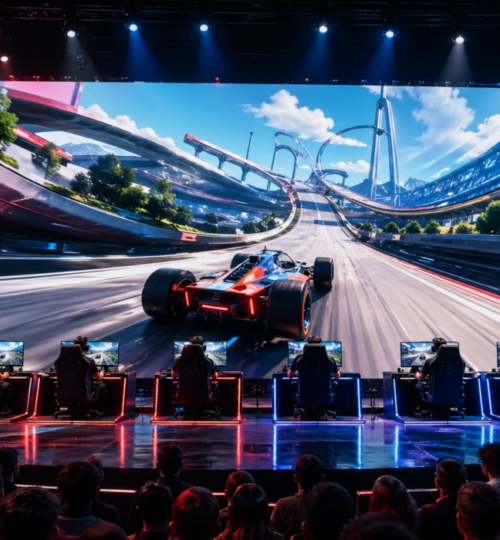
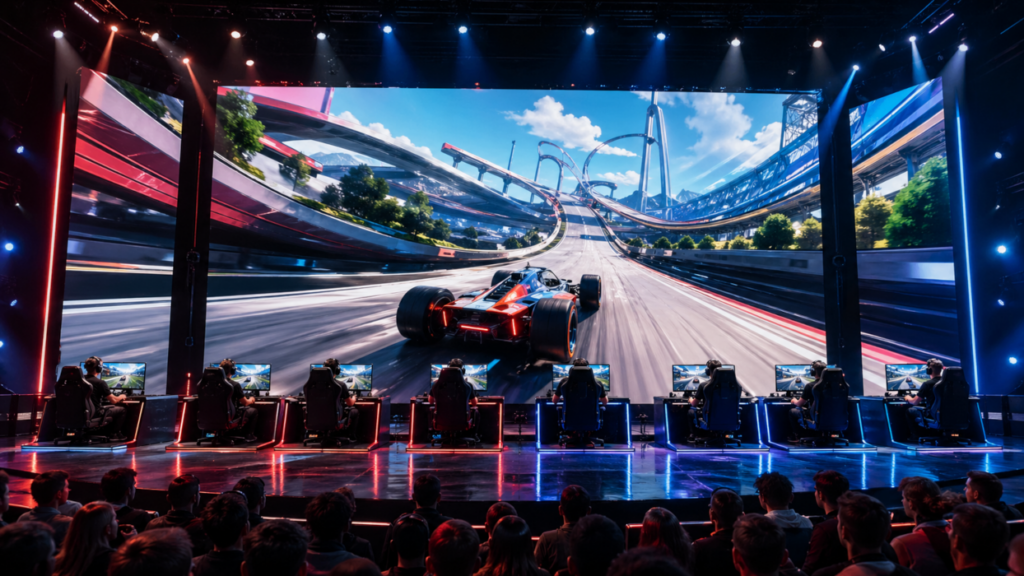
There are esports titles that thrive on strategy, team coordination, hero picks, utility usage, economy management, aim duels, and patch mastery. Then there is Trackmania, a game that strips competition down to one of the cleanest questions in gaming: who can drive the perfect line?
That simplicity is exactly why Trackmania’s arrival at the 2026 Esports World Cup feels bigger than just another game being added to a massive global event. It represents the return of a very old competitive idea to a very modern stage. Before esports became a heavily franchised, broadcast-first industry, communities were built around ladders, time trials, leaderboards, ghost runs, demo files, and the belief that a better player could prove it one attempt at a time.
For a legacy multiplayer community founded in 2004, that DNA feels familiar. Trackmania has always belonged to the same family of competition that powered early online ladders and grassroots tournaments. It is easy to understand, brutally difficult to master, and endlessly replayable. At its highest level, it turns fractions of a second into full-blown drama.
Now, with Trackmania officially joining the Esports World Cup 2026 lineup, that drama is heading to one of the biggest stages in modern esports.
Trackmania Enters the Esports World Cup Era
The Esports World Cup Foundation announced that Trackmania will make its official EWC debut in 2026 through a multi-year partnership with Ubisoft and Ubisoft Nadeo. The event is scheduled for August 17 to August 21, 2026, in Riyadh, Saudi Arabia, as part of the larger Esports World Cup calendar. The Trackmania competition will feature 32 players and a $500,000 prize pool.
That placement matters. The 2026 Esports World Cup itself runs from July 6 through August 23, bringing together more than 2,000 players, 200 clubs, and competitions across 25 tournaments and 24 titles, with a total prize pool exceeding $75 million.
In other words, Trackmania is not quietly sliding into a niche showcase. It is entering a global, multi-title esports festival where fans of shooters, MOBAs, fighting games, sports games, battle royales, and strategy titles will all be watching different pieces of the competitive gaming ecosystem unfold. For racing esports, that visibility is valuable. For Trackmania specifically, it could be transformative.
The EWC announcement frames Trackmania as a precision-focused competition where the world’s best drivers battle through intricate tracks at extreme speed. That description is accurate, but it only scratches the surface. Trackmania is not just about going fast. It is about repeating a track until the impossible begins to feel possible, then discovering that someone else has done it one hundredth of a second better.
Why Trackmania Fits the World Cup Stage
Trackmania has always had a strange magic to it. On the surface, it looks approachable. Cars race on bright, clean, often gravity-defying tracks. The controls are simple compared to traditional racing simulations. There are no tire compounds to manage, no pit strategy, no car tuning menus that scare away casual players. Then the timer starts.
Suddenly, every turn matters. Every landing angle matters. Every wall tap, drift initiation, air brake, and micro-correction can separate a good run from a world-class one. The beauty of Trackmania is that viewers can feel the stakes even if they do not understand every technical detail. When two players are separated by milliseconds, the tension is obvious.
That makes the game unusually watchable for a modern esports audience. In a team shooter, a new viewer may not understand why one rotation changed the round. In a MOBA, they may miss the significance of a lane state or cooldown trade. In Trackmania, the story is more immediate. One driver is ahead. One driver is chasing. One mistake can erase everything.
That clarity is powerful on a mixed-esport stage like EWC. The event will attract fans from many different competitive backgrounds, and Trackmania gives them an easy entry point. You do not need to know twenty years of game history to understand a red split, a green split, or a final corner that decides a match.
The Format: Pressure in Four-Player Lobbies
Trackmania’s EWC 2026 format is designed to create pressure early. According to Ubisoft Nadeo’s 2026 esports outline, the event will feature 32 players in a championship structure. The group stage uses four-player lobbies with a double-elimination format, and the top eight players from each group advance into playoffs. From there, 16 competitors move into single-elimination matches to decide the champion in Riyadh.
That format suits the game well because Trackmania is not only a battle against the clock. In esports form, it becomes a battle against nerves. A driver might know the ideal route. They might have practiced the map for hours. They might have a personal best that would dominate the lobby. None of that guarantees execution when the match is live, the margins are microscopic, and one bad landing can send a run into disaster.
Four-player lobbies also make the viewing experience more dynamic. Instead of simply watching one ghost chase another, fans get a compact race environment where multiple elite drivers are creating pressure at once. The double-elimination structure gives players some room to recover, but not enough to relax. Once playoffs arrive, single elimination turns every mistake into a possible exit.
That is the kind of format that can produce breakout stars. Trackmania already has a dedicated competitive scene, but EWC introduces the game to a broader audience that may not know its top names yet. A clutch playoff run, a ridiculous recovery, or a near-perfect final map can turn a specialist into a recognizable esports figure overnight.
A 20-Year Competitive Thread Comes Full Circle
One of the most interesting parts of this debut is how much history sits underneath it. Ubisoft Nadeo’s own esports page notes that 2026 arrives 20 years after the release of Trackmania Nations ESWC and the first Trackmania World Cup in Paris. It also describes 2026 as a year with two major milestones for the game: the Esports World Cup and the Esports Nations Cup.
That is not just trivia. Trackmania Nations ESWC was one of the titles that helped connect racing games with the early esports identity of the mid-2000s. It was fast, free to access, skill-based, and built around competition that anyone could understand. It belonged to an era when competitive gaming communities were still defining what esports could become.
That makes the 2026 EWC debut feel less like a sudden arrival and more like a long loop finally closing. Trackmania was never absent from competition, but it has often existed just outside the biggest mainstream esports conversations. Its community remained passionate. Its skill ceiling remained absurd. Its content creators, mappers, and elite players kept the ecosystem alive. Now the game is stepping into a global spotlight at a moment when esports is once again trying to balance spectacle, sustainability, and grassroots legitimacy.
For older competitive players, that matters. Trackmania’s rise is a reminder that not every esport needs to follow the same blueprint. A game can survive through community, skill expression, and a format that rewards obsession. In a landscape often dominated by shooters and MOBAs, Trackmania brings back the arcade purity of chasing perfection.
Grassroots Access Still Matters
One of the smartest parts of Trackmania’s 2026 direction is the connection between professional competition and in-game access. Ubisoft Nadeo has highlighted that players can train and qualify for major worldwide events directly in-game through weekly cup events on seasonal campaign tracks.
That matters because Trackmania’s competitive identity depends on accessibility. The fantasy is not just watching a professional driver do something unbelievable. The fantasy is loading the same track, trying the same line, and realizing exactly how hard that unbelievable thing really was.
Few esports allow that kind of direct comparison. In many games, it is difficult for an average player to recreate the same conditions that professionals face. Team dynamics, matchmaking quality, hidden information, economy states, draft phases, and communication all complicate the comparison. Trackmania is different. The map is the map. The clock is the clock. The best run wins.
That transparency is one of the game’s greatest strengths. It turns spectatorship into participation. A fan can watch a championship match, then spend an hour trying to survive the same section that a pro driver took perfectly. That bridge between viewer and competitor is exactly the kind of thing modern esports needs more of.
What This Means for Clubs and Players
The Esports World Cup has increasingly emphasized club ecosystems, with its Club Championship structure and partner programs designed to encourage organizations to invest across multiple titles. Trackmania’s inclusion gives clubs a different kind of competitive asset. Instead of building another five-player roster or signing another shooter lineup, organizations can invest in individual racing specialists who bring a unique skill set and a highly engaged community.
That could be healthy for Trackmania if handled carefully. More club interest can mean better player support, more content, more sponsorship, and more professional infrastructure. It can also help top drivers move from niche recognition into broader esports visibility.
But there is a balance to protect. Trackmania’s appeal has always been tightly connected to its community culture. The game thrives because players, mappers, fans, and creators all contribute to the ecosystem. If EWC attention brings new money and new viewers without weakening that grassroots foundation, the game could enjoy one of the strongest competitive periods in its history.
The qualification pathways also show how global the field is meant to become. Reported qualification routes include Elite Cup rankings, Road to EWC competition, and regional online qualifiers covering Europe, North America, Oceania, South America, MENA, and Asia.
That spread is important. Trackmania has always had strong European roots, but a World Cup stage needs global reach. Regional qualification gives more players a visible path toward Riyadh, and it gives fans around the world a reason to follow the buildup.
The Viewer Experience: Speed, Splits, and Spectacle
Trackmania’s biggest challenge at EWC will not be whether the game is competitive. That part is settled. The challenge is presentation.
At elite speed, Trackmania can be hard to process. A casual viewer may understand who is ahead, but not always why a certain line is faster or why a tiny adjustment saved a run. Good broadcasting will be essential. Camera work, split timing, ghost visualization, caster explanation, and replay tools can turn a technical race into a story that anyone can follow.
The good news is that Trackmania already has the ingredients for strong storytelling. Every map has danger zones. Every player has a visible relationship with risk. Some drivers are consistent. Some are explosive. Some thrive under pressure. Some can set monster times in practice but struggle when another car is breathing down their neck.
That gives casters plenty to work with. The best Trackmania broadcasts make viewers feel the rhythm of the track. They explain why a jump matters before it happens. They build tension around a turn, a landing, or a final checkpoint. When done right, a 40-second run can feel like a full playoff round in another esport.
On the EWC stage, that intensity could surprise viewers who have never taken racing esports seriously. Trackmania does not need long matches to create drama. It needs one clean run, one risky cut, and one player willing to send it.
Why Legacy Communities Should Pay Attention
For communities built before modern ranked matchmaking took over, Trackmania’s EWC debut carries a deeper meaning. It is a reminder that competitive gaming did not begin with franchised leagues, algorithmic ranks, or publisher-controlled ecosystems. It began with players building structures around games they loved.
Leaderboards mattered. Ladders mattered. Tournaments mattered. Player profiles mattered. Reputation mattered. Communities remembered who showed up, who won, who improved, and who disappeared for a year before coming back sharper than ever.
Trackmania still speaks that language. It is leaderboard culture in motion. It rewards grinding, discipline, route knowledge, and public proof. You can talk all you want, but the clock does not care.
That makes its EWC debut feel especially fitting for a revived legacy esports hub. The game connects the old internet competition model with the new global esports stage. It is both nostalgic and current, both grassroots and professional, both simple and brutally deep.
A Debut That Feels Earned
Trackmania joining the Esports World Cup 2026 is not just a racing game getting a tournament slot. It is a validation of a competitive culture that has endured for two decades. It is a chance for elite drivers to show their craft in front of a wider audience. It is an opportunity for clubs to invest in a different kind of esport. Most importantly, it is a reminder that pure skill-based competition still has a place in the modern scene.
The road to Riyadh will be measured in qualifiers, rankings, practice hours, and thousands of tiny mistakes corrected one by one. By the time the 32-player field reaches the EWC stage in August, every driver will know the same truth: Trackmania does not forgive hesitation.
For fans, that is exactly why it is worth watching. Because when the lights are on, the map is loaded, and the timer starts, there is nowhere to hide. No teammates to blame. No draft to question. No patch excuse to lean on. Just the driver, the track, and the clock.