
Disclaimer: The views and opinions expressed in this article are solely those of the author. The mention of any products, services, or methods does not constitute an endorsement.
For a genre built on precision, timing, and muscle memory, fighting games have always lived at the intersection of human skill and hardware. From crowded arcades in the early 2000s to modern online ranked ladders, the tools players use to execute their intent have never been neutral. They shape playstyles, define skill ceilings, and even influence how communities perceive legitimacy.
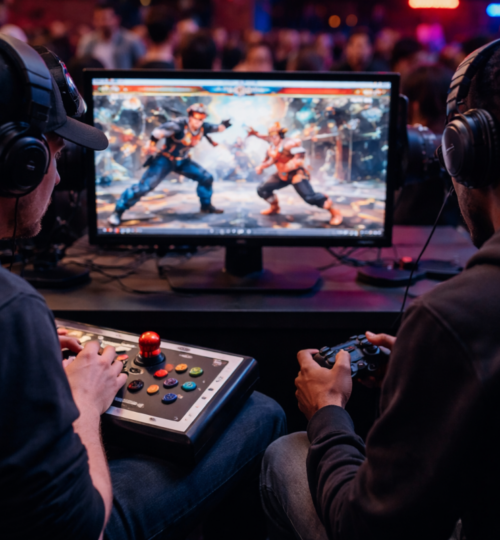
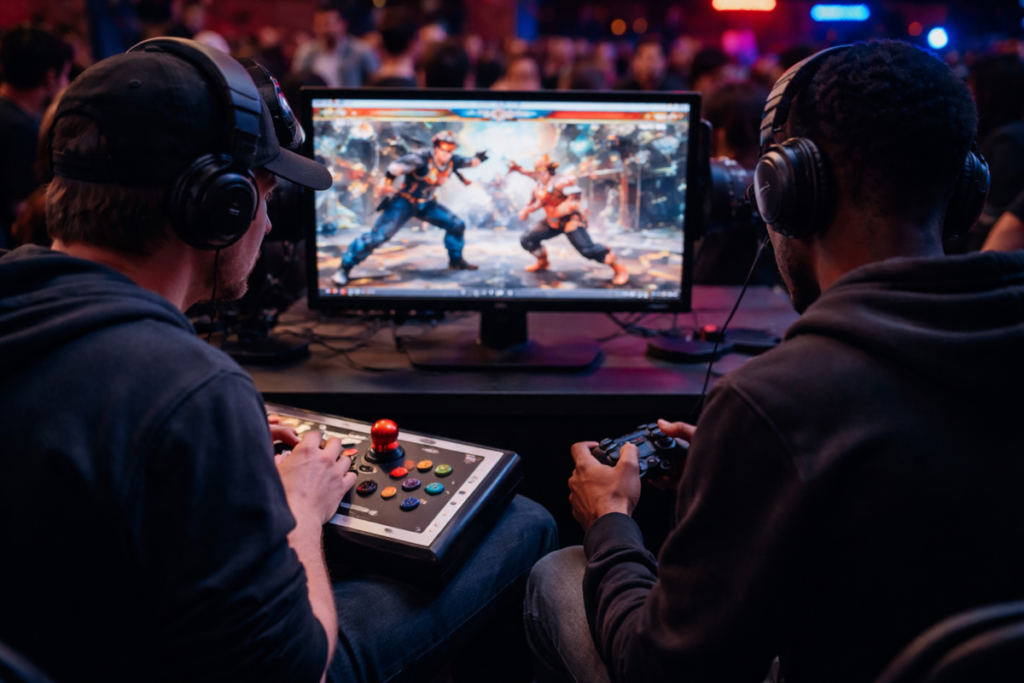
As fighting games surge again in popularity, driven by titles like Street Fighter 6 and Tekken 8, one question continues to divide both veterans and newcomers. What is the future of control schemes in competitive play. Are arcade sticks still the gold standard, or have standard controllers quietly taken over the modern battlefield.
This is not just a matter of preference. It is a reflection of how the genre itself is evolving.
A Legacy Built in Arcades
To understand the current debate, you have to go back to where it started. Fighting games were born in arcades, where the joystick and button layout were not optional. They were the game.
The classic arcade stick offered a physical, almost mechanical relationship with the game. Quarter-circle motions, dragon punches, and charge inputs were designed with that lever in mind. The tactile feedback of a stick snapping back to neutral and the distinct feel of arcade buttons gave players a sense of control that went beyond simple input.
For years, this translated directly into home setups. Competitive players invested in arcade sticks not just for nostalgia, but because they mirrored the environment where the genre was mastered. In early competitive communities, showing up with a stick was often seen as a sign of seriousness. That cultural weight still lingers today.
The Rise of the Controller Player
Something changed quietly over the last decade. Consoles became the primary competitive platform, and accessibility became a bigger focus for developers. Players were no longer required to adapt to arcade hardware. They could compete using what came in the box.
Modern controllers, particularly those from Sony and Microsoft, have evolved significantly. Improved D-pads, responsive analog sticks, and customizable button layouts have made them far more viable for high-level play than their earlier counterparts.
At the same time, the player base expanded. New competitors entered the scene without arcade experience. For them, the controller was not a compromise. It was the default.
The result is a shift in perception. Today, some of the best players in the world compete on standard controllers. The stigma is fading, replaced by a more pragmatic view. The best tool is the one that lets you win.
Execution and Precision: Myth vs Reality
One of the longest-standing arguments in favor of arcade sticks is execution precision. The belief is that sticks allow for cleaner inputs and more consistent motion execution. There is some truth to this, but it is not absolute.
Arcade sticks offer a larger range of motion, which can make certain inputs feel more deliberate. For players trained on that format, motions like half-circles and 360-degree rotations can feel more natural. The separation of buttons also reduces the chance of accidental inputs.
Controllers, however, have their own strengths. The D-pad allows for extremely fast directional taps, which can benefit rapid input sequences. Modern fighting games have also introduced input leniency systems that reduce the need for perfect execution. This narrows the gap significantly.
In practice, execution is less about the device and more about familiarity. A player who has trained for years on a controller will outperform a stick user who is still adjusting, and vice versa.
The myth that one input method guarantees better execution is fading as the data becomes clearer.
Speed, Ergonomics, and Fatigue
Beyond execution, there is a physical dimension to this debate that often gets overlooked. Arcade sticks require a different posture and hand positioning. For some players, this leads to greater comfort during long sessions. The spread-out layout can reduce finger strain, especially when executing complex button combinations.
For others, the opposite is true. Controllers are more compact and familiar, making them easier to use for extended periods. The ability to play in different positions, whether sitting back or leaning forward, adds a level of flexibility that sticks cannot easily replicate.
Speed is also a factor. Certain techniques, like rapid directional changes or tight defensive inputs, can feel faster on a D-pad. On the other hand, multi-button inputs may feel more controlled on a stick. There is no universal winner here. It depends heavily on the player’s physiology and habits.
The Hitbox and Leverless Disruption
While the conversation often centers on sticks versus controllers, a third contender has emerged that complicates the narrative. Leverless controllers, often referred to as Hitbox-style devices, replace the joystick entirely with directional buttons. This fundamentally changes how inputs are performed.
Instead of moving a stick, players press buttons for left, right, up, and down. This allows for extremely precise and fast inputs, particularly for techniques that require rapid directional changes.
In many ways, leverless controllers combine the strengths of both traditional options. They offer the button layout of an arcade stick with the precision of digital inputs.
Their rise has sparked debates about fairness and competitive integrity. Some argue they provide an advantage, especially in games with strict timing windows. Others see them as a natural evolution of input technology.
What is clear is that they are becoming more common in high-level play, adding another layer to the discussion about the future of control schemes.
Developer Design and Input Evolution
Game developers are not neutral observers in this debate. Their design choices actively shape which input methods are viable. Modern fighting games are being built with multiple control schemes in mind. Capcom, for example, introduced modern control options in Street Fighter 6 that simplify inputs for new players. These systems are designed to work seamlessly on standard controllers, lowering the barrier to entry.
At the same time, advanced mechanics still reward precision and timing, ensuring that experienced players can push the limits regardless of their device.
This dual approach reflects a broader trend. Fighting games are trying to be more inclusive without sacrificing depth. That means supporting a wide range of input methods rather than favoring one. The result is a more diverse competitive landscape.
Tournament Standards and Competitive Integrity
In organized competition, consistency is everything. Tournament organizers have had to adapt to the growing variety of input devices. Most major events now allow a wide range of controllers, including arcade sticks, standard controllers, and leverless devices. The focus is on ensuring that all players compete under the same rules, regardless of their hardware.
There are still debates about what should be allowed. Some tournaments have implemented restrictions on certain features, such as simultaneous opposite directional inputs. These rules are designed to prevent unintended advantages.
Despite these discussions, the trend is clear. The competitive scene is becoming more inclusive, recognizing that skill is not tied to a single type of controller.
For a community rooted in player-driven competition, this shift feels familiar. It echoes the early days when players brought whatever they had and proved themselves through performance.
Accessibility and the New Generation
One of the most important factors shaping the future of fighting games is accessibility. Standard controllers lower the barrier to entry. New players do not need to invest in specialized hardware to compete. This is crucial for growing the player base and keeping the genre alive.
Arcade sticks, while iconic, represent an additional cost and learning curve. For some, that is part of the appeal. For others, it is a barrier. Leverless controllers introduce another layer of complexity. They can offer advantages, but they also require a different way of thinking about inputs.
Developers and communities are increasingly aware of these dynamics. The goal is not to eliminate any option, but to ensure that players can choose what works for them without being excluded.
The Psychological Factor
Beyond mechanics and ergonomics, there is a psychological element to input choice. For many veteran players, the arcade stick is more than a tool. It is part of their identity. It connects them to the history of the genre and the communities that built it.
Using a stick can feel like stepping into that legacy. It carries a sense of authenticity that is hard to quantify. Controller players, on the other hand, often approach the game with a different mindset. They are less tied to tradition and more focused on efficiency. Their choice reflects a modern, practical approach to competition.
Neither perspective is wrong. They simply represent different eras of the same community.
The Future: Convergence, Not Replacement
So where does this leave us. The future of fighting game inputs is not about one method replacing another. It is about convergence. Arcade sticks will continue to exist as a preferred option for players who value their feel and legacy. Standard controllers will remain dominant due to their accessibility and convenience. Leverless devices will keep pushing the boundaries of what is possible.
What matters most is that the games themselves support this diversity. As long as developers continue to design systems that accommodate different input methods, the community will thrive.
For a platform built on restoring competitive history and giving players the tools to define their own path, this evolution feels right. The controller in your hands does not define your skill. Your decisions do.
And in a genre where every frame counts, that is the only thing that ever truly mattered.