
Disclaimer: The views and opinions expressed in this article are solely those of the author. The mention of any products, services, or methods does not constitute an endorsement.
For players who remember dragging rigs to LAN events or fine tuning server settings just to shave off a few milliseconds, latency has always been part of the competitive landscape. It used to be something you fought locally, tweaking hardware and connections until everything felt just right. Now that same battle has moved somewhere less tangible. Instead of optimizing your own machine, you are relying on a remote system to process your inputs, render the game, and send it back to you as a video stream.
That shift changes everything. Cloud gaming promises high end experiences on devices small enough to carry anywhere, but it also introduces a fundamental problem. Every action you take has to travel further, pass through more systems, and return fast enough to feel natural. For years, that gap between input and response has been the main reason competitive players stayed cautious. Now, with the arrival of Wi-Fi 7, that conversation is starting to evolve.
The Latency Problem, Reframed
In traditional online gaming, latency exists but it is manageable. Your system still renders the game locally, which means what you see reacts instantly to your inputs. The server confirms outcomes, but your experience is not entirely dependent on that round trip. Even when connections are not perfect, prediction systems smooth things out enough that gameplay remains responsive.
Cloud gaming removes that safety net. Every frame you see has already traveled to a remote server and back. That creates a layered delay that is impossible to ignore. The time it takes for your input to reach the server, for the game to process it, for the frame to be encoded, transmitted, decoded, and displayed all adds up. Individually, those steps can be optimized, but together they form a chain where any weak link can affect the whole experience.
Wireless networking has often been that weak link, especially for handheld devices.
Why Handhelds Expose the Problem
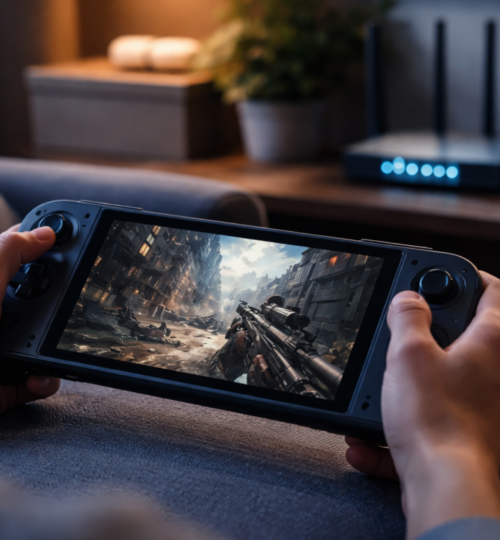
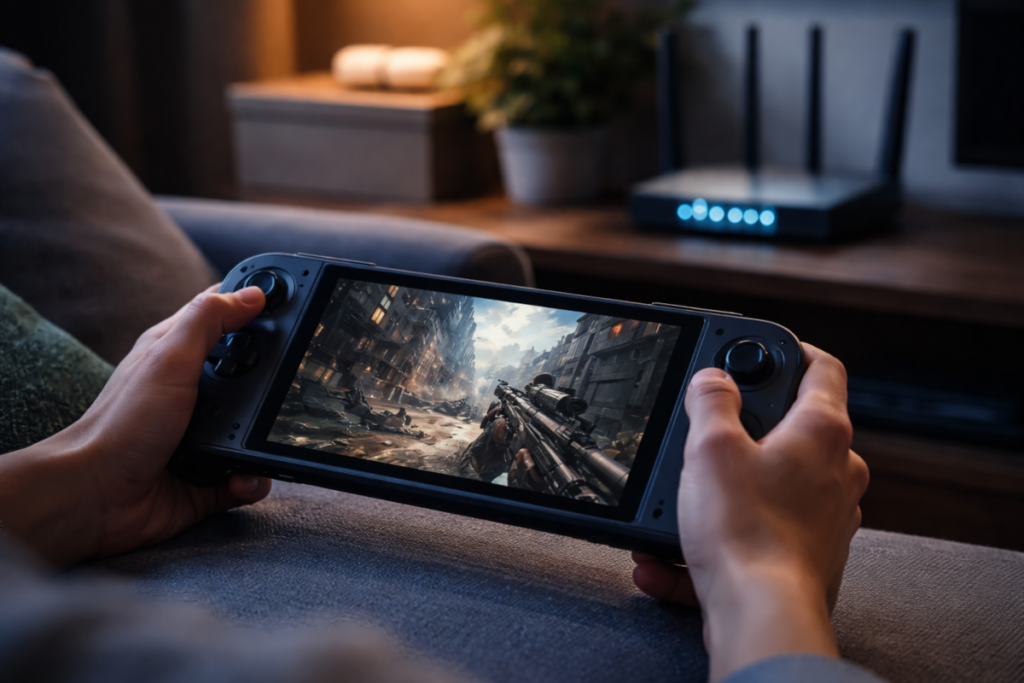
The rise of handheld gaming devices has made cloud streaming more relevant than ever. Devices like the Steam Deck brought full PC gaming into a portable form, while systems like the PlayStation Portal leaned directly into streaming as a primary use case. On top of that, smartphones have become viable platforms through services from companies like NVIDIA and Microsoft.
What all of these devices share is a reliance on wireless connectivity. Unlike a desktop setup that can lock into a stable wired connection, handhelds live in motion. You shift positions, move between rooms, and compete with every other wireless device in your environment. Signal strength changes constantly, and even small fluctuations can introduce jitter that disrupts the flow of gameplay.
That inconsistency has been the real issue. Not just how much latency exists, but how predictable it is.
Wi-Fi 7 and the Shift Toward Stability
Wi-Fi 7 enters the scene with a focus that goes beyond raw speed. Previous generations pushed higher throughput as the main selling point, but for cloud gaming, consistency matters just as much as bandwidth. What Wi-Fi 7 does differently is improve how connections behave under real world conditions.
One of the most important changes is the ability to use multiple frequency bands at the same time. Instead of relying on a single channel that might be congested or unstable, a Wi-Fi 7 connection can distribute data across several paths. If one band experiences interference, the others can continue carrying the load. The result is not just faster data transfer, but a smoother, more resilient connection.
There is also a noticeable improvement in how data is scheduled and transmitted. Communication between devices becomes more efficient, reducing the small delays that build up during packet handling. These micro delays might seem insignificant in isolation, but when you are streaming an entire game, they contribute directly to how responsive everything feels.
Higher bandwidth plays its part as well, though not in the way most people think. It is less about downloading faster and more about maintaining a steady stream of high quality video without aggressive compression. When frames arrive cleanly and consistently, your perception of responsiveness improves, even if the total latency is only slightly reduced.
What This Means in Practice
To understand the impact, it helps to think about the full journey your input takes. When you press a button on a handheld device, that signal travels to a server, triggers an action in the game, gets rendered into a frame, encoded into video, and sent back to your screen. That entire loop happens dozens of times per second.
With older wireless standards, that loop could feel uneven. One moment everything would be responsive, the next you would feel a slight hitch or delay. Those inconsistencies are what break immersion and disrupt performance, especially in competitive scenarios.
Wi-Fi 7 does not eliminate the loop, but it smooths it out. The overall delay becomes more stable, and those sudden spikes become less frequent. When latency is predictable, players can adjust to it. Muscle memory adapts, timing becomes reliable, and the experience starts to feel closer to local play.
For fast paced games, that shift is significant. It means aiming feels steadier, movement feels more controlled, and reactions align more closely with what you see on screen.
The Competitive Perspective
For a community that has always valued precision, the difference between playable and competitive comes down to trust. You need to trust that your inputs are being registered exactly when you make them. You need to trust that what you see reflects what is actually happening in the game.
Cloud gaming has historically struggled with that trust. Even when average latency looked acceptable on paper, the inconsistency made it difficult to rely on. Wi-Fi 7 addresses that concern by reducing variability.
That does not suddenly make cloud gaming the default choice for competitive play, but it does make it more viable in situations where it previously was not. A handheld device connected over Wi-Fi 7 can now deliver an experience that feels stable enough to support more demanding gameplay, especially outside of top tier tournament environments.
The Role of the Home Network
There is a reality check that comes with all of this. Wi-Fi 7 is not a magic fix on its own. It requires the right environment to deliver its benefits.
The quality of your router, the layout of your home, and the number of devices sharing the network all play a role. Even with the latest hardware, poor placement or heavy interference can still introduce issues. The difference is that Wi-Fi 7 gives you more tools to overcome those challenges.
For players who enjoy optimizing their setups, this will feel familiar. It is another layer of control, another way to fine tune performance. The difference now is that you are optimizing a wireless environment rather than a wired one.
Cloud Infrastructure Is Catching Up
While local networking improves, cloud providers are also refining their side of the equation. Servers are being positioned closer to users, encoding technology is becoming more efficient, and overall system latency is gradually decreasing.
These changes compound the benefits of Wi-Fi 7. When both ends of the connection improve, the total experience shifts in a noticeable way. What once felt like a compromise starts to feel like a legitimate alternative.
For handheld users, this is where things get interesting. The combination of better local networking and stronger cloud infrastructure brings portability and performance closer together than they have ever been.
What Still Holds It Back
Even with these advancements, cloud gaming is not free from limitations. Distance to data centers still matters, and not every region benefits equally from infrastructure improvements. Internet service providers can introduce their own inefficiencies, and some game genres remain more sensitive to latency than others.
There is also a psychological factor. Players who have spent years refining their setups may still prefer the certainty of local hardware. That preference is not going away anytime soon, especially at the highest levels of competition.
A Familiar Evolution
For veterans of online gaming, this progression feels familiar. There was a time when playing competitively over the internet seemed unreliable compared to local matches. Over time, improvements in infrastructure changed that perception.
Cloud gaming appears to be following a similar path. It began as a convenience feature, struggled with consistency, and is now entering a phase where the technology is beginning to match its ambitions.
Wi-Fi 7 is not the final step in that journey, but it is an important one. It addresses one of the most unpredictable parts of the experience and replaces it with something more stable.
Final Thoughts
The conversation around cloud gaming on handhelds is shifting. It is no longer just about whether the technology works, but whether it works well enough to matter for players who care about performance.
Wi-Fi 7 moves that line forward. By improving stability and reducing the inconsistencies that have defined wireless connections, it brings cloud streaming closer to the responsiveness that competitive players expect.
For a community that has always adapted to new formats while holding onto its standards, this is not about replacing what came before. It is about expanding what is possible.
And for the first time, handheld cloud gaming is starting to feel like it belongs in that conversation.