
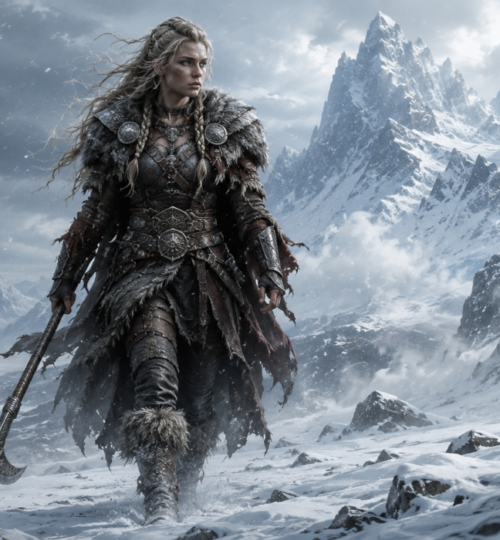
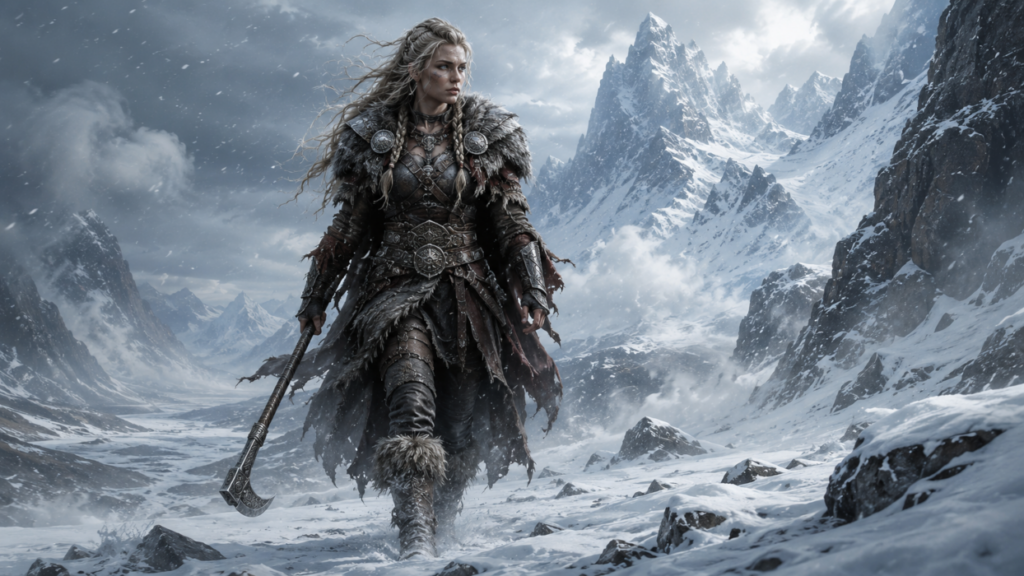
Sony Santa Monica has finally pulled the curtain back on God of War Laufey, and the reveal does something the series has been quietly preparing for since the 2018 reboot. It takes the story away from Kratos as the fixed center of gravity and puts Faye, also known as Laufey, directly in the player’s hands.
That is not a small shift. For years, Faye has been one of the most important unseen forces in modern God of War. She shaped Kratos’ second life. She guided Atreus’ path. She left marks across the Nine Realms before players ever saw her face in a full narrative role. Now the franchise is asking players to meet her not as a memory, not as a shrine, not as a wife spoken about in grief, but as a warrior with her own unfinished fight.
That alone would be enough to make God of War Laufey interesting. The bigger story is what this game appears to do for the entire universe. Based on the reveal, Santa Monica Studio is not just filling in backstory. It is opening the door to a larger mythological framework where the old rules of the franchise may no longer be enough.
Faye Moves From Legend to Lead
Faye has always had weight in the Norse saga. In God of War 2018, her death is the event that pushes Kratos and Atreus into motion. Her ashes become the goal, but her choices become the real mystery. The more players learn, the clearer it becomes that she understood far more than anyone around her. She saw danger coming. She made plans. She challenged fate without turning the story into a simple prophecy puzzle.
God of War Ragnarök expanded that idea by letting players see more of her relationship with Kratos. Those scenes mattered because they gave Faye warmth, humor, patience, and edge. She was not written as a flawless saint who existed only to improve Kratos. She pushed him. She loved him. She also knew he could break if left alone with his worst instincts.
God of War Laufey takes that foundation and gives it teeth. The premise places Faye after her funeral, awakened in a strange afterlife with the plans she made for Kratos and Atreus under threat. That is smart setup. It keeps her tied to the emotional core of the Norse saga while giving her a separate battlefield.
The obvious concern with any prequel-adjacent or afterlife story is that it can feel trapped by known outcomes. We know Faye dies. We know Kratos and Atreus scatter her ashes. We know Ragnarök happens. Santa Monica’s answer appears to be simple. The real tension is not whether Faye survives in a normal sense. The tension is whether her unseen war changes what players thought they understood about destiny, magic, and the gods.
The Everywhen Changes the Scale
The biggest lore bomb in the reveal is the Everywhen, described as the afterlife of the gods and the place where magic returns. That idea instantly changes the franchise’s scale.
God of War has already crossed mythologies before. The original Greek saga gave way to the Norse era, and the franchise proved it could reinvent itself without throwing away its past. Still, each era mostly operated as its own mythological system. Greece had its gods, monsters, curses, and cosmic order. The Norse saga had the Nine Realms, giants, Vanir, Aesir, prophecy, and its own brutal theology.
The Everywhen sounds like a connective layer between mythologies. Not a simple hub world. Not just a menu of themed zones. It appears to be a contested spiritual plane where gods and creatures from different traditions can exist together, fight for influence, and expose how divine power works across the entire God of War universe.
That is a major swing because it gives Santa Monica a way to bring different pantheons into contact without making the whole thing feel like a random crossover. The series has always been best when mythology is not treated like decoration. The Greek games were bloody tragedies built around family, vengeance, and divine rot. The Norse games were slower, colder, and more personal, centered on parenthood, grief, inherited violence, and the question of whether anyone can change.
The Everywhen lets the studio ask a bigger question. What happens when all these mythologies share a source, an endpoint, or a battlefield that even the gods do not fully control?
Sekhmet and Begtse Signal a Wider Mythology War
The reveal mentions two gods Faye will encounter, Sekhmet and Begtse. That choice is telling.
Sekhmet comes from Egyptian mythology, often tied to war, destruction, disease, healing, and the terrifying heat of divine wrath. She is not a soft entry point into Egyptian myth. She is violence with sacred purpose. If Santa Monica is bringing her into God of War Laufey, the studio is signaling that this expansion will not treat Egypt as a pretty backdrop for pyramids and sun imagery. Sekhmet fits God of War because she carries both punishment and protection in the same body.
Begtse points in a very different direction, drawing from Tibetan Buddhist tradition as a fierce protector figure. That is a much less expected pick for a blockbuster action game, and that makes it more interesting. God of War has often pulled from mythology in ways that mainstream audiences recognize quickly. Zeus, Ares, Thor, Odin, Freya, Loki. These names carry instant recognition. Begtse suggests the new game may be willing to move beyond the obvious greatest hits.
That matters. A universe expansion only works if it feels like discovery, not brand management. If God of War Laufey simply trots out famous gods for boss fights, it will feel thin fast. If it treats these figures as powers with their own histories, motives, and contradictions, the Everywhen could become the most flexible and dangerous setting the franchise has ever built.
There is a competitive edge to that as well. Modern players are sharp. Lore communities pick apart every mural, weapon inscription, line reading, and environmental detail within hours. A broader mythological cast gives theory crafters more fuel, but it also raises the bar. The writing has to carry the weight.
Faye’s Combat Can Bridge Old God of War and New God of War
Santa Monica has described Faye’s gameplay as drawing from the movement and fluidity of the Greek era while keeping the Norse era’s character-driven design. That is exactly the right pitch for this character.
Kratos in the Norse games feels heavier than he did in the Greek saga. Every axe throw, shield block, and close-range strike has weight. That change matched the story. This was an older Kratos, controlled, restrained, and trying not to become the monster he used to be. The camera pulled close because the story pulled close.
Faye should not feel like a reskinned Kratos. She needs her own rhythm. The idea of blending Greek-era speed with Norse-era intimacy fits her perfectly. She was a giant, a warrior, a strategist, and someone capable of seeing paths others could not. Her combat should feel purposeful and fast, but not weightless. She should hit with intent.
This is where lore and mechanics can feed each other. If Faye is fighting through the Everywhen, her abilities can reflect a connection to older forms of magic, giant knowledge, and cross-mythological forces. The game does not need to drown players in systems. It needs attacks, movement, gear, and enemies that tell players who Faye is without requiring a lecture.
God of War has always understood that weapons are character writing. The Blades of Chaos are guilt made physical. The Leviathan Axe is restraint, inheritance, and craft. Faye’s weapon set has to say something just as clearly.
The Afterlife Setup Lets Santa Monica Rewrite Player Assumptions
The best part of the premise is that it does not erase Faye’s death. It weaponizes it.
In weaker fiction, bringing a dead character back into focus can cheapen the loss. God of War Laufey appears to avoid that by placing Faye in an afterlife conflict rather than pretending death never mattered. She is not simply back. She is somewhere else, under different rules, trying to protect people who do not even know the fight is happening.
That gives the story a tragic edge. Faye may be acting from love, but love in God of War is rarely clean. Kratos loved his family in Greece and destroyed a world through grief and rage. Odin claimed to love knowledge and control, then poisoned everything around him. Freya’s love for Baldur became a curse. Atreus’ love for his father pushed him into secrets and reckless choices.
Faye’s love has always seemed wiser than most, but God of War Laufey has the chance to complicate that. What did she hide? What did she sacrifice? How much of Kratos and Atreus’ path was protected, and how much was manipulated for survival?
That is the kind of story this franchise handles well. Not good people versus bad gods. Broken people making choices under pressure, then living with the damage.
Kratos Sitting Out Is a Risk Worth Taking
A God of War game without Kratos as the lead will annoy part of the audience. No mystery there. Kratos is one of PlayStation’s defining characters, and the reboot era gave him a second life that many franchises never get. Taking him out of the lead role is risky.
It is also necessary.
The series cannot keep asking Kratos to carry every myth, every theme, and every emotional arc forever. His story still has room left, especially after the ending of Ragnarök, but the universe around him has become too rich to stay locked to one perspective. Atreus already proved that point in Ragnarök. His sections were divisive for some players, but they showed the franchise could survive outside Kratos’ direct control.
Faye is a stronger test. She is not just the son carrying the family story forward. She is the missing parent, the dead wife, the giant warrior, the architect of the Norse saga’s emotional structure. Making her playable says Santa Monica trusts the audience to care about the universe, not just the rage god at its center.
That is healthy for the franchise. Long-running series die when they become too afraid of their own audience.
Lore Expansion Needs Discipline
The Everywhen could be brilliant. It could also become messy if the writing tries to explain too much too quickly.
God of War works best when its mythology feels lived in. Players do not need an encyclopedia entry every time a god appears. They need behavior, conflict, visual identity, and consequences. Mimir’s stories worked because they were sharp, funny, bitter, and tied to the world around him. The murals worked because they made prophecy feel physical. The gods worked because their personalities matched the systems they ruled.
God of War Laufey needs that same discipline. The danger of a cross-mythology setting is overload. Too many gods. Too many names. Too many cosmic rules. Too much lore stacked on top of lore until the human story gets buried.
Faye is the anchor. Every major expansion should reflect back on her. If Sekhmet appears, the story should not simply say, “Here is an Egyptian god.” It should force Faye into a conflict that exposes something about war, motherhood, fury, healing, or protection. If Begtse appears, his role should test Faye’s understanding of guardianship, violence, and duty. The new mythology should pressure the lead character, not just decorate her journey.
The Franchise Is Building a Mythological Endgame
God of War Laufey feels like the kind of entry that could quietly set up the franchise’s next decade. The Greek saga was about destroying a pantheon. The Norse saga was about breaking cycles. This new chapter looks like it may be about what connects divine systems underneath the surface.
That opens a lot of doors. Egypt has been teased and discussed by fans for years. Other mythologies have been hinted at through symbols and references across the reboot era. The Everywhen gives Santa Monica a story reason to bring those threads together without forcing Kratos to physically travel from one mythological territory to another every time the studio wants a new setting.
For a legacy multiplayer community, that is worth watching even if God of War remains a single-player franchise. Big single-player releases shape the gaming conversation. They set expectations for production values, narrative ambition, combat design, and how studios treat old IP without sanding off its identity. God of War 2018 changed how people talked about franchise reboots. Ragnarök showed how hard it is to end a giant story without losing momentum. Laufey may show whether a major series can expand sideways, deepen its lore, and pass the spotlight without feeling like a spin-off wearing the main series’ armor.
The reveal makes one thing clear. Santa Monica is not treating Faye as bonus lore. The studio is treating her as a lead capable of carrying the next mainline God of War entry, and the Everywhen gives her a stage large enough to make that choice matter.