
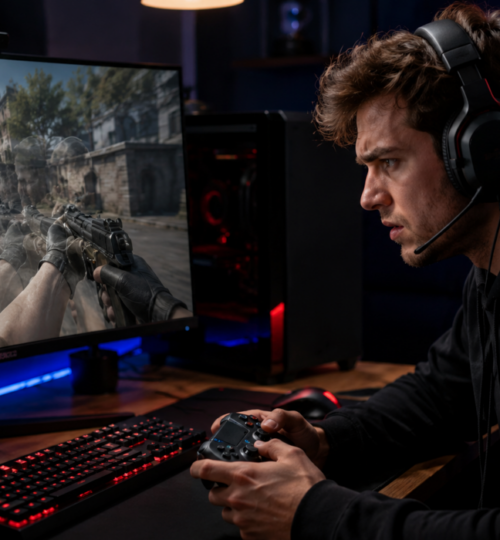
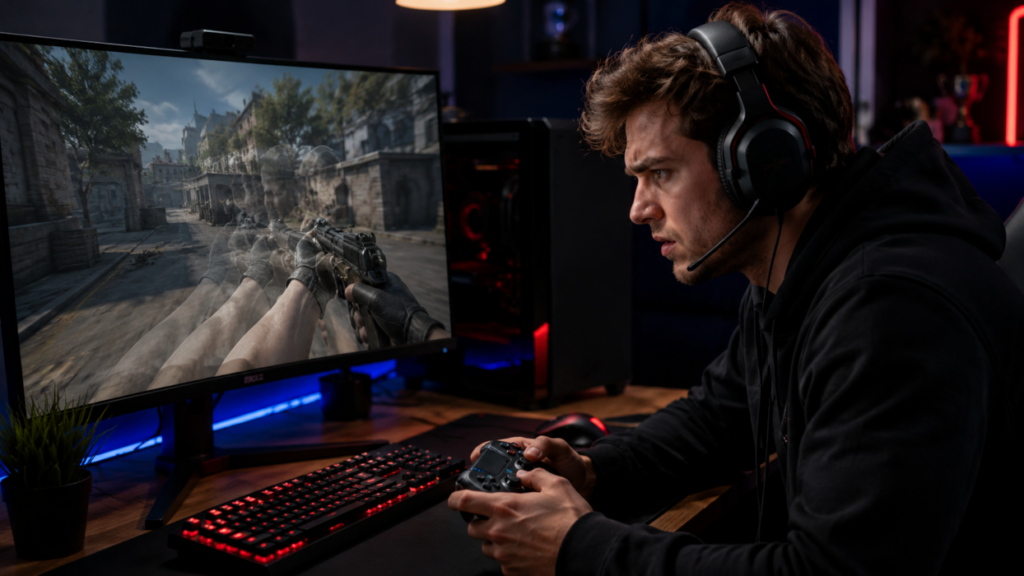
Cloud gaming has been stuck in a strange place for years. It is no longer a joke, but it still has not become the console killer that executives kept promising. It works often enough to impress people, fails often enough to annoy them, and lives in that frustrating middle space where the technology feels both futuristic and unfinished. That is the core problem. Cloud gaming keeps almost working.
For casual players, it can be magic. A game launches on a phone, a browser, a smart TV, or a low-powered laptop without a giant download or expensive GPU. For traveling players, it can feel like a cheat code. For Game Pass users, GeForce Now users, and PlayStation Plus Premium subscribers, the pitch is obvious. Your games follow you. Your hardware matters less. Your storage drive stops filling up every week. Then the match starts.
A little input delay creeps in. The image softens during motion. The Wi-Fi hiccups. A competitive shooter feels slightly off. A fighting game becomes a bad idea. A racing game feels playable, but not quite right. Cloud gaming does not always collapse under pressure, but it still reminds players that the game is not really running in the room with them.
The Dream Is Still Powerful
The appeal of cloud gaming is easy to understand. Gaming hardware is expensive, downloads are massive, and modern games are becoming harder to casually try. A single blockbuster can demand over 100 GB of storage. GPU prices still sting. Console generations keep asking players to buy into new boxes, new accessories, and new ecosystem rules.
Cloud gaming offers a clean fantasy. Press play. Start gaming. No install. No patch anxiety. No hardware upgrade. No fan screaming under the desk like a jet engine trying to leave Earth.
That fantasy matters. A revived multiplayer community understands this better than most because access has always shaped competition. If players cannot install a game, cannot run it well, or cannot afford the right machine, the player pool shrinks. Cloud gaming promises to lower that wall. More players in more places, using more devices, with fewer excuses.
That part is real. Cloud gaming is already useful for checking out single-player games, grinding slower-paced titles, testing something before downloading it, or playing while away from your main setup. It is also a strong fit for people who treat gaming like streaming video, picking up sessions across devices rather than sitting at one battle station every night.
The issue is not whether cloud gaming has value. It clearly does. The issue is whether it can replace local gaming for the players who care most about precision.
Latency Is Still the Boss Fight
Cloud gaming has one enemy that refuses to die, latency. Every input has to travel from your controller or keyboard to a remote server. The server runs the game, renders the frame, compresses the video, sends it back, and your device displays it. That chain can be shockingly fast, but it is still a chain.
Local hardware has a shorter path. Press a button, the machine reacts. On a solid PC or console setup, the delay is small enough that most players never think about it. Competitive players absolutely do. They can feel bad frame pacing, poor polling rates, overloaded servers, weak netcode, and display lag. Add cloud streaming into that mix and the margin gets thinner.
This is why cloud gaming can feel great in one genre and rough in another. Turn-based strategy, RPGs, management games, adventure games, and slower action titles can survive a little extra delay. They may even feel excellent. Competitive shooters, arena shooters, rhythm games, fighters, and high-level racing games expose every weak point.
A casual Halo session over the cloud can be fun. A serious ranked match is another story. The higher the skill level, the less forgiving the experience becomes. Cloud gaming does not only need to work. It needs to disappear. The best version is the one players stop noticing. That is a brutal standard.
Image Quality Has Improved, But Compression Still Shows
Cloud gaming is not just about input delay. It is also about video quality. The game is rendered somewhere else and streamed back as video, which means compression is always involved. Better codecs, higher bitrates, and stronger data centers have improved the experience a lot, but motion is still the stress test.
Slow scenes can look sharp. Menus can look nearly native. Cinematic single-player games can hold up well, especially on smaller screens. Then a multiplayer match breaks out with explosions, fast camera movement, particles, smoke, and dark corners. The stream has to keep up.
That is where compression artifacts can show up. Fine detail can smear. Distant enemies can be harder to read. Dark areas can get muddy. The image may still look good in a screenshot, but competitive gaming is not played in screenshots. It is played during motion, under pressure, with tiny visual cues deciding fights.
For players raised on LAN parties, CRT timing, high-refresh monitors, and custom PC builds, this matters. A slightly soft image is not just a cosmetic issue. It can affect target tracking, reaction confidence, and map awareness. Cloud gaming has made serious progress here, especially with premium tiers and stronger streaming options, but the last stretch is the hardest.
The Business Model Is Messy
The tech problems get most of the attention, but the business model may be just as tricky. Players do not simply want access to games. They want confidence that their libraries, saves, purchases, and communities will still matter later.
Cloud gaming has already burned some trust. Google Stadia became the cautionary tale. It had interesting technology, decent performance in good conditions, and real ambition. Then it shut down. Google handled refunds better than many expected, but the message landed anyway. A cloud gaming platform can vanish. That memory still hangs over the category.
Different services now approach the problem in different ways. Xbox Cloud Gaming is tied heavily to Game Pass and the Xbox account system, with growing support for streaming games players own. Nvidia GeForce Now takes another route, connecting with existing PC storefronts so players can stream many games they already bought. PlayStation offers cloud streaming through higher PlayStation Plus tiers, though Sony has been more controlled and console-centered in how it presents the feature.
Each model solves one problem while creating another. Subscription access is easy, but games can rotate. Storefront-linked streaming respects existing purchases, but game support depends on publisher permissions and service agreements. Platform-owned ecosystems feel smooth, but they can lock players into one company’s rules.
Gamers remember. They remember shutdowns, removed games, dead launchers, broken promises, and accounts trapped in corporate systems. Cloud gaming has to fight not only technical doubt, but memory.
Ownership Still Feels Weird
Players understand buying a disc. They understand downloading a game from Steam, Xbox, PlayStation, Epic, or GOG. Even with modern DRM concerns, local installs still feel like possession in a practical sense. The files exist on your machine. The game runs on your hardware. Mods might work. Tweaks might work. Offline play might work, depending on the game.
Cloud gaming changes that feeling. The player may own a license, but the actual experience depends on server access, streaming rights, supported regions, queue times, account status, publisher approval, and network quality. That makes the game feel less like something you own and more like something you are allowed to visit.
That may not bother every player. Younger gamers who grew up with subscriptions, digital libraries, and cross-device accounts may see it as normal. Veteran players are often harder to convince. A community that lived through old server browsers, clan ladders, modded maps, and privately hosted matches knows the value of control.
Ownership is not nostalgia. It affects preservation, competition, modding, and community independence. If a game only exists through a cloud service, the community sits in the passenger seat.
Cloud Gaming Works Best as a Companion
The strongest version of cloud gaming right now is not replacement. It is extension.
That is where the technology shines. A player can try a Game Pass title instantly before deciding whether to install it. Someone traveling can keep playing without packing a console. A lower-end laptop can become a temporary gaming machine. A smart TV can handle a couch session without another box under the screen. A handheld can stream a game it cannot run locally at acceptable settings. That is useful. No cope required.
Cloud gaming also gives publishers and platform holders a way to keep players connected across screens. Microsoft has been especially aggressive here, treating cloud play as part of a broader Xbox identity rather than a single device strategy. Nvidia has leaned into the high-performance angle with GeForce Now, making the pitch that cloud gaming can feel closer to a premium PC experience when the network and tier are right.
That is a smarter pitch than claiming local hardware is dead. Local hardware is not dead. It is still the gold standard for serious play. But cloud gaming can fill the gaps between devices, installs, and sessions. It can turn dead time into game time.
Competitive Gaming Is the Hardest Sell
For esports, cloud gaming has a serious credibility gap. Competitive players do not want “pretty good.” They want consistent. They want repeatable. They want every input to feel the same from match to match.
Cloud gaming struggles because the experience depends on too many outside factors. A player on fiber near a data center may have a great session. Another player on crowded home Wi-Fi may suffer. Someone else may be fine until peak evening traffic hits. Even if the service is strong, the player’s route to that service can betray them.
That makes cloud gaming hard to standardize for competition. Online esports already has enough issues with ping, server regions, tick rates, hardware differences, and matchmaking quality. Adding streaming performance into the stack gives organizers another variable to worry about.
Cloud gaming could still play a role in competitive ecosystems, especially for spectating, practice access, demo stations, community events, and lower-stakes ladders. It may help players test games before joining a scene. It may help older titles reach people without strong hardware. It may even support certain tournament formats where all players are placed under controlled conditions.
But serious ranked play from home over cloud streaming remains a tough sell. The players most likely to notice problems are the exact players most likely to reject the format.
The Network Problem Is Not Equal for Everyone
Cloud gaming quality depends heavily on location, home internet, router quality, Wi-Fi congestion, ISP routing, data caps, and the distance to the server. That creates an uneven experience. One player says it feels native. Another says it is unplayable. Both can be telling the truth.
This is one reason public opinion on cloud gaming feels so chaotic. Reviews and social posts often conflict because the service is not the only variable. A great cloud platform cannot fully save a bad local network. A powerful data center cannot fix weak Wi-Fi in an apartment full of competing signals. A premium subscription cannot remove every mile between the player and the server.
Edge computing and regional server expansion can help. Better codecs can help. Wi-Fi 6, Wi-Fi 7, stronger routers, and fiber adoption can help. Higher bitrates and lower-latency streaming standards can help too. Cloud gaming is improving because many surrounding technologies are improving at the same time. Still, gaming is not video streaming. Netflix can buffer. A match cannot. A video can hide delay. A headshot cannot.
Publishers Like the Control
Cloud gaming is not only a player convenience play. It is also attractive to publishers because it can shift control away from local machines. If games run in data centers, piracy gets harder. Cheating through local file tampering gets harder. Hardware fragmentation can be reduced. Games can be updated server-side without relying on every player’s machine in the same way.
That sounds great for companies. For players, it is mixed.
Less cheating is good. Easier access is good. Fewer hardware barriers are good. But tighter control can also mean fewer mods, less preservation, less tinkering, and less community ownership. The history of multiplayer gaming is filled with players extending the life of games long after publishers moved on. Mods, private servers, custom maps, community patches, and fan-run ladders kept scenes alive.
Cloud gaming can work against that spirit if it becomes too closed. A service that gives easy access while killing player agency would be a bad trade for many legacy communities. The healthiest future is not one where every game becomes a locked stream from a corporate server. It is one where cloud access adds options without erasing local play.
Hardware Still Has a Culture
PC and console gaming are not only delivery methods. They are cultures. Players build rigs, tune settings, choose monitors, debate controllers, customize keybinds, test mice, upgrade GPUs, and obsess over performance. That culture is not going away because a server can render the game somewhere else.
For many players, the machine is part of the hobby. The setup matters. The feel matters. The pride matters. A high-end PC is not just a box that runs software. It is a personal weapon, a workstation, and sometimes a ridiculous RGB shrine to bad financial decisions.
Cloud gaming strips some of that away. That may be perfect for people who do not care about hardware. It may be less appealing to players who see hardware control as part of competitive identity. Esports was built around low latency, controlled setups, and repeatable performance. Cloud gaming has to earn trust in that culture, not assume it can replace it.
The Future Is Hybrid
The most realistic future is not cloud versus local. It is cloud plus local. Players will install the games they care about most and stream the rest. They will run competitive titles locally and use cloud play for slower games, travel, trials, and convenience. They will expect saves, friends lists, purchases, and progress to move across devices.
That future is already forming. Xbox wants players to think beyond the console box. Nvidia wants cloud servers to feel like rented high-end PCs. Sony is testing where cloud streaming fits inside its premium subscription model. Other services keep chasing device flexibility, cheaper access, and broader game support.
Cloud gaming keeps almost working because the promise is strong and the pain points are stubborn. It is good enough to be useful, not consistent enough to take over. It is improving fast, but gamers are not wrong to be skeptical. The tech has to beat more than bandwidth limits. It has to beat muscle memory, ownership anxiety, competitive standards, and years of platform mistrust.
The next big win for cloud gaming will not come from telling players their hardware is obsolete. It will come from making cloud play feel invisible in the moments where it already makes sense.