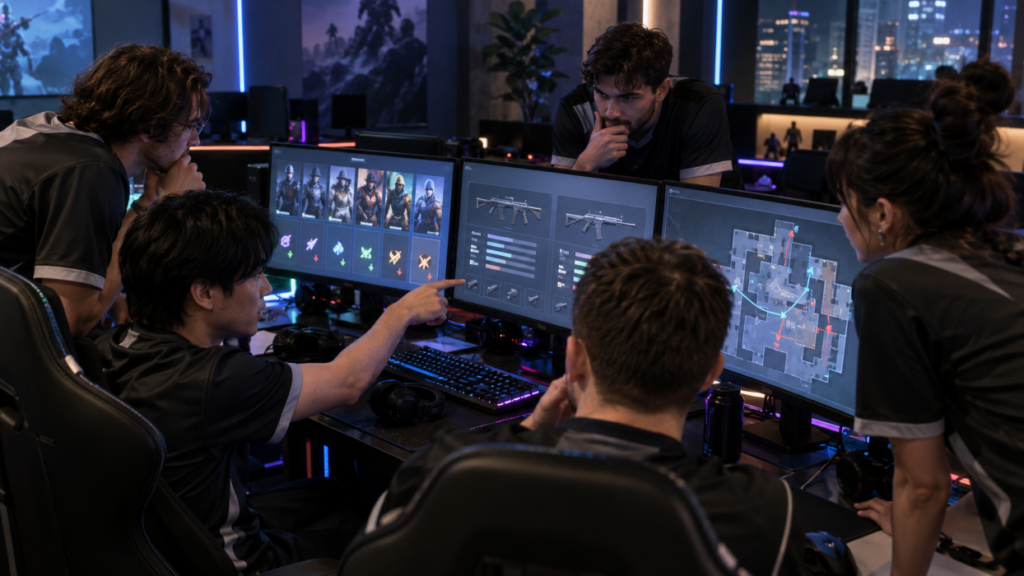
A balance patch can turn months of ranked experience into partially outdated information overnight. The mechanics are still familiar, the maps are recognizable, and good aim remains good aim, but the assumptions surrounding every engagement can change. A weapon loses the damage breakpoint players built habits around, a character gains enough mobility to escape situations that were previously guaranteed kills, or a map enters rotation and suddenly thousands of players are learning competitive setups at the same time.
That period immediately after a major update is one of the most revealing parts of any ranked season. Players who understand why a change matters often gain ground before the wider player base settles on the new answers. Recent updates across Rainbow Six Siege, Apex Legends, VALORANT, and Overwatch offer very different examples of the same competitive phenomenon: the meta does not simply switch from one preferred character or weapon to another. It moves through a messy discovery phase where old knowledge, experimentation, execution, and adaptation collide.
Rainbow Six Siege Put Established Weapon Habits Under Pressure
Rainbow Six Siege’s Year 11 Season 3 update, Operation Split Fire, contains the kind of balance changes that can immediately disturb established ranked habits. Ubisoft sharply reduced the SMG-12’s damage from 28 to 16, cut its magazine from 32 rounds to 22, and reduced its total ammunition. The weapon remains available to Dokkaebi, Vigil, and Warden, but sustained close-range spraying now carries far more risk than before.
That is more significant than a simple damage nerf. High-rate-of-fire secondary weapons often become part of an operator’s identity in ranked because players build their entire engagement style around them. A Vigil player accustomed to aggressively committing with the SMG-12 now has less room for missed bullets, while Dokkaebi players may have to rethink how confidently they can transition from utility use into a close fight.
Ubisoft also reduced damage and increased first-shot recoil for the AR-15.50 and MK14 EBR, while removing the Muzzle Brake from specific defensive loadouts. Those changes hit the consistency of DMR pressure, especially in repeated long-range engagements where fast follow-up shots previously carried relatively little mechanical punishment.
Dokkaebi herself received another meaningful change. Her Jegeo Payload now requires a continuous connection to its target, meaning defenders can interrupt the process by breaking that connection or eliminating her. The operator therefore becomes more dependent on safe positioning and team timing during activation.
Ranked players feel these changes differently from organized teams. A coordinated stack may quickly redistribute roles and adjust operator selections, while solo and duo players encounter teammates still playing from the previous patch’s muscle memory. For the first few weeks, that creates uneven matches where two players can select the same operator but effectively be playing two different versions of the meta because only one has adjusted their decision-making.
Siege is also moving toward four balancing patches per season, according to Ubisoft’s Year 11 roadmap. More frequent tuning means adaptation itself becomes a larger competitive skill because a comfortable strategy may have a shorter shelf life than it once did.
Apex Legends Changed Both Characters and the Economics of Loot
Apex Legends’ Marked season provides an even broader example because Respawn changed character kits, weapons, loot systems, maps, and ranked ladder timing together. Bloodhound received a major rework after Respawn said the character had become nearly absent in middle and higher skill tiers, with the lowest pick rate among players at Gold and above. The new kit adds stronger tracking tools and replaces Bloodhound’s previous ultimate with Allfather’s Cloak, which can temporarily conceal players moving through its area while granting increased movement speed and threat vision.
That creates an immediate ranked experiment. Bloodhound players who previously operated primarily as information providers now have tools for initiating movement, setting ambushes, or escaping third parties. Teams facing Bloodhound must also develop new expectations about when apparently open space may actually contain concealed opponents.
Loba and Rampart received substantial buffs as well. Loba’s tactical deploys faster, travels farther, and reaches its destination more quickly, while Black Market’s cooldown dropped from 150 to 120 seconds. Rampart received stronger early EVO walls, faster wall deployment, and much greater movement speed while spinning or firing Sheila.
Respawn simultaneously reduced parts of Valkyrie’s power, including lower base damage on Missile Swarm and a reduction in her ultimate’s launch height. That creates exactly the conditions that produce ladder experimentation. Established selections become less automatic, previously marginal characters receive another look, and compositions that were considered inefficient one month earlier begin appearing in serious ranked matches.
The energy ammunition rework may have an even wider effect because it changes how squads think about inventory and prolonged engagements. Energy ammunition no longer appears as normal loot. Energy weapons instead carry their own ammunition reserves and regenerate one magazine worth over 18 seconds, with regeneration pausing while the weapon is firing or reloading.
That alters the cost of carrying an energy weapon. Players no longer need backpack slots filled with energy stacks, which gives them room for other resources, but a drawn-out fight can exhaust the weapon’s reserve and force a waiting period. Short engagements therefore reward energy weapons differently from long poke battles or chaotic multi-team fights.
Apex also extended its ranked ladder competitions to five days, giving players more time to improve their standing. That matters because balance and ladder structure interact. A temporary meta advantage becomes more valuable when players have enough matches to repeatedly exploit it, while players who adapt slowly can spend several sessions paying Ranked Points for lessons everyone else already learned.
VALORANT Shows How Small Changes Can Move Ranked Behavior
VALORANT’s recent patches demonstrate the opposite approach. Riot has recently made smaller targeted adjustments rather than rewriting half the agent roster at once, but minor changes can still matter because VALORANT rounds are decided by extremely narrow timing and positioning windows.
Patch 13.01 made Iso’s weapon equip instantaneous after Double Tap, extended Yoru’s Gatecrash active duration from 15 to 20 seconds, and changed the Outlaw so its second shot carries more recovery time, spread, and recoil. Phoenix then received an ultimate cost increase from six points to seven in Patch 13.02 because Riot felt Run It Back was becoming available too frequently.
None of those changes rewrites VALORANT by itself. Their ranked effect comes from how the game handles opportunity. Giving Yoru five additional seconds on Gatecrash increases the window for delayed rotations, repositioning, and deception. Increasing Phoenix’s ultimate cost can remove an expected Run It Back from a round where an experienced Phoenix player previously assumed it would be available. Changing the Outlaw’s second-shot behavior punishes players who treated the weapon’s follow-up shot as nearly free.
Map rotation can matter even more. Patch 13.04 placed Abyss into Competitive while removing Breeze. Every map rotation changes the practical value of agent familiarity because abilities interact with geometry. Controller smoke placement, Sentinel setups, recon lineups, defensive anchors, and attacker defaults all have to be reconsidered.
Veterans of ladder systems recognize this pattern. Map knowledge often creates one of the fastest early-patch advantages because it does not require superior raw mechanics. A player who already knows how a new or returning map flows can make better rotations and cleaner utility decisions while mechanically stronger opponents are still solving basic positioning problems.
Riot has also been attacking ranked manipulation outside direct game balance. Patch 13.01 expanded detection and penalties for confirmed rank manipulation, including possible suspensions, rank reversions, and ranked reward reversions. Patch 13.05 added penalties for detected stream-sniping and instalock tools, with temporary bans that can escalate for repeated use.
That belongs in any serious discussion of the ranked meta. Ladder competition depends on more than weapon statistics and character strength. The integrity of the player pool determines whether visible rank actually reflects competitive performance.
Overwatch Demonstrates the Chaos of Rapid Hotfixes
Overwatch offers perhaps the clearest recent example of why patch-day knowledge has such a short expiration date. Blizzard introduced new tank hero D.Mon with Season 4 on August 11, then issued substantial buffs the following day. Plasma Saber damage increased from 60 to 65, Propulsor fuel consumption dropped considerably, fuel regeneration increased, and Fusion Repeater received both higher damage and a shorter cooldown. Further responsiveness changes arrived shortly afterward.
Jetpack Cat moved in the opposite direction. Blizzard reduced the hero’s base movement speed from 6 to 5.5 meters per second and increased the self-healing penalty on Purr from 25 percent to 40 percent in the August 14 hotfix.
Rapid adjustments like these make early tier lists especially unreliable. A character can move through multiple balance states before the community has enough match data to understand the first one. Players copying a composition from a guide, stream, or discussion posted a few days earlier may already be working from outdated assumptions.
Overwatch also made direct ranked-system changes by inserting the new Emerald tier between Platinum and Diamond. Blizzard said the redistribution primarily moves players from those existing ranks into Emerald while making the highest Champion divisions more exclusive. Challenger Score requirements at Grandmaster and Champion were also raised, with Champion 1 increasing from 700 to 900.
That creates a different kind of reset. Even if player skill remained perfectly static, the labels describing that skill changed. Comparing a player’s current rank with an earlier season therefore requires more context than simply reading the badge.
The Early Patch Ladder Rewards Information Before Consensus Forms
The first competitive advantage after a major balance update is often informational. Players do not need to discover the final best composition immediately. They need to identify which old assumptions have become dangerous.
Damage breakpoints deserve attention first because they determine whether familiar fights still behave as expected. Cooldowns come next because ability rotations are often learned almost subconsciously. Mobility changes affect positioning, while weapon handling adjustments can expose habits that previously went unpunished.
The strongest ranked players during this period tend to experiment without abandoning fundamentals. They test altered characters and weapons, but they also recognize when something merely feels new rather than genuinely strong. Ranked ladders routinely overreact to fresh options because players encounter them more frequently and remember surprising deaths more clearly than routine ones.
Professional play also provides incomplete answers. Organized teams operate with defined communication, planned compositions, dedicated practice, and players chosen for specific roles. Ranked contains improvised teams, uneven communication, one-tricks, unfamiliar maps, and players trying something because they saw it work in a tournament the night before.
A character can therefore become dominant in tournament play without becoming equally effective in ordinary ranked matches. The reverse can happen as well, particularly with characters whose value comes from individual aggression, unfamiliarity, or punishing weak coordination.
Adaptation Has Become Part of Ranked Skill
Older competitive communities often treated the ladder as a long-term test of mechanical execution, map knowledge, teamwork, and consistency. Those qualities still matter, but modern live-service competition adds another requirement: players must repeatedly rebuild parts of their understanding while the season is already underway.
Rainbow Six Siege can change weapon reliability and operator counterplay. Apex can rewrite ammunition management while remaking several legends. VALORANT can alter a single timing window and change how an agent handles rotations. Overwatch can introduce a new rank tier while rapidly adjusting a newly released hero within days.
That constant movement creates frustration when a practiced strategy suddenly loses value, but it also prevents ranked competition from becoming completely solved. The players who rise fastest after a reset are often the ones willing to discard outdated habits before everyone else agrees those habits are outdated.