Disclaimer: The views and opinions expressed in this article are solely those of the author. The mention of any products, services, or methods does not constitute an endorsement.
Aimbots used to leave a familiar technical trail. They hooked game processes, read memory, injected code, patched files, or depended on drivers that anti-cheat teams could hunt directly. Computer vision cheats change that equation by treating the game like a video feed. The cheat watches what appears on the screen, identifies targets from rendered frames, then converts those detections into mouse, controller, or firing inputs.
That shift matters because the game client may never be directly modified at all. Riot Games now describes “pixelbots” as computer vision cheats that can inject player input for aiming or perfectly timed actions, and says computer vision has joined kernel cheats and DMA-based methods among the favored cheating approaches of recent years. Riot also reported in June 2026 that about 0.7 percent of PC ranked matches across League of Legends and VALORANT were infected by a detected cheater, with pixelbots appearing as one of the tracked categories.
The Cheat Is Watching the Same Picture as the Player
The basic idea is simple enough to explain without touching the internals of a game. Windows already provides legitimate ways for applications to obtain desktop images frame by frame for purposes such as remote desktop, collaboration, streaming, and recording. Microsoft’s Desktop Duplication API, for example, gives software access to copies of what is displayed on a monitor, including full-screen DirectX applications.
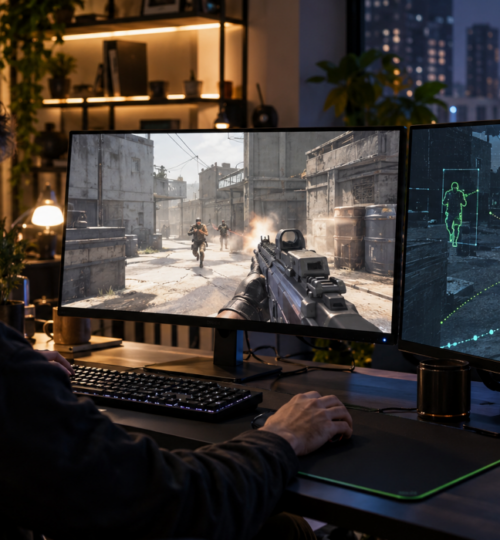
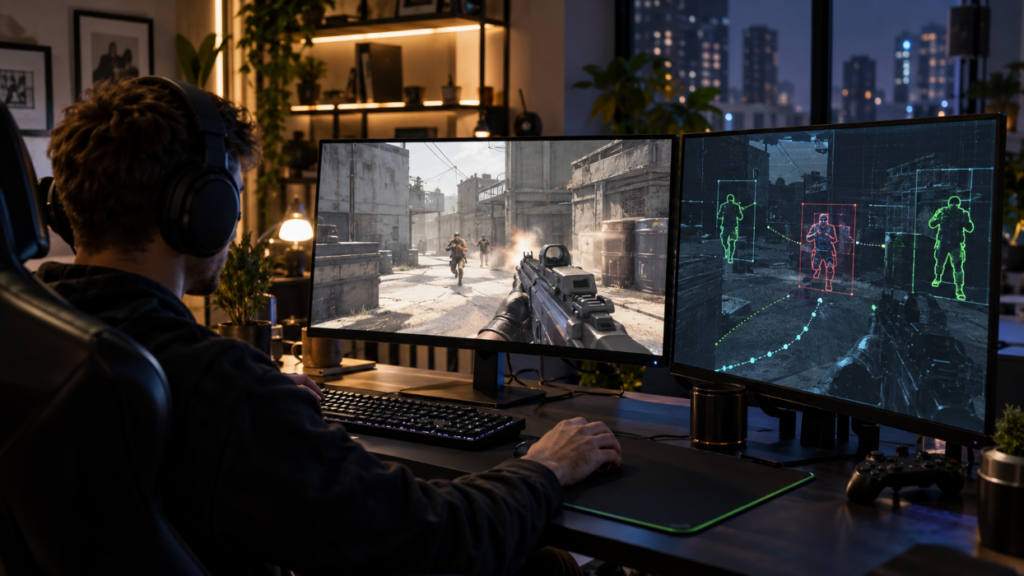
A visual cheat can treat those frames as camera images. A computer vision model looks for shapes, colors, silhouettes, character models, health indicators, or other visible patterns that help it decide where an opponent is located on screen. The software does not need to ask the game engine for an enemy’s coordinates if it can estimate the same answer from the final image being sent to the display.
That distinction is why the term “AI cheat” can be misleading if it is taken to mean something exotic. The AI portion is often an object detector or related vision model performing a task that is routine in other fields: identify an object in an image and estimate where it is. What makes the system a cheat is the next step, where detection is converted into automated gameplay input.
From Detection to Automated Aim
A computer vision model can return a location for an opponent inside the captured frame. From there, the automation layer decides whether the crosshair should move, whether a shot should be triggered, or whether another timed action should occur. The important competitive distinction is that the recognition and decision loop can happen repeatedly, at machine speed, without the player manually performing each correction.
This gives visual cheats a very different dependency chain from old memory-reading aimbots. A traditional cheat may depend on internal offsets, object structures, signatures, or other game-specific data that can change after patches. A screen-reading system cares more about what the game looks like. If character models and visual cues remain recognizable, a patch can change large parts of the executable without necessarily breaking the vision model.
That portability is part of the appeal for cheat developers. The same general method can potentially be adapted across several shooters because humans on a screen still look like humans on a screen, even when the engine underneath them is different. The model may still need retraining or adjustment for art style, team colors, effects, motion blur, visibility, or unusual character designs, but the cheat is no longer tied to one game’s memory layout in the same way.
Why “External” Does Not Mean Invisible
Cheat sellers frequently market visual systems as if staying outside game memory makes them impossible to detect. That claim is too strong. Avoiding direct interaction with the protected process removes some detection opportunities, but it does not erase every observable trace of automated play.
EA explicitly classifies pixel-bots as external cheats that can function as aimbots by reading the screen. Its Javelin anti-cheat program combines specific detections with broader telemetry and other protections, while recent updates have also targeted malicious input devices, macro software, synthetic input, and DMA hardware. In September 2026, EA said it had deployed hundreds of detection updates during the previous year and was continuing work on behavioral analysis and hardware-level protections.
The input itself becomes evidence. Automated assistance can create patterns in reaction time, consistency, recoil correction, target acquisition, or micro-adjustments that differ from normal human play. Activision’s RICOCHET team said in February 2026 that its device detections focus on timing, consistency, response patterns, aim behavior, recoil control, and precision rather than relying only on identifying a particular piece of hardware.
That approach matters for computer vision cheats because the safest place for defenders to look may be the output rather than the cheat process. If a system sees only pixels but produces machine-driven input, the server can still study what those inputs look like over time.
The Rise of the Two-Computer Cheat
The harder version of the problem appears when the vision system moves off the gaming machine entirely. A second PC, capture device, or other external processor can receive video output, analyze the image, and return automated input through another device. In that arrangement, the protected gaming PC can appear relatively clean because the recognition workload is happening somewhere else.
That architecture has moved well beyond theory. Commercial cheat sellers openly advertise external computer vision products built around separate processing devices, capture feeds, and hardware-generated input. Their marketing claims should never be treated as proof of undetectability, but the products themselves demonstrate that the market is actively selling this model rather than merely discussing it as a research experiment.
This also explains why Secure Boot, TPM checks, kernel drivers, and process scanning cannot solve the problem by themselves. Those defenses still matter because they close off many local attack paths, and publishers continue expanding them. They are strongest against threats that compromise the gaming system. A camera-like observer outside that system changes the security boundary.
AI Lowered the Cost of Seeing the Game
Computer vision aimbots existed before the current AI boom, but modern object detection has made the concept much more practical. Widely available vision models can recognize people and objects quickly on consumer GPUs, and the broader machine learning ecosystem has made training, inference, model conversion, and real-time image processing far easier than it was a decade ago.
The result is a lower engineering barrier. Cheat developers no longer need the same level of reverse-engineering knowledge if the rendered image contains enough information to drive automation. They still face latency, false detections, visual clutter, animation changes, smoke, lighting, occlusion, effects, and the need to keep inputs from looking robotic, but the starting point is much more accessible.
Recent academic work treats visual aimbots as a live defensive problem. A July 2026 paper in High-Confidence Computing evaluated defenses against AI-driven visual cheats using a 10,000-image benchmark drawn from Counter-Strike 2, Rust, Marvel Rivals, and Apex Legends. The researchers focused on altering rendered visuals in ways intended to interfere with object detectors while keeping the image acceptable for human players.
That research direction is telling. Instead of only asking how to detect the cheat program, defenders are asking how to make the game image itself hostile to automated vision.
Anti-Cheat Is Moving Toward Behavior and Deception
Behavioral detection is becoming more important because it works even when defenders cannot see the code generating the input. A server already receives a stream of actions from every player. Over enough time, those actions can be studied for patterns that point toward automation, especially when several signals are combined rather than treating one fast flick or one accurate burst as proof.
Activision has been explicit about this direction. Its 2026 security policy says RICOCHET combines client and server detection, application monitoring, hardware validation, and behavioral models designed to identify automated actions with superhuman speed or accuracy. The company also said in September 2026 that its systems analyze gameplay over time for patterns associated with automated assistance.
Visual deception adds another defensive option. Activision previously published research on server-controlled “hallucinations,” game entities visible to cheating systems but designed to expose automated targeting or information gathering. More recent academic work has explored adversarial visual changes and decoy-like techniques aimed specifically at confusing computer vision models. The common idea is to force the cheat to react to information a human would ignore, or to make real targets harder for the model to classify reliably.
False Positives Are the Hard Part
The technical challenge is only half of the problem. Competitive games contain legitimate players with extremely fast reactions, high mouse control, rehearsed recoil patterns, disciplined crosshair placement, and thousands of hours of mechanical practice. Any system that simply bans everyone who looks “too accurate” would punish exactly the players ranked modes are supposed to reward.
That is why publishers talk so much about confidence, layered evidence, and gradual deployment. EA says its detection work is tested against false positives and reports an accuracy rate above 99 percent for its Javelin enforcement, while also maintaining an appeals process. Activision likewise says detection methods are researched and validated before penalties are applied.
Accessibility creates another complication. Devices that remap controls, translate inputs, or support players with disabilities can overlap technically with hardware categories that cheat makers also abuse. The enforcement problem is therefore based on behavior and unfair automation, not simply the existence of unusual hardware. Both EA and Activision have publicly framed this as a distinction their systems need to make.
Competitive Trust Is Becoming a Systems Problem
For players, computer vision cheats are frustrating because they attack something ranked play has always depended on: the assumption that visible mechanical skill came from the person holding the mouse or controller. If software can watch the same pixels a human sees and convert them into highly consistent aim corrections, the old line between “external tool” and “game hack” becomes less useful.
For developers, the response is spreading across the whole stack. Client security still matters. Kernel protection still matters. Secure Boot, TPM-based checks, remote attestation, device detection, server telemetry, replay analysis, account security, and legal action against cheat businesses all cover different failure points. No single layer has to catch every cheat if several layers can make the total system expensive and unreliable to attack.
That broader strategy is already visible in 2026. Activision is pairing behavioral systems with hardware checks and vendor disruption, while EA is extending Javelin toward input manipulation, DMA defenses, machine learning, and stronger platform security. Riot, meanwhile, is openly tracking pixelbots as their own cheating class rather than treating them as a variation of traditional memory hacks.
The long-term contest will probably be decided less by whether anti-cheat can find one forbidden file and more by whether automated play can remain statistically indistinguishable from a skilled human across thousands of small decisions. That is a much harder standard for cheat developers to meet. A vision model can learn to recognize an opponent on screen, but competitive play produces far more information than target location alone, and defenders are increasingly building their systems around that difference.