
Disclaimer: The views and opinions expressed in this article are solely those of the author. The mention of any products, services, or methods does not constitute an endorsement.
The premium controller market has become increasingly competitive in 2026, with third-party manufacturers offering hardware configurations that were once largely associated with expensive first-party accessories. Interchangeable control modules, magnetic thumbstick sensors, adjustable triggers, and programmable rear buttons have become defining features of a growing selection of high-end gamepads. Some controllers now allow players to rearrange their entire button layout, while others concentrate on replaceable components, specialized inputs, and improved connectivity between gaming platforms.
For competitive multiplayer players, these developments address familiar concerns about comfort, precision, and long-term reliability. A controller’s physical layout influences how easily players execute movement combinations, maintain camera control, and perform repeated actions under pressure. Hardware durability matters as well, especially when a worn analog stick can make an otherwise functional controller unsuitable for competitive play.
The expanding market has also made purchasing decisions more complicated. Manufacturers frequently describe their controllers as modular or customizable, although those terms can represent substantially different capabilities. Understanding which components can actually be replaced, how the hardware communicates with a console, and what features remain supported over time is becoming increasingly relevant to players considering premium equipment.
How Modular Controllers Became a Serious Alternative
Premium controller customization developed gradually through products such as Microsoft’s Xbox Elite Wireless Controller Series 2 and Sony’s DualSense Edge. Microsoft’s controller introduced an established collection of interchangeable thumbstick caps, adjustable stick tension, rear paddles, and trigger stops. Sony subsequently expanded the concept with replaceable analog stick assemblies, giving PlayStation 5 owners a direct way to address certain hardware failures without replacing the complete controller.
The distinction between interchangeable accessories and replaceable internal components remains important. Swapping a thumbstick cap can improve grip or change the effective stick height, but it cannot repair a failing position sensor. Sony’s DualSense Edge replacement stick module demonstrates a more substantial approach by allowing owners to remove an entire analog assembly and install a compatible replacement.
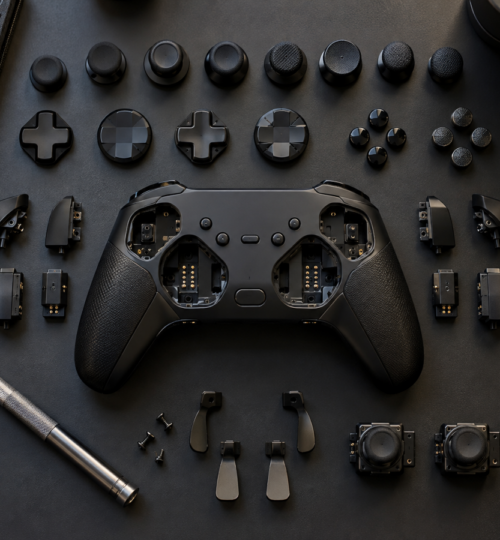
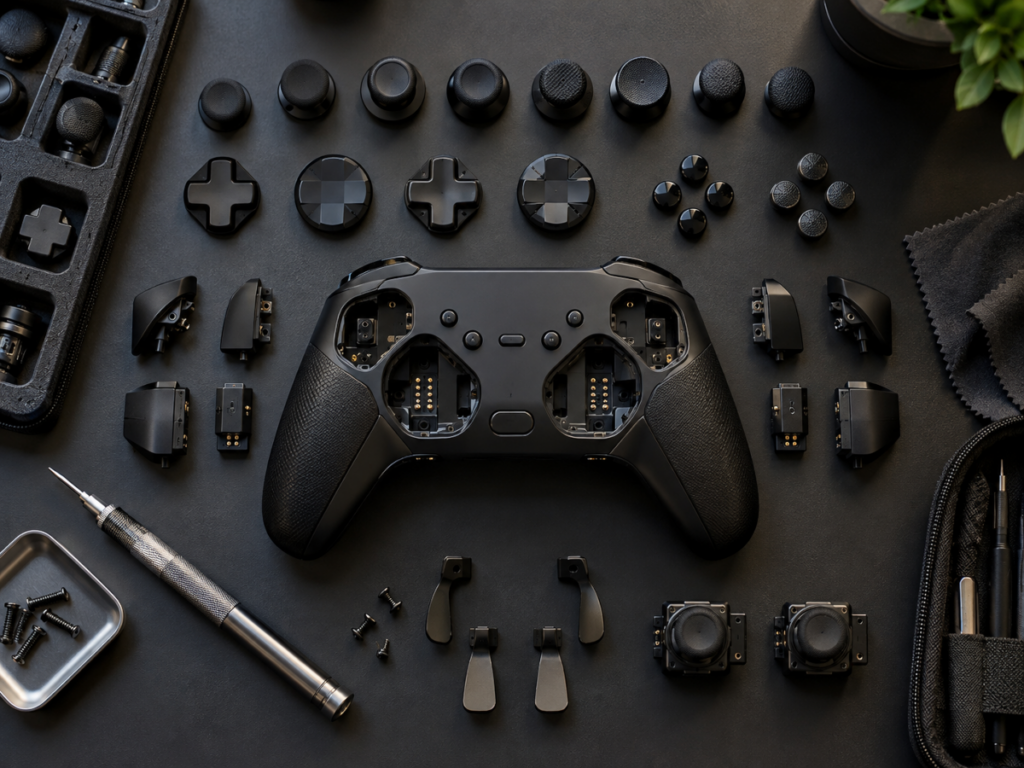
Third-party manufacturers have extended modular design into areas that first-party premium controllers generally leave unchanged. Some models allow players to move the analog sticks into symmetrical or asymmetrical arrangements, while others substitute traditional face buttons with six-button layouts designed for fighting games. Interchangeable triggers, removable batteries, and specialized directional controls further expand the available configurations.
These designs appeal to players who regularly switch between genres, although the benefits depend on how each controller implements its removable components. A modular system can offer considerable flexibility, but proprietary replacement parts, limited availability, and differences in console compatibility can reduce its practical value.
Victrix Pro BFG Reloaded Expands Physical Customization
The Turtle Beach Victrix Pro BFG Reloaded represents one of the more comprehensive implementations of modular controller hardware. Released globally in September 2025, the updated model builds upon the original Pro BFG with Hall Effect thumbsticks and triggers, an improved Fightpad module, and extensive physical customization. Separate officially licensed versions support PlayStation and Xbox platforms, while a distinct PC edition offers a different combination of included components.
Turtle Beach’s official Pro BFG Reloaded announcement describes three modular control sections and 11 interchangeable components, including alternative thumbstick caps, directional pads, and stick gates. The console versions also include a redesigned six-button Fightpad featuring Kailh microswitches. That module allows players to replace a conventional face-button arrangement with controls better suited to certain fighting-game inputs.
The ability to modify the physical layout is particularly relevant to gamers who participate in several competitive genres. A conventional dual-stick configuration works naturally for shooters, while the Fightpad offers a more specialized button arrangement for fighting games. Players can also experiment with different stick positions rather than adapting to a permanently fixed arrangement.
Four programmable rear buttons provide additional input options, while five-position adjustable triggers allow players to change trigger travel. Shorter travel can be useful when repeatedly activating digital-style controls in shooters, whereas longer movement remains preferable for games requiring progressive analog input. These adjustments affect the controller’s physical behavior without requiring changes to a game’s control scheme.
The Reloaded model introduces improvements over its predecessor, although the PlayStation version still lacks the DualSense’s adaptive triggers and advanced haptic feedback. That omission may be acceptable for competitive players who prioritize interchangeable controls, but it reduces the controller’s appeal for games designed around Sony’s distinctive feedback features. At its original U.S. suggested retail price of $209.99, buyers must decide whether modularity provides enough value to justify those compromises.
Thrustmaster ESWAP X2 H.E Focuses on Replaceable Precision
Thrustmaster has developed its ESWAP controller family around interchangeable modules and customizable control arrangements. The ESWAP X2 H.E combines that architecture with the company’s H.E.A.R.T. magnetic sensor technology, giving Xbox and PC players an alternative to conventional potentiometer-based thumbsticks.
The ESWAP X2 H.E product specifications describe hot-swappable modules, mechanical face buttons, four remappable rear buttons, and configurable analog stick positioning. Players can arrange the sticks symmetrically or asymmetrically, depending on their preferences. ThrustmapperX software provides further control over stick sensitivity, trigger activation settings, and button assignments.
The replaceable modules also provide a maintenance advantage. Instead of disassembling the complete controller to reach a failed analog assembly, owners can exchange compatible modules using the system’s removable design. Replacement cost and availability still depend on Thrustmaster’s accessory ecosystem, and buyers must verify compatibility with the specific ESWAP generation they own.
One limitation is the controller’s wired-only connection. For players using a fixed desk setup or competing at organized events, a cable may be entirely acceptable and eliminates concerns about wireless battery life. Console gamers who prefer playing from a couch may find the lack of wireless functionality harder to accommodate, particularly given the controller’s premium pricing.
Hall Effect and TMR Sensors Are Changing Analog Stick Design
Analog stick drift remains one of the most persistent complaints surrounding modern controllers. Traditional potentiometer-based sticks measure movement through electrical contact along resistive surfaces, which can deteriorate through repeated use. Wear, contamination, and changes in mechanical centering can eventually cause unwanted movement or inconsistent input readings.
Hall Effect sensors measure changes in magnetic fields rather than depending on the same sliding electrical contacts. This removes an important source of sensor wear and can improve long-term reliability when the surrounding mechanical components remain in good condition. Manufacturers have increasingly adopted the technology in premium controllers, particularly as competition has intensified around durability and precision.
Tunnel Magnetoresistance, commonly abbreviated TMR, offers another magnetic sensing approach. TMR sensors detect magnetic-field changes through variations in electrical resistance and can provide high sensitivity with relatively low power consumption. The GameSir G7 Pro, for example, incorporates TMR analog sticks alongside Hall Effect triggers, microswitch controls, and programmable buttons.
Magnetic sensors should not be interpreted as a complete solution to controller drift. The physical centering mechanism still depends on moving parts, and worn springs, damaged assemblies, calibration errors, or electrical faults can affect performance. Marketing descriptions that promise drift-free operation generally emphasize the elimination of potentiometer contact wear rather than immunity to every possible malfunction.
Sensor performance also depends on firmware and signal processing. Resolution, deadzone configuration, filtering, and response curves influence how physical stick movement becomes a digital input. A controller equipped with advanced magnetic sensors can still feel inconsistent if its calibration or processing introduces unexpected behavior.
For competitive players, predictable input behavior is often more useful than impressive technical specifications alone. Consistent centering, accurate movement detection, and stable response curves contribute to aiming and movement control, particularly when players have developed muscle memory around a specific sensitivity configuration.
Specialized Layouts for Shooters and Fighting Games
Different competitive genres place different demands on controller hardware. Fighting games depend heavily on consistent directional inputs and reliable button activation, while shooters require precise analog movement and convenient access to actions performed during aiming. A design that works well for one genre may introduce unnecessary complexity in another.
The Turtle Beach Stealth Pivot controller illustrates an alternative approach to modular design. Its rotating control sections allow players to change between a conventional arrangement and a configuration intended for fighting and retro-style games. The adjustment takes place through built-in rotating assemblies rather than requiring users to remove and install separate modules.
The Stealth Pivot also includes Hall Effect thumbsticks, adjustable trigger stops, programmable controls, and an integrated display for configuration and notifications. Its connection options vary by platform, with wireless support on Windows PCs and a wired connection required for Xbox consoles. This makes it a more natural fit for players who frequently change genres on PC than for someone seeking an entirely wireless Xbox setup.
For shooter players, rear buttons often provide one of the most immediately useful premium features. Moving jump, crouch, reload, or equipment commands to rear controls can reduce interruptions to camera movement because the right thumb can remain on the analog stick. The benefit depends on comfortable button placement and the player’s ability to operate those controls without accidental presses.
Fighting-game competitors have different priorities, particularly around directional accuracy, button spacing, and activation feel. A six-button face layout may be more useful than additional rear paddles, while mechanical switches can provide distinctive tactile feedback during repeated inputs. Personal preference remains substantial because controller shape and hand positioning influence comfort during extended matches.
SteelSeries Brings a Different Form of Modularity to Xbox and PC
SteelSeries entered the premium Xbox controller category with the Aeon Pro, introduced on September 8, 2026. The controller launched with a U.S. suggested retail price of $259.99, placing it near the upper end of the consumer market. Its design emphasizes system connectivity, battery management, and onboard configuration rather than extensive rearrangement of the primary control layout.
The official SteelSeries Aeon Pro announcement details the company’s QuickSwitch docking system, Hall Effect thumbsticks, mechanical switches, programmable rear buttons, and an integrated OLED display. The dock is designed to simplify switching between connected Xbox and PC systems, addressing a practical inconvenience for players who regularly use both platforms.
A removable dual-battery arrangement provides another form of modularity. One rechargeable battery can power the controller while the other remains available for charging, allowing users to exchange batteries without relying entirely on a charging cable. The controller also includes interchangeable thumbstick caps that can be stored in its docking system.
SteelSeries’ approach differs from the Victrix and Thrustmaster designs because it concentrates on the surrounding controller experience. The interchangeable stick options change the player’s physical contact with the controls, but the announced system does not provide the same rearrangeable face-button sections or user-replaceable analog assemblies found in more extensively modular competitors. Its central advantages concern how the controller connects, remains powered, and manages configurations.
Those features may be especially convenient for gamers who alternate between PC and Xbox throughout the week. Someone who plays exclusively on one console could find considerably less value in the docking arrangement, however, and may prefer to direct the additional expense toward replaceable analog modules or specialized controls.
Console Compatibility Remains a Major Restriction
Console manufacturers maintain hardware requirements that third-party controller makers must satisfy. A gamepad functioning correctly through USB on Windows does not automatically provide native compatibility with PlayStation 5 or Xbox Series consoles. Supported connection methods, licensed hardware capabilities, and game-specific requirements can differ substantially.
Sony maintains an accessory licensing program that includes products such as the Victrix Pro BFG Reloaded and Nacon Revolution 5 Pro. The company’s official PlayStation accessories catalog identifies supported third-party controllers, giving buyers a reliable starting point for checking compatibility. Even officially licensed products may omit features available on Sony’s first-party hardware.
Xbox compatibility presents additional concerns because Microsoft began restricting unauthorized third-party accessories in 2023. Some controllers and adapters without the appropriate authorization can encounter connection restrictions, regardless of whether they function on a Windows computer. Checking for official Xbox licensing is especially important when purchasing unfamiliar brands or imported accessories.
Compatibility also includes secondary functions that may matter during multiplayer sessions. Headset audio, microphone support, vibration, wireless communication, and configuration profiles can vary between platforms. Players should check the exact connection requirements of their chosen controller rather than assuming its advertised features operate identically on every supported system.
Polling Rates and Trigger Adjustments Need Context
High polling rates have become a prominent selling point for competitive controllers. Polling rate describes how frequently a device reports its input state, with higher rates providing more frequent opportunities for updated input information to reach the connected system.
A polling rate of 250 Hz corresponds to a four-millisecond reporting interval, while 1,000 Hz corresponds to one millisecond. Those figures describe the nominal interval between reports, not the complete delay between a player’s physical action and its appearance on screen. Controller processing, communication overhead, game input handling, rendering, and display response all contribute to total input latency.
The Razer Wolverine V3 Pro provides a useful example of platform-specific performance differences. Razer’s published specifications identify a 250 Hz polling rate when connected to Xbox or operating wirelessly, while a special wired PC tournament mode supports 1,000 Hz. The official Wolverine V3 Pro specifications make that distinction clear, demonstrating why advertised maximum polling rates should be evaluated alongside connection and platform requirements.
Adjustable triggers provide another example of hardware specifications that require practical interpretation. A short trigger stop can reduce the movement required for repeated shooting inputs, but it does not eliminate every source of input delay. Racing games and other titles that depend on variable analog pressure generally benefit from retaining a greater range of trigger travel.
Programmable buttons also deserve attention in organized competition. Most conventional remapping simply relocates an existing input to another physical button, while automated input sequences and rapid-fire functions can create separate competitive integrity concerns. Tournament organizers may restrict specific programmable features, so players should review event rules before relying on specialized controller configurations.
Repairability May Become Modularity’s Most Valuable Feature
Premium controller pricing creates a difficult ownership calculation when internal components begin failing. A controller costing approximately $180 to $260 represents a substantial investment, particularly for players who use their equipment heavily. Replacing the entire device because of a worn analog assembly can be expensive when its buttons, housing, triggers, and electronics otherwise remain functional.
Replaceable stick modules offer a practical alternative. A player experiencing problems with a compatible removable module may be able to install a replacement without performing complicated repairs or purchasing another controller. This approach also makes it easier to maintain familiar equipment, preserving the physical feel and configuration that a player has spent time learning.
The benefits depend on continued replacement-part availability. A modular controller becomes less economical if proprietary parts disappear from retail channels after a product revision or if newer modules cannot operate with older hardware. Manufacturers that maintain consistent accessory compatibility across generations could offer a meaningful advantage for long-term ownership.
Modular construction introduces engineering challenges as well. Removable sections require electrical connections and mechanical retention systems capable of handling repeated installation without developing looseness or intermittent contact. A poorly implemented modular interface can introduce reliability problems that would be less likely in a permanently assembled controller.
Warranty coverage adds another consideration. Routine module replacement may be permitted while deeper disassembly remains restricted, and separately purchased components can have different warranty terms from the original controller. Players considering a premium modular design should examine its support policies and available spare parts before treating repairability as an established long-term benefit.
Choosing a Controller Around Actual Playing Requirements
The growing selection of premium controllers makes it easier to find hardware suited to particular habits, but additional customization does not automatically translate into better performance. A shooter player who consistently uses rear buttons and short trigger stops may benefit more from comfortable ergonomics than from interchangeable face-button modules. Someone who frequently alternates between fighting games and shooters has stronger reasons to consider a controller whose physical layout can change.
Software support can be as important as the mechanical design. Deadzone adjustment, sensitivity curves, firmware updates, and onboard profile storage all affect how a controller behaves throughout its working life. Dependence on proprietary software becomes a potential limitation if updates stop, operating system compatibility changes, or essential settings cannot be modified directly from the device.
The expense also extends beyond the initial purchase. Replacement modules, alternative thumbsticks, specialized button sections, and proprietary accessories can increase the total cost of ownership. A comparatively expensive controller with affordable, consistently available replacement parts may ultimately cost less to maintain than a cheaper model that requires complete replacement after a hardware failure.
For established competitive communities, equipment consistency introduces an additional consideration. Players who practice with a particular controller develop familiarity with its grip, stick resistance, button placement, and activation behavior. Maintaining that configuration through component replacement can be preferable to adapting to a different controller during an active competition season.
Tournament organizers and team managers may also find practical advantages in serviceable controller hardware. Maintaining replacement modules and spare components could reduce equipment interruptions, especially at local events where hardware support is limited. That benefit depends on manufacturers supplying parts reliably and designing their systems for repeated maintenance.
The most revealing test for today’s modular controllers may arrive several years after purchase. Models with dependable replacement components, stable firmware, and durable connection mechanisms will demonstrate whether modularity provides lasting value beyond customization at launch. As manufacturers introduce new controller generations, their willingness to maintain compatibility with existing accessories will help determine which designs remain useful to competitive players long after their original release.