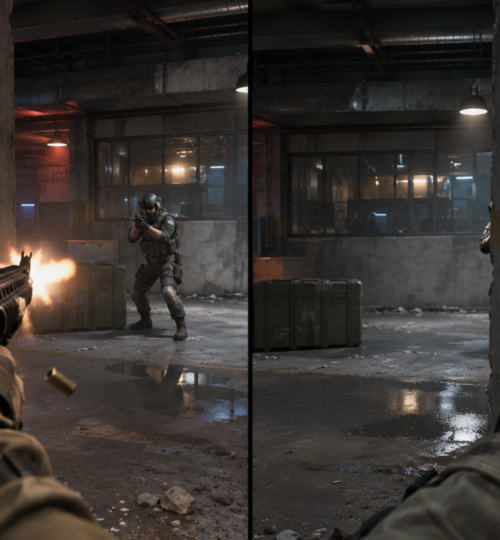
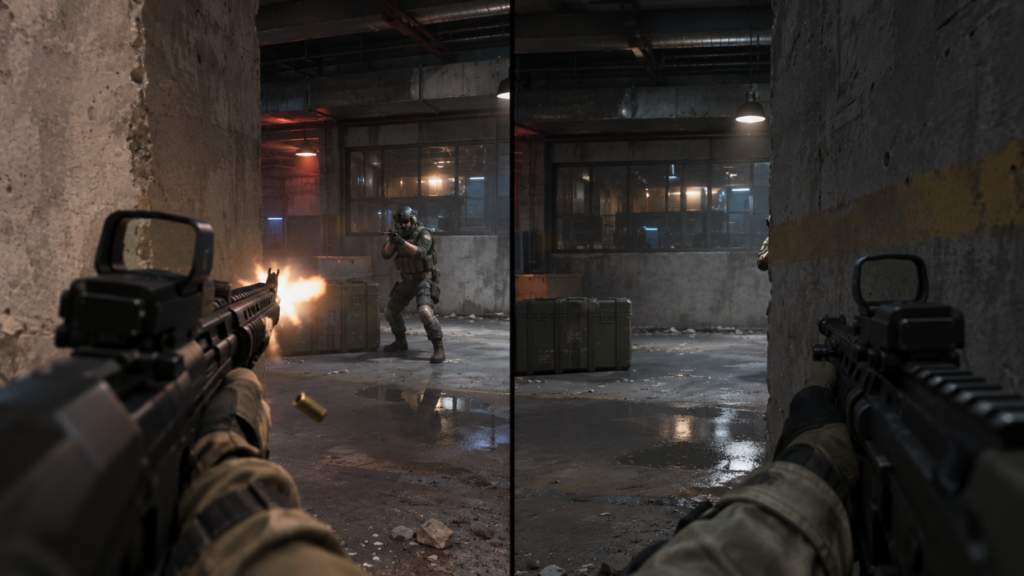
A player rounds a corner in a competitive shooter, fires a headshot, and wins the engagement before the defender appears to react. From the defender’s perspective, the opponent was barely visible before the death animation began. Both players believe their timing was correct, yet the server has already determined the outcome.
This familiar situation remains one of the most frustrating aspects of competitive multiplayer gaming. Known as peeker’s advantage, the phenomenon has challenged developers since the early days of online first-person shooters. Despite substantial improvements in server infrastructure, network prediction, and hit registration, the problem persists in 2026.
Games such as Counter-Strike 2, VALORANT, and Rainbow Six Siege have invested heavily in networking technologies intended to reduce the effects of latency. Their approaches differ, but they share a difficult technical problem: players expect immediate responses to their actions while their computers exchange information across networks that introduce unavoidable delays. Recent research suggests that improvements in client performance and network synchronization can reduce peeker’s advantage considerably, although eliminating it entirely remains beyond conventional online multiplayer architecture.
Why Peeker’s Advantage Exists
Peeker’s advantage begins with a fundamental difference between what players see locally and what the game server knows. In a server-authoritative multiplayer game, each player’s computer renders its own representation of the environment using information received from the server. That information is always slightly delayed, even when the connection is excellent.
Consider two players approaching a corner. The defender remains stationary, watching an expected entry point, while the attacker moves toward the opening. When the attacker rounds the corner, their computer immediately predicts and displays that movement without waiting for server confirmation.
The defender cannot see that movement until the attacker’s positional information reaches the server, gets processed, and travels back to the defender’s computer. During that interval, the attacker may already have a visible target while remaining hidden on the defender’s screen. The difference can provide enough opportunity to identify an opponent, adjust aim, and fire before the defender receives the information needed to react.
The severity depends on network latency, server processing, client frame rates, and the buffering used to maintain smooth movement. These delays accumulate across different parts of the communication process, producing an information advantage that can become substantial relative to the time required to win a gunfight. The exact timing also depends on how the game handles character movement, camera position, and hit validation.
In its technical explanation of VALORANT’s netcode, Riot Games demonstrated how these delays affect competitive engagements. The developer’s 2020 analysis showed how reducing server processing time, lowering network latency, and increasing client performance could narrow the attacker’s reaction-time advantage. During internal testing, skilled players could identify changes of approximately 10 milliseconds in peeker’s advantage, while differences around 20 milliseconds noticeably affected engagements.
Those results came from Riot’s development tests rather than a universal benchmark for every shooter. Nevertheless, they demonstrate how small timing differences can influence matches involving highly skilled opponents. When players have comparable aim and reaction times, a few additional milliseconds can determine whether a defender fires successfully or dies before responding.
Does Higher Ping Actually Give Attackers an Advantage?
A persistent belief among competitive players is that deliberately increasing ping can make aggressive peeking more effective. The explanation suggests that a high-latency attacker can move farther around a corner before the defender receives an updated position. Although the idea sounds plausible, it overlooks how servers process shots and determine combat outcomes.
In a server-authoritative system with appropriate hit validation, higher latency also delays the attacker’s commands reaching the server. The attacker may see an opponent on their own screen, but the shot still requires server validation. Increasing the attacker’s ping does not automatically create additional time to win an engagement, even though the resulting visual discrepancies can make encounters appear inconsistent.
Ubisoft addressed this distinction in its technical discussion of ping abuse and peeker’s advantage for Rainbow Six Siege. The developer explained that the defender’s latency was especially important in determining the available reaction window. Under the networking model described in its 2017 analysis, an attacker with higher ping did not automatically receive a greater advantage simply by moving out of cover.
Experimental research has provided support for that distinction. A study published at the 2024 Foundations of Digital Games conference, The Effects of Network Latency on the Peeker’s Advantage in First-person Shooter Games, examined player engagements using a modified open-source shooter.
The researchers varied network latency and the distance players stood from a corner. Their results indicated that the defender’s latency had a greater effect on peeker’s advantage than the attacker’s latency. The study also found that the advantage was smallest when the peeker stood nearest the corner, demonstrating that positioning and visibility geometry influence the outcome alongside networking delays.
These findings do not establish that high-ping opponents behave identically across every shooter. Games apply different lag-compensation limits and hit-validation rules, while packet loss and inconsistent latency can introduce additional synchronization problems. They do challenge the assumption that intentionally increasing ping provides a reliable advantage across modern competitive games.
How Modern Netcode Reduces Peeker’s Advantage
Modern multiplayer netcode relies on several mechanisms working together to maintain responsive gameplay. Server tick rates receive much of the attention, but client-side prediction, interpolation, and lag compensation can have equally important effects on what players experience. Improving one component does not guarantee that the entire networking system will feel more responsive.
Higher Server Tick Rates
A server’s tick rate determines how frequently its simulation advances. At 64 ticks per second, each simulation interval lasts approximately 15.625 milliseconds. At 128 ticks per second, that interval decreases to approximately 7.8125 milliseconds.
Higher tick rates allow servers to process simulation changes at finer intervals, potentially reducing certain forms of timing delay. However, tick rate alone does not determine how quickly an opponent appears on another player’s monitor. Packet delivery, server workload, client rendering, and interpolation all contribute to the result.
VALORANT adopted 128-tick servers as part of its original competitive networking design. Riot combined that approach with regional infrastructure, optimized server processing, and small movement buffers intended to limit unnecessary delay. The objective was to reduce the time between an action occurring and other players receiving visible information about it.
Higher tick rates also impose additional computational demands. Servers must perform simulation work more frequently, and the benefits depend on maintaining consistent processing times under actual match conditions. A server advertising 128-tick operation offers limited reassurance if its hardware cannot sustain that rate reliably.
Client-Side Prediction and Interpolation
Client-side prediction makes movement feel responsive by allowing a player’s computer to display the expected result of an input immediately. Without prediction, movement could feel delayed by the time required for commands to travel to the server and receive confirmation. The local client therefore operates slightly ahead of the authoritative information it receives.
Interpolation addresses a different problem. Since remote player positions arrive through discrete network updates, the client smooths movement between known positions instead of displaying abrupt jumps. This generally makes opponents easier to track, but maintaining a buffer of previous updates introduces additional visual delay.
Reducing interpolation can improve responsiveness under stable conditions. Setting it too aggressively increases the risk of visible stuttering when packets arrive late or unevenly. Developers must balance smooth character movement against the competitive value of receiving positional information as quickly as possible.
Lag Compensation and Server Rewind
Lag compensation allows a server to evaluate certain actions using an earlier representation of the game world. When a player fires at an opponent, the server can reconstruct relevant positions from the time associated with that shot instead of judging everything against the latest server state.
This improves hit registration for players experiencing ordinary network delays. Without compensation, players would frequently need to aim ahead of moving targets to account for the time their commands spend traveling across the network. Server rewind allows shots that were accurately aimed on a player’s screen to remain valid under appropriate conditions.
The disadvantage becomes apparent when a defender reaches cover but is subsequently killed by a shot that was valid against an earlier position. The attacker may have fired before the defender reached safety on the attacker’s screen, while the defender receives the result after moving behind the wall. These situations contribute to complaints about dying behind cover, even when the server’s decision follows its configured validation rules.
Developers therefore restrict how far backward the server can evaluate combat events. More generous compensation can improve shooting consistency for higher-latency players, but may increase the frequency of deaths that appear to occur behind cover. Stricter limits can reduce those situations while making shots less reliable for participants connecting from distant regions.
Counter-Strike 2 and the Limits of Sub-Tick Networking
Counter-Strike 2 introduced a networking approach built around sub-tick input timing. Instead of relying exclusively on regular server tick boundaries to determine when an input occurred, the system records more precise timing information for supported actions. This allows certain events to be evaluated according to when they occurred between simulation updates.
In principle, a shot fired just after one tick can retain its more precise timing rather than being treated as though it happened at the next tick boundary. However, accurate input timestamps do not eliminate the communication delay between players. An accurately recorded shot can still be evaluated against positions that another player experienced differently because of network latency and interpolation.
Valve acknowledged the continuing problem in its February 2024 Counter-Strike 2 networking update. The company reported reducing steady-state peeker’s advantage by approximately 16 milliseconds and decreasing the frequency of unusually large delays associated with excessive command queue depth.
The update also introduced buffering options intended to smooth gameplay when packets were lost. These settings illustrate a continuing compromise because additional buffering can reduce visible stuttering while increasing latency. A smoother connection may consequently feel less responsive if its buffering introduces too much delay.
What Recent CS2 Testing Suggests
The discussion remains active in 2026. In October, YouTube creator Gilborg conducted a comparison involving Counter-Strike: Source, Counter-Strike: Global Offensive, and Counter-Strike 2. The experiment involved repeated engagements in which one player held an angle while another peeked.
As described in an October 2026 report examining the comparison, the participants completed 120 duels in each game. The peeking player won approximately 46% of engagements in Counter-Strike: Source, 47% in CS:GO, and 58% in Counter-Strike 2. The results suggested a greater advantage for the attacking player under the experiment’s conditions.
Those figures require caution. A limited player sample, individual reaction times, differences in game mechanics, and the relatively small number of engagements make it impossible to isolate netcode as the cause of the observed variation. The experiment measured match outcomes rather than directly measuring the milliseconds of visual advantage experienced by each player.
Still, the comparison raises a reasonable question about how Counter-Strike 2 rewards aggressive movement relative to earlier entries. If active peeking produces better results than stationary defense under otherwise comparable conditions, the tactical consequences deserve investigation. Properly controlled testing across multiple network conditions would be necessary before attributing that difference to sub-tick processing or another specific technical feature.
What New Research Reveals in 2026
A study published in IEEE Transactions on Games in 2026 offers additional evidence about the factors influencing peeker’s advantage. Researchers Costas Michaelides and Boris Bellalta examined the problem through simulations modeling client behavior, server processing, network delays, and player reaction times.
Their paper, Demystifying the Peeker’s Advantage in Multiplayer First-Person Shooter Games, reported that client frame rate was the most influential factor in their simulated configurations. The researchers found that a game operating at 120 frames per second with a 60-tick server could reduce peeker’s advantage below 100 milliseconds.
The study also reported comparatively small effects from server tick rate and network delay within its modeling assumptions. These findings should not be interpreted as proof that ping and tick rate are unimportant in commercial multiplayer games. The results describe the behavior of an abstract simulation model, while actual games differ in their buffering, movement prediction, hit validation, and rendering implementations.
The research nevertheless identifies an area that competitive discussions sometimes overlook. Increasing server tick rate cannot provide its full potential benefit if a client’s rendering pipeline remains slow or inconsistent. A high-performance graphics system and monitor can improve the speed at which incoming positional information becomes visible, even though they cannot accelerate packets traveling across the internet.
That distinction places client-side performance alongside server infrastructure as a meaningful part of competitive responsiveness. It also helps explain why players using the same server and similar internet connections may experience different levels of apparent peeker’s advantage.
Why Low Ping Doesn’t Guarantee Fair Gunfights
Ping is normally displayed as the round-trip time between a player and the server. A connection showing 15 milliseconds is generally preferable to one showing 80 milliseconds, provided other network characteristics are comparable. However, the displayed value does not describe every delay involved in an engagement.
Two players with identical ping can experience different results because their systems process inputs, render frames, and handle network updates at different speeds. A computer producing 240 frames per second has a theoretical frame interval of approximately 4.17 milliseconds. At 60 frames per second, that interval rises to approximately 16.67 milliseconds.
Actual display latency depends on more than these intervals, including input processing, rendering queues, synchronization settings, and monitor behavior. Nevertheless, the difference illustrates why high frame rates can contribute to faster visual feedback. A player using a responsive display and a consistently performing computer may receive actionable information sooner than an opponent with comparable network latency.
Frame-time consistency also matters. A system averaging 180 FPS may still experience occasional long frames caused by CPU scheduling, shader compilation, or background processing. Those interruptions can delay the appearance of an opponent at precisely the wrong moment.
Network stability introduces another complication. Jitter occurs when packet arrival times vary, forcing the game to manage uneven updates. Packet loss can require prediction or recovery mechanisms, while congestion and excessive router buffering can increase latency during periods of network activity.
A stable 35-millisecond connection may consequently produce more consistent engagements than one displaying 20 milliseconds but suffering frequent latency spikes. Competitive quality depends on the behavior of the entire connection rather than the lowest ping number displayed on a scoreboard. This is particularly relevant to players whose household networks experience competing traffic from downloads, streaming devices, or other connected systems.
Can Modern Netcode Eliminate Peeker’s Advantage?
Completely eliminating the underlying information delay would require both players to experience changes in the game world simultaneously. Conventional internet connections cannot provide that synchronization because information takes time to travel between separate computers. Even a local network introduces processing and transmission delays, although they are usually much smaller than those associated with distant online servers.
One theoretical approach would involve delaying local movement until the server confirms every action. That could eliminate certain differences between locally predicted and authoritative movement, but it would make controls feel sluggish for most competitive shooters. Client-side prediction remains valuable because players expect immediate responses to their inputs.
Another possibility involves artificially delaying low-latency players to bring their experiences closer to those of higher-latency opponents. Such systems might reduce particular timing disparities, but they would also penalize participants who maintain better connections. Artificial delay can make a game feel less responsive without resolving every difference in rendering or hit validation.
Developers have therefore concentrated on reducing latency and limiting situations in which network conditions produce extreme outcomes. Better regional server coverage, improved routing, efficient simulation processing, and carefully adjusted compensation systems can all contribute to that objective. The effectiveness of each improvement depends on the game’s networking architecture and the conditions under which matches are played.
Game design also affects how much benefit an attacker can extract from an early glimpse of an opponent. Movement acceleration, character visibility, map geometry, and weapon accuracy influence the available reaction window. A shooter that requires attackers to stop before firing accurately can partially offset the networking advantage through its movement and shooting mechanics.
These decisions help explain why peeking feels different across competitive titles even when their network conditions are similar. An aggressive swing that works well in one game may be punished heavily in another because of differences in movement penalties, weapon behavior, or defensive positioning.
What Peeker’s Advantage Means for Competitive Play
Understanding peeker’s advantage changes how experienced players evaluate defensive positioning. Holding a predictable angle while remaining completely stationary can provide an opponent with a straightforward target, particularly when the attacker already knows the defender’s location. The defender may have limited opportunity to react once the attacker’s movement becomes visible.
Changing positions, varying distance from corners, and holding less predictable sightlines can reduce that exposure. The correct approach depends on the game’s movement mechanics, weapon behavior, and map geometry. An aggressive repositioning maneuver may be effective in one situation while exposing the defender to multiple attackers in another.
Coordinated teams have additional ways to limit the problem. Utility that restricts vision or forces movement can reduce an attacker’s ability to exploit a favorable timing window. Crossfires and coordinated defensive positions also create problems that cannot be solved simply by gaining a few milliseconds of visual information.
For tournament organizers, network consistency remains an essential part of competitive conditions. Regional server selection, stable server performance, and clear connection requirements can reduce avoidable differences between participants. Online competitions involving geographically distant teams face particular difficulties because a single server location may favor one region over another.
Local-area-network tournaments reduce many of these problems by placing participants much closer to the game server. They can substantially lower network delays, although client rendering and simulation timing still prevent completely instantaneous synchronization. Consistent hardware configurations and controlled network conditions can also make competitive results easier to evaluate.
Tournament administrators examining disputes over hit registration should distinguish ordinary latency effects from server instability or configuration problems. A single recording rarely provides enough information to establish precisely what both clients displayed when a shot occurred. Server-side timing data, network statistics, and synchronized recordings offer a stronger basis for investigating repeated problems.
Server providers face similar scrutiny. A service advertising a high tick rate offers limited assurance if it cannot sustain consistent simulation timing, while a low reported ping cannot compensate for unstable packet delivery. Competitive communities evaluating hosting arrangements should pay attention to server performance under load, routing consistency, and the game’s actual networking requirements.
The most useful improvements may come from identifying where avoidable delay accumulates rather than concentrating on a single headline specification. A server that processes actions consistently, clients that render incoming updates promptly, and network paths that avoid unpredictable latency can collectively produce more reliable engagements. Measuring those components separately gives developers and competitive organizers a better chance of identifying the specific conditions responsible for questionable gunfights.