
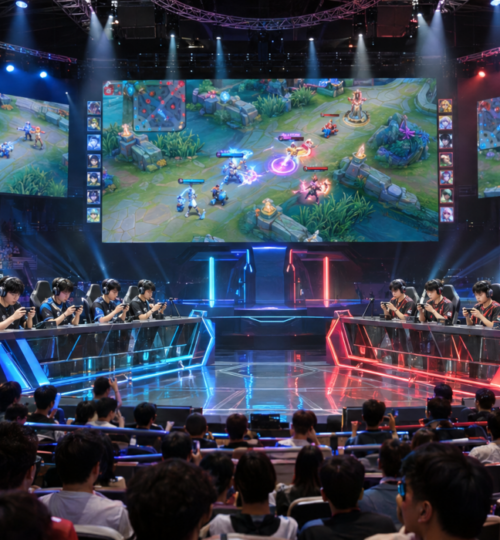
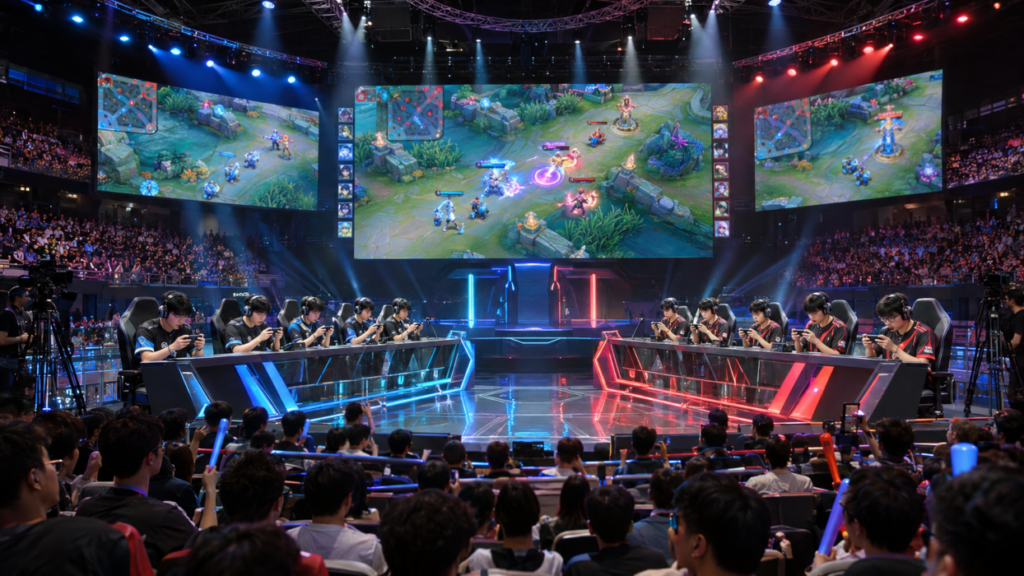
A smartphone tournament can now draw a larger live audience than some of the biggest PC esports events. In January 2026, the Mobile Legends: Bang Bang M7 World Championship reached roughly 5.68 million peak concurrent viewers, a figure that places mobile competition among esports’ largest spectacles. The numbers make it difficult to dismiss mobile esports as a minor extension of casual phone gaming.
A separate industry forecast predicts that mobile esports will grow at a compound annual rate of 27.6% from 2026 through 2036. That projection suggests substantial commercial opportunity, but it describes expected market growth, not an increase already achieved. The distinction matters because record-breaking finals, year-round audience engagement, and esports revenue measure different things.
What the 27.6% Esports Growth Forecast Actually Measures
Future Market Insights’ esports market forecast projects 27.6% compound annual growth for the mobile platform segment between 2026 and 2036. It estimates the overall esports market at $4.5 billion in 2026 and $30.7 billion in 2036, equivalent to 21.1% annualized growth. The mobile figure is therefore a projection for one segment, rather than an observed increase in tournament viewers or smartphone game sales.
Compounding makes that forecast ambitious. Ten consecutive years of 27.6% growth would make a market more than eleven times its starting size, assuming the projection materialized. The publicly available summary does not provide enough detail to establish exactly how much mobile esports revenue would begin with, so the percentage cannot reliably be converted into a mobile-specific dollar total.
The distinction between mobile gaming and mobile esports is equally important. Spending on a game’s cosmetics, battle passes, or other in-app purchases contributes to the broader games business, but does not automatically become revenue for professional competition. Esports generates its own commercial activity through arrangements such as sponsorship, media rights, live events, and publisher support, with different accounting methods across industry reports.
Mobile Gaming’s Scale Creates an Opening for Esports
The broader mobile market is already enormous. Newzoo’s 2026 global games market figures forecast $213.9 billion in gaming revenue worldwide, including $121.1 billion from mobile, or 57% of the total. Console revenue is projected at $46.9 billion and PC at $45.9 billion, while mobile revenue itself is expected to grow 6.8% year over year.
That 6.8% forecast and the 27.6% mobile esports forecast are not competing estimates of the same market. One addresses revenue from mobile games, while the other models growth in organized competitive gaming over a much longer period. What the figures do establish is that esports publishers can recruit from a large existing population of smartphone players, without first persuading them to purchase a dedicated gaming system.
Entry costs help explain mobile competition’s reach. A player with a compatible phone and sufficient connectivity can try a free-to-play competitive title without buying a console or building a PC. That does not eliminate costs: devices vary greatly in performance, mobile data can be expensive, and sustained competitive play often benefits from reliable home internet and newer hardware.
A large install base also cannot guarantee a tournament audience. Players may enjoy ranked matches while having little interest in professional broadcasts, or follow a famous team without spending money on the game. Publishers need reasons for participants to stay involved between major championships, especially when frequent balance changes can alter the games they have spent years learning.
Mobile Legends Has Set the Audience Benchmark
Mobile Legends: Bang Bang provides the clearest example of a mobile title sustaining major competitive interest. At the M7 World Championship in Jakarta in January 2026, Aurora Gaming PH defeated Indonesia’s Alter Ego 4-0 in the final. The event reached 5,680,511 peak concurrent viewers in the audience tracked by Esports Charts, with the final delivering the tournament’s biggest surge.
In its first-half 2026 esports viewership analysis, Esports Charts ranked M7 above every other tournament during that period. The IEM Cologne Major in Counter-Strike reached about 2.75 million peak viewers, and the League of Legends LCK Road to MSI reached about 2.27 million. Peak viewership captures the busiest instant of a broadcast; it should not be confused with unique viewers, hours watched, or commercial returns.
The game has also built audiences around domestic competition, particularly in Indonesia and the Philippines. MPL Indonesia Season 15 accumulated approximately 113.3 million hours watched in 2025, according to Esports Charts. That engagement over a lengthy league season gives teams recurring exposure and creates opportunities for rivalries to develop beyond the few days of an international final.
Professional competition in these regions benefits from familiar broadcast languages, recognizable players, and established local team identities. A championship’s record peak is impressive, but regular-season viewership determines whether sponsors and organizers can reach audiences repeatedly. These are different forms of success, and the strongest mobile leagues have demonstrated both.
PUBG Mobile, Free Fire, and Arena of Valor Build Different Audiences
Mobile Legends does not represent the entire mobile esports market. In its ranking of the most-watched mobile esports games of 2025, Esports Charts recorded approximately 398.8 million hours watched for MLBB, followed by Arena of Valor at 124.6 million, PUBG Mobile at 93.5 million, Free Fire at 70.4 million, and Battlegrounds Mobile India at 50.2 million. The gap between first and second place reveals how concentrated viewing activity remains around a few major titles.
Each game reaches its audience through a different competitive structure. PUBG Mobile and Free Fire bring battle royale formats to tournaments, while Arena of Valor has particularly established competitive circuits in parts of Asia. Battlegrounds Mobile India demonstrates how a localized title can sustain an extensive domestic scene while maintaining connections with the wider PUBG Mobile competitive ecosystem.
Hardware accessibility shapes these communities as much as genre preference. Free Fire has historically appealed to owners of less powerful Android phones, whereas more demanding settings in other titles can reward players with newer devices. Tournament participation still depends on local distribution, regulations, publisher investment, and a schedule players can follow consistently.
The viewing figures also describe distinct publishing ecosystems. A game with strong domestic broadcasts may exceed the watch time of an international title that attracts larger audiences only during a championship. Comparing them requires attention to broadcast hours and platform coverage, not simply their highest simultaneous viewer count.
Southeast Asia’s Competitive Culture Drives Much of the Demand
Indonesia and the Philippines have supplied many of mobile esports’ most dedicated viewers and teams. Their success is supported by established mobile-first gaming habits, competitive communities, and local-language coverage that makes recurring league matches accessible. For many participants, entering a team-based mobile game requires less initial spending than assembling a comparable PC setup.
That economic advantage should not be confused with universal affordability. Competitive performance can suffer when a phone overheats, a data connection fluctuates, or a player’s device cannot maintain a stable frame rate. Local infrastructure and household purchasing power influence the experience as strongly as the game’s advertised minimum system requirements.
Publishers are trying to translate regional strength into broader international participation. In its January 2026 MLBB esports roadmap, MOONTON Games announced a five-region structure covering Southeast Asia, Eastern Europe and Central Asia, Europe/Middle East/Africa, East Asia, and the Americas. It also confirmed plans for the M8 World Championship finals in Türkiye in January 2027, with the wildcard stage in Thailand.
Expansion into new regions involves more than placing a championship on another continent. Competitive circuits need broadcasters who know local audiences, administrators who can enforce rules, and enough active teams to make qualification meaningful. The same tournament model may work very differently where mobile esports already has a following and where organizers are still trying to establish one.
Competitive Integrity and Hardware Standards Still Matter
Smartphone competition has technical demands of its own. Touch controls require practiced input accuracy, while screen size, refresh rate, touch response, and sustained processor performance can affect how consistently a player executes. Long matches may expose thermal throttling that is less obvious during a quick gaming session.
Network reliability creates another challenge. Cellular connections can be fast, but congestion, variable signal strength, and packet loss may disrupt matches even when a connection appears adequate in a speed test. For serious remote competition, stable latency is often more valuable than impressive download speed.
Organizers must decide whether competitors can use their own devices, which peripherals are allowed, and whether emulators are prohibited. Those decisions should follow the rules of the specific game and event rather than assumptions imported from PC esports. Clear hardware and software policies reduce disputes when players suspect someone has gained an unfair advantage.
Remote tournaments must also address account sharing, unauthorized modifications, identity verification, and manipulated results. These are familiar issues for anyone who has administered online ladders, but enforcement becomes harder when large groups of entrants use different networks and devices. Prize pools and public rankings make transparent dispute procedures particularly valuable.
Audience Records Do Not Guarantee Continuous Growth
The 27.6% projection looks less certain when set against recent viewing patterns. Stream Hatchet’s 2025 live streaming report measured approximately 567 million hours watched for mobile esports in 2025, down from 635 million in 2024. Average viewership fell 19% in its dataset, with the report identifying an 18% decline in MLBB hours watched as a major factor.
These figures do not invalidate M7’s record in January 2026. They measure a previous full year, whereas M7’s 5.68 million peak measures a single moment at one tournament. Esports Charts and Stream Hatchet also have different event and platform coverage, and Stream Hatchet expressly excludes TikTok Live from this comparison, so their totals should not be treated as interchangeable.
Large finals can coexist with weaker routine viewing. A dramatic playoff run may pull in occasional spectators who do not return for weekly league matches, while a change in scheduling can alter total hours watched without changing the popularity of the game itself. For a publisher or sponsor evaluating a season, audience retention and repeated exposure matter at least as much as a headline peak.
Commercial sustainability remains difficult to judge from viewership alone. Event production, travel, administration, broadcasts, and prize funding all cost money, while sponsorship and media agreements vary by title and territory. A league can be successful at attracting attention without demonstrating that its events can operate independently of publisher financing.
The Amateur Scene Will Test Whether Mobile Esports Can Sustain Its Momentum
Professional events can inspire players, but local competitions give them somewhere to compete. Community ladders, amateur leagues, and recurring tournaments create a path beyond ordinary ranked matchmaking. They also preserve match histories and team identities that are easy to lose when activity is limited to a game’s built-in queue.
Experienced PC gaming communities already understand many of the administrative requirements. Ratings, eligibility rules, match verification, scheduled play, and dispute resolution carry over to mobile games, although practical details differ. Organizers must check each publisher’s tournament permissions before collecting entry fees, promising prizes, or broadcasting matches commercially.
A healthy amateur circuit also needs a realistic approach to competitive fairness. Some players can practice on premium phones over stable Wi-Fi, while others enter with older devices and less dependable connections. Competition formats should make their technical requirements clear so teams understand what they are agreeing to before the first match.
For mobile esports, the more revealing measure of long-term growth may be how many players continue competing after the excitement of a major final has passed. Regular leagues need predictable schedules, credible rankings, accessible rules, and enough participants to produce worthwhile matches. Building those conditions across more regions will determine whether extraordinary viewing peaks develop into the sustained commercial activity implied by the 27.6% forecast.