
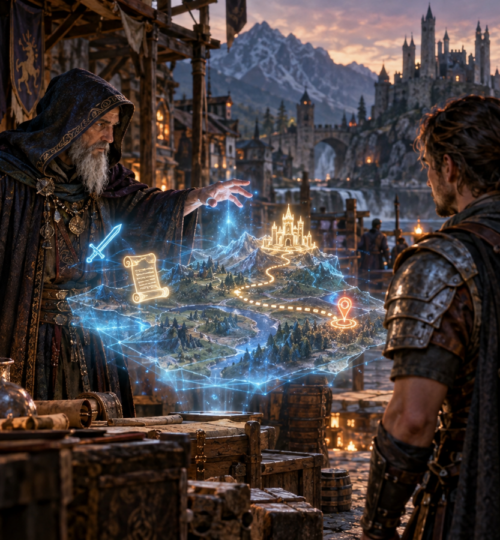
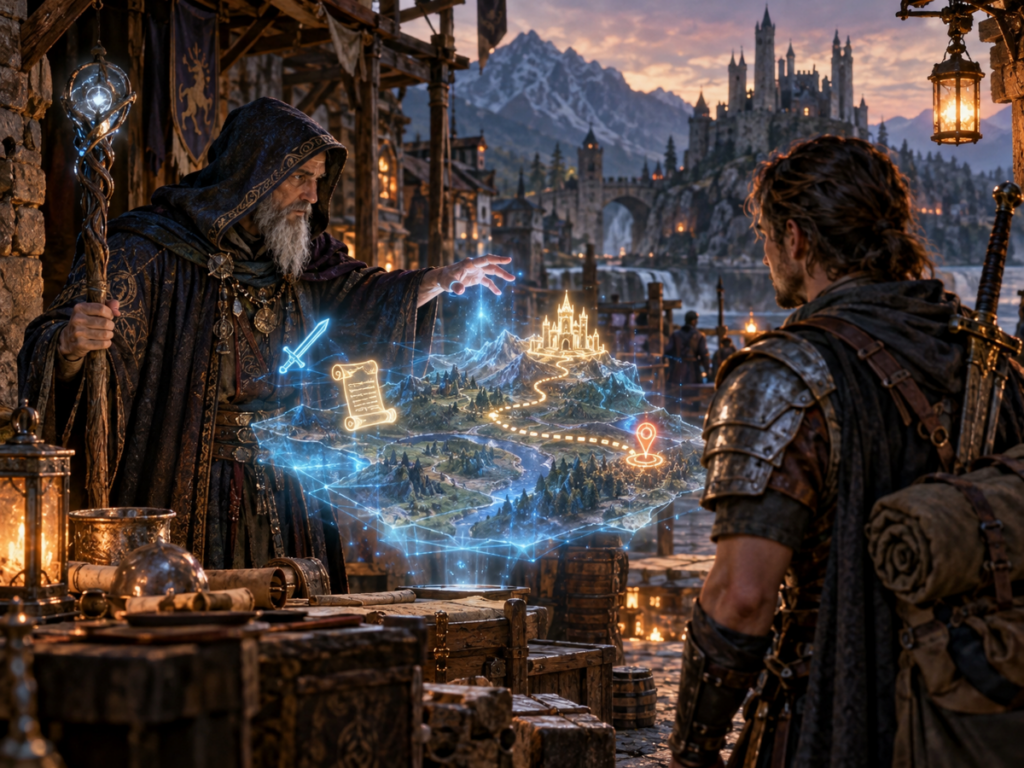
For most of gaming history, an NPC could surprise players only inside a box that a designer had already built. Dialogue trees branched, faction systems tracked reputation, radiant quest systems recombined authored pieces, and simulation-heavy games produced stories through interacting rules. Generative AI changes the size of that box because an NPC can now produce language, react to unexpected player input, remember prior exchanges, and potentially decide what to ask the player to do next.
That last step matters more than letting a shopkeeper answer a weird question. The moment an NPC can invent a quest, it is no longer improvising conversation around a fixed game state. It is proposing objectives, rewards, enemies, locations, relationships, and consequences that may alter the shared world. For single-player RPGs, that could create side stories no designer wrote word for word. For online games, it could also create exploits, contradictions, unfair rewards, moderation problems, and the multiplayer equivalent of a dungeon master who occasionally forgets the rules.
The Industry Is Already Moving Beyond Scripted Dialogue
Ubisoft has spent several years testing what happens when generative models are placed closer to the player. Its 2024 NEO NPC prototype used an Inworld language model and NVIDIA technology to let authored characters improvise conversation while writers still defined their personalities, histories, and narrative roles. Ubisoft stressed that the characters did not have free will and were still expected to remain inside a designed story.
The experiment moved further in 2025 with Teammates, a closed-playtest prototype set in a first-person shooter. Ubisoft said its AI-controlled companions could respond to real-time voice commands, interpret environmental cues, adapt behavior, and assist with mission objectives, while an internal API added protections aimed at hallucinations, bias, and toxicity. That is still different from an NPC freely authoring a quest, but it shows how quickly the line between “character that talks” and “character that acts” is moving.
NVIDIA is pushing in the same direction with ACE, a collection of technologies for conversational and actionable game characters. Its developer material describes systems that combine speech, perception, language models, memory, and action, with examples ranging from AI teammates in PUBG to autonomous characters in inZOI. Once an NPC can perceive a situation, remember what happened, and choose an action, generating a mission proposal is less a science-fiction leap than another layer in the same stack.
A Generated Quest Is a Game-System Problem, Not a Writing Trick
The easy version of an AI quest is mostly cosmetic. An NPC knows that bandits occupy a nearby ruin, the game already supports a “clear location” activity, and the model invents a reason for this particular character to care about it. The objective, enemy placement, reward table, and completion logic remain deterministic. The AI supplies context and presentation, while the game engine supplies truth.
The hard version gives the model authority to create the activity itself. An NPC could decide that a rival merchant should be robbed, ask for an object that has never existed, promise a reward outside the economy’s normal limits, or send the player to a location that is inaccessible at the current stage of the campaign. A language model can produce a convincing sentence without knowing whether the underlying game can support what that sentence promises.
That difference suggests a technical rule that should sit underneath any serious system: the model may propose, but the game must validate. An AI character could output a structured request containing an objective type, target, location, reward class, faction consequence, time limit, and required world conditions. A deterministic quest service would then check those fields against real game state before the mission becomes active.
This is where old-school game design remains more valuable than raw model fluency. Quest flags, encounter tables, faction rules, spawn systems, inventory checks, level gates, and server-side authority are the machinery that keeps a generated story from becoming nonsense. Generative AI can make the seams less visible, but it cannot be allowed to replace the seams.
The Best AI Quests Would Be Constrained Improvisation
A good tabletop game master does not need infinite freedom to make a session feel responsive. The game master needs a clear picture of the world, the characters, the available threats, and what has already happened. AI-driven NPCs need the same kind of bounded context, except the boundaries must be enforced by software rather than social agreement.
An NPC should know its own goals, relationships, permitted knowledge, geographic reach, and authority. A city guard might be able to ask for help investigating a theft, escorting a witness, or watching a gate, but should not be able to appoint the player king, reveal secret lore the guard could not know, or hand out a raid-tier weapon for catching a pickpocket. The character becomes more believable when its power to improvise matches its position in the game world.
This model also gives human writers meaningful control. Writers can define motives, taboos, speech patterns, faction attitudes, emotional states, and story boundaries, then allow the NPC to generate moment-to-moment variations inside them. Ubisoft described a similar philosophy with NEO NPC, where writers created the character foundation and the model improvised within that authored identity.
The result could be more interesting than endless procedural chores because the quest would emerge from remembered interaction. A smuggler the player embarrassed three hours earlier might ask for help only after exhausting other options. A squadmate who survived several missions with the player could propose an off-book rescue because the relationship system, world state, and character memory all support that choice.
Multiplayer Turns Creativity Into a Fairness Problem
Shared worlds make this much harder. In a single-player RPG, a strange reward or oddly timed mission may be a minor balance problem. In a competitive or economy-driven online game, one generated quest can become a farm route, a duplication exploit, a progression shortcut, or an information advantage that only one player happened to receive.
Any online implementation would need server-authoritative validation and strict reward budgets. The model should never decide raw currency values, item rarity, rating changes, matchmaking advantages, or access to competitive equipment on its own. Those outputs should come from normal game systems after the generated quest has been classified into a known risk and reward category.
Competitive modes require even tighter boundaries. An AI-generated side contract that sends a squad to extract intel during an unranked PvE session could add variety without damaging the integrity of a ladder. An NPC inventing an asymmetric objective in the middle of a ranked match would be much harder to justify because the players need to know that the rules, scoring, and opportunities are consistent.
There is also the problem of reproducibility. Esports administrators, anti-cheat teams, support staff, and competitive players all depend on being able to reconstruct what happened. If AI-generated missions ever touch ranked play, the system would need logs of the NPC’s inputs, validated quest data, game-state checks, rewards, and final outcomes so a disputed event can be reviewed without relying on a generated conversation that vanished after the match.
Players Will Try to Break the NPC on Purpose
Every multiplayer community contains people who test boundaries for fun, advantage, or both. A generative NPC will be prompt-injected, insulted, baited into saying forbidden things, asked to reveal hidden information, and pushed to create the most absurd objective the system will accept. That behavior is not an edge case. It is part of the feature’s real operating environment.
Valve’s Steam rules already treat live-generated AI content differently from material created before release. Developers using live generation must disclose it and describe guardrails intended to prevent illegal output, and Steam provides a reporting path for players who encounter problematic generated content. That policy does not solve game design problems, but it makes clear that a live AI system carries responsibilities that a prerecorded dialogue tree does not.
Quest generation raises the stakes because bad output can become an instruction rather than a line of dialogue. A model that says something inappropriate is a moderation failure. A model that turns that idea into a tracked objective, marks another player as the target, or creates a reward for completing it has crossed into game logic, where moderation, griefing prevention, and exploit resistance all meet.
Developers would therefore need multiple filters instead of a single text check. Player input may need moderation before reaching the model, generated proposals may need semantic checks, quest parameters must pass game-rule validation, and the final dialogue still has to be screened before the player sees it. The AI is only one component in a chain that must fail safely.
Writers and Performers Still Define the Character
There is a labor issue hiding inside the technical one. A character who can improvise hundreds of hours of dialogue needs a voice, a personality, and enough authored material to remain recognizable. The industry has already spent years arguing over who controls the performances and source material that make that possible.
The 2025 SAG-AFTRA Interactive Media Agreement added consent and disclosure requirements around AI digital replicas, and its guidance specifically addresses real-time generated dialogue. The agreement also requires reasonably specific descriptions of intended replica use, including whether a character will be used for real-time generation. Those provisions matter directly to any system where an NPC can keep producing new spoken material long after the recording session ends.
For writers, the job could shift toward building character systems rather than scripting every possible line. That can be creatively rich if the studio treats authorship as design work with continuing ownership over tone, story logic, and revision. It becomes far less attractive if “AI quests” is simply a budget phrase for removing writers and shipping a model with a lore dump.
Players will notice the difference. Generated dialogue can be grammatically clean and still feel empty because no one made a strong decision about what the character wants, what the story is about, or why the mission matters. Infinite content is not the same thing as authored purpose.
The Real Opportunity Is a World That Can Respond Without Breaking
The most convincing use of AI quest generation is probably a hybrid system that combines authored story structure with machine improvisation. Designers create the world, factions, mechanics, quest families, reward limits, character motives, and story rules. The model interprets what has happened and selects or assembles a valid response that feels personal to the current player or party.
That approach sacrifices the fantasy of an NPC inventing absolutely anything, but games have always depended on meaningful constraints. Physics rules limit movement, combat systems limit actions, economies limit rewards, and competitive rule sets limit what counts as a legitimate win. Narrative systems benefit from the same discipline.
The payoff could still be substantial. A veteran NPC might remember that your squad abandoned an earlier extraction, distrust you for it, and later offer a recovery mission only after the faction situation changes. The objective could be assembled from validated world data, the reward could come from a controlled table, and the dialogue could be generated around your actual shared history. Nothing about that needs an NPC to possess unlimited authority.
In that kind of system, the memorable part would not be that a language model authored a quest. It would be that the quartermaster remembered who failed to bring back a convoy, changed tone, refused one job, and later offered a dangerous recovery contract because the front line moved and supplies ran low. The quest would feel improvised, but every objective, reward, location, and consequence would still be legal according to the game. That is a far more demanding design target than infinite dialogue, and a much more interesting one.