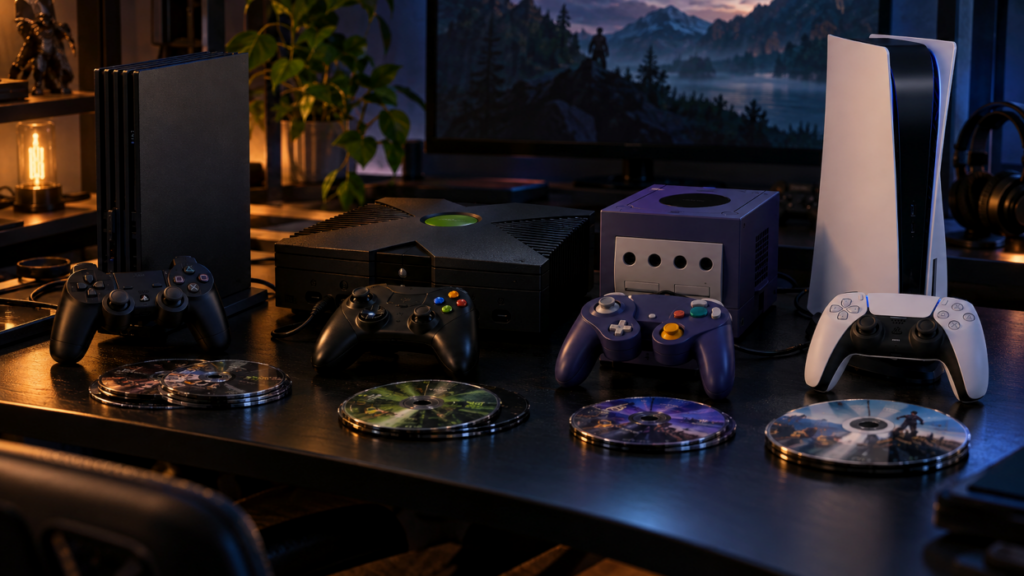
A PlayStation 2 game disc sliding into a PlayStation 5 should be an ordinary sight by now. Sony has released several generations of PlayStation hardware since the PS2, and modern consoles possess enough processing power to emulate many older gaming experiences. Yet a standard PS5 still cannot play an original PS2 disc. In October 2026, independent developers demonstrated that a jailbroken PS5 could accomplish something Sony has never officially supported.
The breakthrough came through PS5SX2, a community-developed PlayStation 2 emulator adapted for modified PS5 hardware. Meanwhile, Nintendo’s Switch 2 experienced its own security breakthrough when a researcher demonstrated a software-based exploit capable of running unauthorized code and modifying games. Both developments have renewed questions about hardware ownership, backward compatibility, and the limitations manufacturers place on older software.
For competitive gaming communities, the consequences extend beyond nostalgia. Classic multiplayer titles established tournament formats, competitive traditions, and communities that helped shape modern esports. Preserving those games requires functioning software, compatible hardware, and, whenever possible, the networking infrastructure that made organized competition possible.
The PS5 Jailbreak That Brought PlayStation 2 Discs Back
Sony’s official backward compatibility support remains concentrated on the PlayStation 4 generation. The company’s PS5 compatibility documentation describes access to more than 4,000 PS4 games, including titles that benefit from newer hardware. Earlier PlayStation generations receive more selective treatment, with certain classics offered through digital releases or subscription services rather than compatibility with their original discs.
That limitation became particularly noticeable in October 2026 when developer Sword introduced physical disc support to PS5SX2. Built around the established PCSX2 emulator, the project allows PlayStation 2 games to run on jailbroken PS5 systems. Early implementations could recognize a PS2 DVD, copy its contents to storage, and launch the resulting game image.
Development advanced rapidly. Version 2.02, released October 10, introduced experimental disc-reading improvements, while version 2.10, released October 14, allowed PS2 DVDs to appear as launchable tiles on the PS5 home screen. Players could then launch supported games directly from their discs or choose to copy them to storage. The project’s official GitHub release history documents those changes and subsequent improvements.
Version 2.15, released October 19, continued refining the experience with reduced disc-reading stutter and additional interface features. These updates demonstrate how quickly independent developers can improve an emulator when technical access to the hardware becomes available. They also illustrate the difference between demonstrating compatibility and delivering a thoroughly tested commercial feature.
PS5SX2 remains an unofficial emulator requiring a jailbroken console, compatible supporting software, and a PS2 BIOS. Performance and compatibility vary between games, and the PS5’s built-in optical drive cannot read the CD-based PS2 releases commonly identified by their blue disc surfaces. Experimental external optical-drive support offers additional possibilities, but it does not eliminate the project’s technical restrictions.
The achievement nevertheless raises a reasonable question about official support. Owners who purchased PS2 DVDs decades ago now have a community-developed method of playing supported titles on modern PlayStation hardware, provided they have a compatible modified console. Sony has never offered equivalent general-purpose PS2 disc compatibility through standard PS5 software.
Reports have also discussed possible future PS3 disc support through independent development. That remains a considerably more demanding technical challenge because of the PlayStation 3’s Cell processor architecture and the complexity of emulating its hardware. Plans to pursue such support should not be mistaken for an established capability.
Xbox Demonstrates the Benefits and Limitations of Official Backward Compatibility
Microsoft has taken a broader approach to backward compatibility across Xbox generations. Xbox Series X supports selected titles from the original Xbox and Xbox 360 libraries alongside the much larger Xbox One catalog. For supported older games, inserting a physical disc generally initiates a download of a compatible game package, with the disc serving as proof of ownership.
The benefits extend beyond convenience. Some backward-compatible titles receive higher rendering resolutions, improved loading times, Auto HDR, or FPS Boost, depending on the game and hardware. These enhancements allow older releases to benefit from modern systems without requiring complete remakes, although changes to performance characteristics can affect how a game feels compared with its original version.
Microsoft’s program has never offered universal compatibility. In its November 2021 backward compatibility announcement, the company added more than 70 original Xbox and Xbox 360 titles while identifying that expansion as the program’s final addition. Licensing restrictions, legal complications, and technical limitations prevented other games from joining the catalog.
An original Xbox or Xbox 360 disc therefore does not automatically work on Xbox Series X simply because the console is powerful enough to emulate older hardware. Each supported title requires an approved compatibility implementation, and many games remain unavailable. Xbox Series S owners also lack an optical drive, preventing them from inserting physical discs directly.
Microsoft introduced another preservation-related development in 2026. Its disc-to-digital program, announced in August and expanded beyond Xbox Insiders in late September, allows owners of supported Xbox One and Xbox Series X discs to claim digital entitlements. Eligible games can then be accessed digitally, including on supported devices without an optical drive.
The newer program addresses a different ownership problem from traditional backward compatibility. It helps players retain access to supported physical purchases as hardware moves toward digital distribution, but it does not automatically extend the older Xbox and Xbox 360 compatibility catalogs. Eligibility still depends on the participating title, leaving gaps in the historical library.
Microsoft’s efforts demonstrate that meaningful preservation can happen within an officially supported console environment. They also expose the boundaries of manufacturer-controlled compatibility, where technical feasibility, licensing arrangements, and commercial priorities determine which games survive a hardware transition.
Backward Compatibility Cannot Restore Dead Multiplayer Servers
The limitations become particularly clear when examining Halo. The Xbox 360 editions of Halo 3, Halo: Reach, and several related titles were central to the development of competitive console multiplayer. Their matchmaking systems, rankings, playlists, and community features helped establish expectations that modern online shooters continue to follow.
On January 13, 2022, Microsoft and 343 Industries discontinued or reduced the original Xbox 360 Halo online services. As detailed in Halo Support’s service retirement documentation, affected games retained certain playable modes, but features such as online matchmaking, file sharing, and challenges became unavailable in supported cases.
Halo: The Master Chief Collection preserved much of the series through updated releases and modern online infrastructure. It offers a practical alternative for competitive Halo players, although its networking systems, playlists, and features do not reproduce every aspect of the original Xbox 360 experience. The original releases and their surrounding services remain distinct pieces of gaming history.
This illustrates a problem that backward compatibility alone cannot solve. A modern console might execute a twenty-year-old game perfectly while its original authentication servers, matchmaking services, or ranking databases no longer exist. Without replacement infrastructure, significant portions of the multiplayer experience remain inaccessible.
The same difficulty affects numerous older competitive games, including SOCOM II, Star Wars Battlefront II, and early console Call of Duty releases. Some communities have developed alternative networking solutions, community servers, or modified clients to restore multiplayer access. Others remain dependent on original hardware, unofficial workarounds, or whatever online functionality survived.
Competitive preservation also involves details that ordinary single-player compatibility does not necessarily address. Controller responsiveness, frame timing, network synchronization, server configuration, and game version consistency can influence competitive fairness. A technically functional game may still behave differently enough to create problems for players attempting to reproduce historical competition.
Nintendo Switch 2 Supports Older Games, but Access Remains Selective
Nintendo entered its latest console generation with a more accommodating approach to compatibility than some previous hardware transitions. The Switch 2 supports compatible physical and digital Nintendo Switch games, allowing many existing purchases to move forward. Nintendo’s official compatibility guidance acknowledges that hardware differences can prevent certain games from working properly.
The company’s approach to older generations remains more selective. Nintendo Switch Online provides subscription access to selected classic titles, including Nintendo 64 games and a GameCube collection available specifically on Switch 2. These releases offer modern conveniences, but the available selection depends on Nintendo’s publishing decisions.
Original GameCube discs cannot be inserted into a Switch 2, and owning an older physical release does not automatically grant access to its subscription equivalent. Continued access to Nintendo Classics also requires an eligible active membership. A historically important game may therefore remain unavailable through official channels even when other titles from the same generation are supported.
For competitive communities, these restrictions can determine whether a classic title receives renewed attention or remains dependent on aging equipment. Nintendo has demonstrated that it can deliver older games through emulation, but the company retains control over which releases enter its catalog and under what conditions players can access them.
That controlled environment provides the background for the recent Switch 2 security breakthrough. Independent developers have begun finding ways to execute software outside Nintendo’s approved distribution system, potentially opening additional opportunities for experimentation and preservation.
The October 2026 Switch 2 Jailbreak Opens Another Door
In October 2026, security researcher Sammy Hajhamid, known online as Pepsipu, publicly documented a software-only Switch 2 exploit called ns2jb. His technical explanation of the jailbreak describes how vulnerabilities involving SmileBASIC 4 and Nintendo’s system software allowed unauthorized native code execution.
The exploit was demonstrated on Switch 2 firmware version 23.0.1 without requiring a physical modification chip. It is tethered, meaning the procedure requires external assistance and must be repeated after restarting the console. The implementation provides substantial access through compromised system modules but does not constitute unrestricted kernel control or permanent custom firmware.
Hajhamid demonstrated the exploit’s capabilities by modifying Mario Kart World to include unofficial playable characters. The research also described opportunities for running homebrew applications, examining game software, accessing save data, and interacting with certain hardware components. These functions could eventually contribute to preservation tools, although the demonstrated exploit remains an early technical achievement.
The method also depends on software that Nintendo can restrict or remove from distribution. Reports following the disclosure indicated that SmileBASIC 4 had disappeared from certain Nintendo eShop listings, complicating access for people who did not already possess the application. Firmware updates may also close the vulnerabilities used by ns2jb.
The exploit does not establish GameCube backward compatibility on Switch 2, nor does it demonstrate unrestricted commercial game execution. It provides researchers with another route into a system designed to prevent unauthorized software from running. Developing reliable emulators or a mature homebrew environment would require substantial additional work.
Nintendo has legitimate reasons to maintain strong platform security, including protecting online services and limiting cheating. Those same restrictions can prevent owners from running independent preservation software on hardware they purchased. The Switch 2 research illustrates how those competing interests continue to shape console modification communities.
When Publishers Withdraw Support, Players Rebuild the Experience
Independent preservation efforts have already demonstrated that classic competitive games can remain active without continuing support from their original publishers. Super Smash Bros. Melee, released for the GameCube in 2001, provides one of the clearest examples. Its competitive community continued organizing events and refining strategies through several succeeding Nintendo console generations.
The community-developed Slippi project extended Melee’s competitive life by introducing improved online functionality through a modified Dolphin emulator. As described on Slippi’s official project website, the software supports online matchmaking, improved netcode, replay files, and gameplay statistics.
Rollback netcode became particularly valuable because it addressed problems associated with traditional online emulation. By predicting inputs and correcting game states when necessary, rollback can maintain more responsive gameplay across network connections than conventional fixed-delay approaches under suitable conditions. Connection quality and implementation still matter, but the technology helped make remote Melee competition substantially more practical.
Slippi’s contribution goes beyond making an older game executable on modern hardware. Its developers built competitive infrastructure around a release that never originally supported modern online matchmaking. That work allowed the community to continue organizing matches while retaining much of the gameplay that made Melee competitively distinctive.
Similar problems exist throughout older multiplayer gaming. Some titles require replacement master servers, while others need alternative authentication systems, community patches, or modifications to obsolete networking components. Reconstructing these systems can involve reverse engineering protocols that were never publicly documented.
The technical challenges become especially difficult when games depend on centralized services that publishers have shut down. Even with a working executable, matchmaking may fail because the original service no longer responds. Community developers must sometimes rebuild enough of the missing infrastructure to let players discover servers, connect to matches, and maintain stable sessions.
Historical competitive records present another preservation challenge. Tournament results, player rankings, clan memberships, and match statistics often existed in databases operated by organizations that eventually closed. Unless independent archives survived, restoring the game software cannot recover records that have already disappeared.
For long-running competitive communities, those records provide continuity between generations of players. A restored leaderboard can show how teams performed, which games supported organized competition, and how individual competitors progressed over time. Preserving that information requires database maintenance and historical documentation alongside the technical work needed to keep games operational.
Jailbreaking, Ownership, and the Security Problems Behind Preservation
Console manufacturers have legitimate security concerns about unauthorized software. System restrictions help protect accounts, payment information, copyrighted content, and online services. Multiplayer competition also depends on mechanisms that prevent modified clients from gaining unfair advantages.
Jailbreaking introduces complications because the same technical access that supports emulators or homebrew applications may also enable cheating. A console running unauthorized system software can potentially bypass protections intended to maintain competitive integrity. Preservation projects must account for those risks when they interact with active online environments.
Legal considerations add another layer of difficulty. Emulation software is not automatically unlawful, but distributing copyrighted game files, using proprietary firmware, and circumventing technological protection measures can raise separate legal issues. The applicable rules depend on jurisdiction and circumstances, and physical ownership does not necessarily authorize every form of copying or distribution.
A collector running a legitimately purchased game, a developer writing an emulator, and someone distributing unauthorized commercial copies are engaging in different activities. Their technical methods may overlap, but their legal circumstances and intentions are not interchangeable. Treating all console modifications as piracy fails to distinguish preservation research from copyright infringement.
Publishers also face practical obstacles when considering official compatibility support. Older games may contain music, branding, licensed characters, or middleware governed by agreements that have expired. Reintroducing those titles can require negotiations and engineering work that publishers consider financially unjustified.
These constraints help explain why official backward compatibility programs remain selective. They do not resolve the frustration of players who own working copies of older games but cannot use them on newer hardware from the same manufacturer. Independent emulation often emerges where commercial support has ended or never existed.
Who Should Decide When a Competitive Game Reaches the End of Its Life?
PS5SX2 demonstrates what becomes possible when independent developers gain sufficient access to modern hardware. Sony has chosen not to provide general PS2 disc compatibility on PS5, yet community developers have produced a working alternative with expanding functionality. The achievement does not establish that building and supporting an equivalent commercial feature would be effortless, but it raises legitimate questions about why owners have so few official options.
Microsoft’s compatibility program shows how manufacturer support can extend the useful life of older purchases, while Nintendo’s curated libraries demonstrate another approach based on controlled distribution. Both models retain restrictions that leave some historical releases inaccessible. Independent projects continue filling those gaps through emulation, software modification, and replacement infrastructure.
For competitive gaming, a more useful preservation policy would also address the services that disappear when publishers retire older titles. Documenting multiplayer protocols, permitting community-operated servers where feasible, and providing practical ways to maintain access to discontinued software could preserve functionality that backward compatibility alone cannot restore.
These arrangements would require careful attention to security, licensing, and continuing intellectual property rights. A publisher might have valid reasons to prevent modified clients from connecting to current competitive services while still permitting an abandoned game’s community to operate isolated replacement servers. Separate environments could allow preservation work without exposing active commercial games to additional risks.
The most difficult cases involve games whose developers have disappeared, publishers have changed ownership, or source code and server infrastructure are no longer maintained. Even communities with substantial technical expertise may lack the documentation needed to reproduce the original experience accurately. Establishing preservation procedures before those resources disappear would give future community developers a considerably stronger starting point.
For games with surviving competitive communities, the practical question is who maintains the software and infrastructure after commercial support ends. That responsibility may eventually fall to volunteers who rebuild networking systems, preserve historical records, test compatibility updates, and maintain servers for increasingly small groups of dedicated players. Their ability to continue that work depends as much on access to technical information and stable hosting resources as it does on the availability of an emulator.
When those resources are available, an older competitive title can remain operational long after its original commercial lifespan. Communities can continue scheduling matches, maintaining rankings, and developing their own infrastructure around games they still want to play. The challenge for publishers and preservation developers is finding workable arrangements before the original software, services, and technical knowledge become too difficult to recover.