Disclaimer: The views and opinions expressed in this article are solely those of the author. The mention of any products, services, or methods does not constitute an endorsement.
Nintendo entered the current handheld generation from an unusual position. The original Switch helped prove that players would accept compromises in raw performance for the ability to carry a serious game library between the couch, television, hotel room, and commute. Valve later pushed that idea in another direction with Steam Deck, turning years of accumulated PC purchases into a portable library and helping establish handheld PCs as a serious hardware category.
Nintendo Switch 2 arrived on June 5, 2025, facing a market that had changed considerably since its predecessor appeared in 2017. Nintendo still had Mario, Zelda, Pokémon, and its enormous installed audience, but portable gaming was no longer its private territory. The launch lineup therefore mattered beyond the normal question of whether a new console had enough games. Switch 2 needed to demonstrate that it could keep Nintendo’s traditional strengths while competing for some of the same portable AAA gaming time that Steam Deck had claimed.
More than a year later, Nintendo’s opening move looks stronger than a simple first-party console launch. Switch 2 did not attempt to become a Steam Deck with Mario games. Its bigger threat to Valve’s ecosystem came from becoming a more capable Nintendo machine that could increasingly play the kinds of third-party games that once made handheld PCs the obvious second device for enthusiasts.
Nintendo Built a Launch Library Around More Than Mario
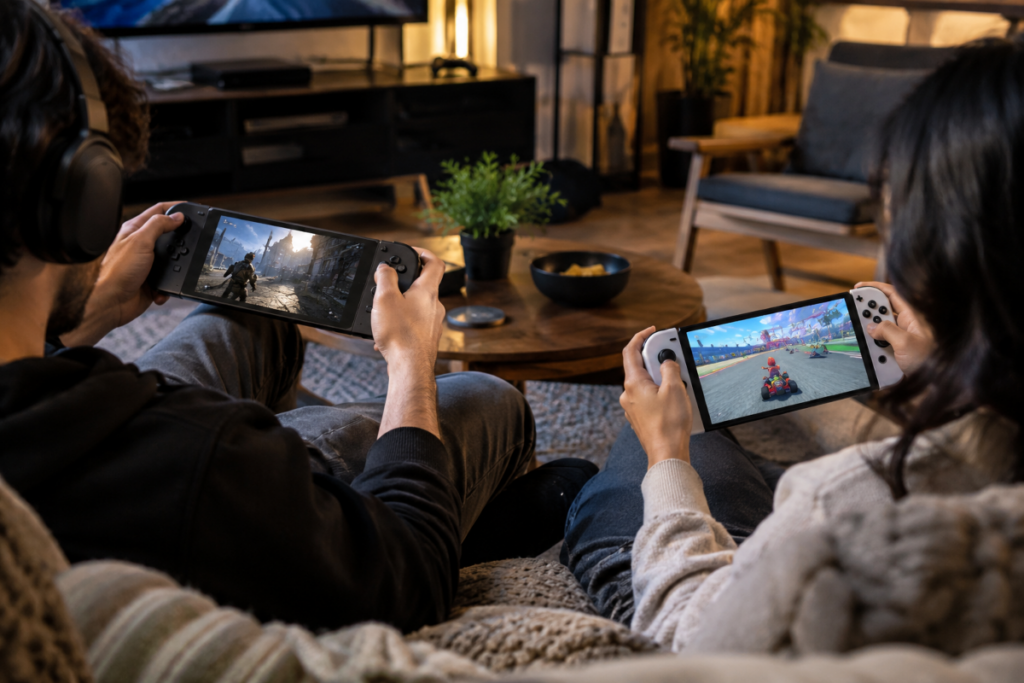
Mario Kart World was the centerpiece of the Switch 2 launch, and Nintendo gave it the kind of role expected from a new Mario Kart on fresh hardware. It introduced an interconnected world, Free Roam, Knockout Tour, and races supporting up to 24 drivers. For multiplayer players in particular, it immediately gave the system an exclusive social game with enough scale to sell hardware rather than merely fill out a release calendar.
The more interesting part of the launch was everything surrounding it. Nintendo’s June 5 lineup included more than 20 titles, with Cyberpunk 2077: Ultimate Edition, Street Fighter 6, Split Fiction, Civilization VII, Fortnite, Hitman World of Assassination, Hogwarts Legacy, No Man’s Sky, Yakuza 0 Director’s Cut, and several other third-party releases appearing beside Nintendo’s own software.
That selection sent a different message from the early years of the original Switch. Nintendo was still selling a Nintendo console, but publishers were willing to bring recognizable PC and current-generation franchises to the machine from the beginning.
Cyberpunk 2077 was especially significant. The original Switch spent much of its life receiving technically ambitious ports that sometimes required major visual reductions, cloud streaming, or simply never appeared. Putting Cyberpunk 2077: Ultimate Edition on Switch 2 at launch gave Nintendo a useful demonstration that its new machine occupied a different performance class.
Street Fighter 6 carried another implication. Competitive fighting games benefit from large communities, predictable performance, local play, and easy access to controllers and displays. Having one of the defining fighting games of the current generation available on day one made Switch 2 more credible as a secondary competitive machine than the original Switch had been for much of its life.
Steam Deck Still Owns the Library Argument
Switch 2’s launch lineup was impressive partly because Steam Deck changed the standard by which portable libraries are judged. Valve does not need a conventional launch lineup for every hardware revision because Steam itself is the library.
A player who bought PC games for years before purchasing a Deck may already own hundreds of potential handheld titles on day one. Valve’s Deck Verified program sorts tested games into Verified, Playable, Unsupported, and Unknown categories, while Proton allows many Windows games to run through SteamOS without requiring native Linux versions.
That creates an economic advantage Nintendo cannot easily copy. A Steam user who already owns Cyberpunk 2077, Street Fighter 6, Civilization VII, or another multiplatform release does not necessarily need to buy it again to play it on Deck. Steam’s frequent sales, bundles, indie catalog, older PC releases, modding possibilities, and enormous back catalog strengthen that advantage.
Switch 2 does have its own answer in backward compatibility. The system plays compatible physical and digital Switch software, with some older titles receiving free updates or paid Switch 2 Edition upgrades. Nintendo therefore avoided the traditional console problem of asking an established audience to start from zero.
The scale is still different. Steam represents decades of PC software, while Switch 2 inherits one console generation plus its new catalog. For players whose purchasing history is centered on Steam, Valve remains extremely difficult to displace.
Switch 2 Attacks Steam Deck Where Consoles Have an Advantage
The comparison changes when software compatibility stops being the only consideration. Steam Deck is a handheld PC designed to make PC gaming unusually convenient, but it still inherits some of PC gaming’s complications.
Valve’s compatibility system exists because games can behave differently under SteamOS and Proton. Launchers, anti-cheat systems, controller support, interface scaling, updates, and middleware can affect whether a game receives a Verified rating. Some players enjoy tweaking settings, installing alternative software, experimenting with compatibility layers, or configuring controls. Others simply want to press the power button and play.
Nintendo’s console model gives Switch 2 an advantage with that second group. Developers targeting Switch 2 know the exact hardware configuration. Players are buying software packaged for a fixed platform rather than asking whether a Windows game behaves properly through a compatibility layer.
That matters in multiplayer gaming because anti-cheat remains one of Linux gaming’s persistent complications. Valve explicitly includes anti-cheat support among the requirements considered for Deck compatibility. A competitive game that depends on unsupported middleware can remain unavailable regardless of whether the Deck’s hardware could otherwise run it.
Nintendo also improved the physical hardware enough to make comparisons with handheld PCs more reasonable. Switch 2 has a 7.9-inch 1920×1080 LCD with HDR10 and variable refresh rate support up to 120 Hz, 256 GB of internal UFS storage, Wi-Fi 6, and a custom Nvidia processor. Its dock includes wired Ethernet, while compatible displays and software can support higher-resolution television output.
Those specifications do not turn Switch 2 into an open PC, and specification-sheet comparisons between architectures can be misleading. They do mean that Nintendo is asking far fewer players to tolerate the visibly dated handheld hardware characteristics that increasingly separated the original Switch from newer portable PCs.
Nintendo’s Exclusive Games Remain the Weapon Valve Cannot Copy
Steam Deck can compete against Switch 2 versions of third-party games with price, existing ownership, settings flexibility, mods, and access to the broader PC ecosystem. It has a much harder answer for Mario Kart World.
That distinction sits at the center of the competition. Someone choosing between two devices to play Cyberpunk 2077 has several factors to compare. Someone wanting Nintendo’s major first-party releases has already had much of the decision made for them.
Nintendo strengthened that position after launch with software such as Donkey Kong Bananza and additional first-party releases, while maintaining access to compatible Switch games. By June 30, 2026, Nintendo reported worldwide Switch 2 hardware sales of 23.68 million units. That does not measure how many sales came at the expense of handheld PCs, but it establishes that publishers are dealing with a substantial active platform rather than an experimental device category.
A large installed base can create its own momentum. Publishers have more reason to fund ports, ports make the hardware attractive to more players, and additional hardware sales make future ports easier to justify. The original Switch demonstrated how powerful that cycle can become even when its hardware trails competing machines.
For Valve, the uncomfortable scenario is therefore not Nintendo convincing dedicated PC players to abandon Steam. It is Nintendo reducing the reasons those players have to buy a second handheld.
Third-Party Ports Are the Real Competitive Pressure
The Steam Deck became an attractive companion device partly because it covered software that Nintendo hardware could not. A player might own a Switch for Zelda, Mario Kart, Smash, and Pokémon, then use a Deck for larger PC releases, older games, indies, emulation, and the rest of a Steam library. Switch 2 begins to weaken that division if major publishers keep supporting it.
The launch lineup established the pattern immediately. Cyberpunk 2077 covered the demanding open-world RPG category. Street Fighter 6 brought a major competitive fighter. Civilization VII addressed strategy players while supporting Joy-Con 2 mouse controls. Split Fiction covered modern cooperative play. Fortnite provided one of gaming’s largest cross-platform multiplayer spaces with a Switch 2 version offering 60 fps gameplay and upgraded visual features compared with the original Switch version.
No individual port threatens Steam Deck. The cumulative effect matters more. Every major game that receives a competent Switch 2 release removes one potential reason for a console-focused player to enter the handheld PC market.
The reverse pressure also remains strong. A game available on both platforms frequently gives Steam Deck owners little reason to repurchase it through Nintendo’s store, especially if they already own the PC version. Cross-save support can help in individual games, but there is no universal bridge between Nintendo purchases and Steam ownership.
The battle is therefore partly about where a player’s library begins accumulating. Once someone owns dozens or hundreds of games on a platform, switching becomes less attractive even when another machine has appealing hardware.
Physical Games Give Nintendo a Strange but Useful Difference
Switch 2 also preserves something increasingly uncommon in portable PC gaming: physical software. Compatible original Switch cartridges work in the system, and Switch 2 supports both conventional game cards and the newer game-key card format.
Game-key cards have been controversial because the full game is not stored on the card. The card instead authorizes a download, after which it must remain inserted to launch the software. That weakens some of the archival appeal traditionally associated with physical media, but the format still permits a physical object to function as transferable game ownership in ways a Steam license generally does not.
For collectors, families, used-game buyers, and players who trade completed games, Nintendo’s retail ecosystem remains meaningful. Steam Deck offers enormous digital freedom in other respects, but Steam itself is fundamentally tied to account-based digital purchases.
Nintendo therefore has an unusual mixture of old and new distribution models. Full physical games, downloadable software, game-key cards, backward-compatible Switch cartridges, and digital virtual game cards all exist around the same hardware. It is messier than the traditional cartridge model, but it gives consumers options that handheld PCs generally approach differently.
Steam Deck’s Openness Remains Its Defensive Wall
Nintendo can compete on software availability, convenience, exclusives, and local multiplayer. It cannot easily compete with the basic freedom of owning a PC. Steam Deck owners can leave SteamOS, enter desktop mode, install software, connect peripherals, change operating systems, run games from other stores through community solutions, use mods, and treat the device as a small computer. That flexibility is fundamental to the machine’s identity.
The enthusiast community surrounding handheld PCs extends the concept even further. Steam Deck exists beside devices from ASUS, Lenovo, MSI, and other manufacturers, which means Valve’s real contribution extends beyond one hardware model. It helped establish the expectation that a player’s existing PC library should travel with them.
Nintendo has almost the opposite philosophy. Switch 2 is tightly controlled, predictable, and designed around a fixed hardware and software environment. That restriction can be a disadvantage to enthusiasts while simultaneously being the reason another group prefers it.
The two systems consequently overlap without becoming interchangeable. Steam Deck is strongest for the player who wants portable access to PC gaming. Switch 2 is strongest for the player who wants Nintendo software and a console experience that can also handle an expanding range of major third-party games.
The Bigger Threat Is a Shrinking Need for Two Handhelds
The most interesting competition between Switch 2 and Steam Deck is happening among players who could reasonably own either device, or both. Nintendo does not need to win over someone with a massive Steam library and years invested in PC gaming. It needs to make the second purchase harder to justify.
That is why the Switch 2 launch lineup mattered so much. Mario Kart World sold Nintendo’s traditional strength, while Cyberpunk 2077, Street Fighter 6, Split Fiction, Civilization VII, Fortnite, Hitman, and the rest demonstrated that third-party portable gaming no longer automatically pointed toward a handheld PC.
Valve retains powerful advantages. Steam’s catalog is enormous, existing libraries carry forward, game pricing can be aggressive, PC software is far more open, and Deck owners are not limited to software specifically approved for a single console. For enthusiasts who treat handheld gaming as an extension of PC gaming, Switch 2 is unlikely to replace that relationship.
Nintendo’s opportunity lies elsewhere. If Switch 2 continues receiving serious third-party support while its exclusive library grows, a player who mainly wants one portable gaming device may find fewer gaps that require a Steam Deck to fill. Nintendo sold more than 3.5 million Switch 2 systems worldwide during its first four days and reached 23.68 million by the end of June 2026, giving publishers a large audience to consider when planning future releases.
The next phase depends less on another hardware comparison than on publisher behavior. Every major PC and console game that skips Switch 2 protects a piece of the handheld PC argument. Every technically sound Switch 2 port makes Nintendo’s machine more self-sufficient. For Valve, that is the pressure worth watching, because the strongest competitor to a portable PC may be the console that gradually gives mainstream players fewer reasons to need one.