Disclaimer: The views and opinions expressed in this article are solely those of the author. The mention of any products, services, or methods does not constitute an endorsement.
Bringing a modern, visually demanding game to portable hardware presents challenges that go well beyond reducing resolution and lowering a few graphics settings. For gamers who pay attention to frame rates, rendering technology, and hardware performance, Indiana Jones and the Great Circle on Nintendo Switch 2 offers an interesting example of how developers adapt current-generation games to a hybrid console.
Originally released for Xbox Series X|S and PC in December 2024, followed by PlayStation 5 in April 2025, MachineGames’ first-person adventure arrived on Nintendo Switch 2 on May 12, 2026. Its arrival raised a reasonable technical question: Was this a straightforward port of the existing game, or had the developers produced something closer to a remaster?
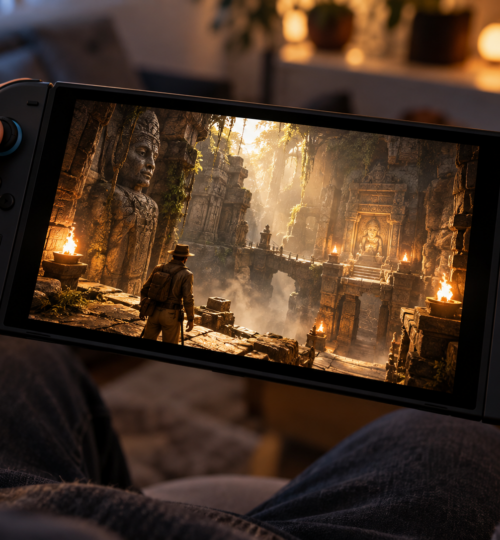
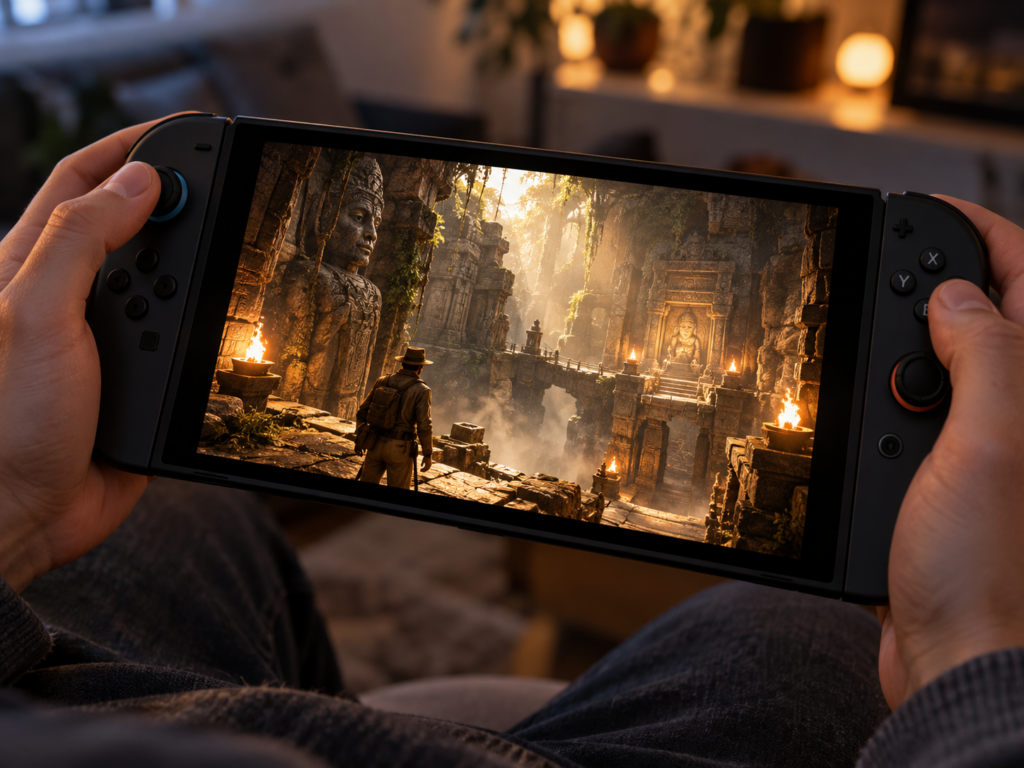
The answer is that Indiana Jones and the Great Circle on Switch 2 is a native port, developed specifically for Nintendo’s hardware rather than a remaster. However, the engineering behind that port is substantial. MachineGames retained several advanced rendering features, including ray-traced global illumination, while making adjustments to resolution, visual detail, and performance to accommodate the console’s capabilities.
For anyone interested in how modern game engines scale across different hardware platforms, the results are worth examining.
What Separates a Port From a Remaster?
The distinction between a port and a remaster can become confusing, particularly when developers introduce platform-specific visual enhancements or make significant technical changes.
A port adapts an existing game to run on another platform while preserving its underlying content, gameplay systems, and general presentation. Developers may rewrite portions of the rendering pipeline, introduce different input methods, optimize memory consumption, and adjust graphical settings. Those changes can demand extensive engineering work without turning the finished product into a remaster.
A remaster generally involves deliberately updating an existing game’s presentation, often through higher-resolution assets, improved lighting, revised effects, or other visual upgrades. Some remasters also include interface improvements, additional content, or modernized controls. The distinction is not formally regulated, but the intended scope of the work matters.
MachineGames approached the Switch 2 release as a platform adaptation. In an April 2026 interview with Nintendo Life, creative director Axel Torvenius confirmed that the studio handled the conversion internally and preserved the original gameplay systems and content.
That includes the game’s exploration, combat mechanics, environmental puzzles, cinematic sequences, and story progression. The Switch 2 release follows the same adventure rather than presenting a rebuilt or expanded edition. The work involved in achieving that result is where the technical discussion becomes interesting.
The 30 FPS Decision and Its Effect on Gameplay
The most immediately noticeable difference between the Switch 2 version and its counterparts is the frame rate. On Xbox Series X|S and PlayStation 5, Indiana Jones and the Great Circle targets 60 frames per second. MachineGames reduced that target to 30 FPS for Switch 2, prioritizing visual consistency and preservation of the game’s rendering features.
The difference affects more than perceived smoothness. At 60 FPS, a new frame can be presented approximately every 16.7 milliseconds. At 30 FPS, that interval increases to roughly 33.3 milliseconds, meaning animations and camera movements update half as frequently.
Experienced multiplayer gamers will recognize the consequences immediately. Higher frame rates generally improve motion clarity and reduce the time between input processing opportunities and visual feedback. Although Indiana Jones and the Great Circle is a single-player experience, its first-person combat, environmental interactions, and camera movements still benefit from responsive controls.
The game’s slower exploration sequences make the 30 FPS target easier to accept than it would be in a competitive shooter. Examining artifacts, solving puzzles, and searching environments rarely demand the rapid visual feedback associated with multiplayer combat.
However, 30 FPS is a performance target rather than an absolute guarantee. Digital Foundry’s May 2026 technical analysis identified frame-rate drops during demanding sections, particularly when moving quickly through populated areas or engaging multiple enemies.
Certain situations in the Vatican can push performance into the mid-20 FPS range. Some cinematic sequences also exhibit instability, making frame pacing one of the port’s more noticeable weaknesses. The 30 FPS decision therefore represents a deliberate compromise that generally works during ordinary gameplay but occasionally becomes apparent under heavier workloads.
Dynamic Resolution and DLSS Keep the Image Together
Resolution scaling plays a major role in how the Switch 2 version maintains its presentation. MachineGames confirmed a 1080p output target in docked mode and 720p in handheld mode. Those figures describe the intended output resolution rather than a guarantee that every frame is rendered internally at that resolution.
The game uses dynamic resolution scaling, allowing the rendering workload to change according to scene complexity. When GPU demand increases, internal resolution can decrease to help protect the frame rate. Nvidia’s Deep Learning Super Sampling, or DLSS, provides additional assistance by reconstructing the image from a lower rendering resolution.
According to MachineGames’ technical discussion with Nintendo Everything, the game can render at its full target resolution when sufficient performance is available. DLSS is used when the internal resolution needs to drop, reconstructing the image to the intended 1080p or 720p output.
Digital Foundry reported dynamic internal rendering ranges extending from approximately 540p to 1080p in docked mode and 360p to 720p in handheld mode. Those lower figures sound severe in isolation, but reconstructed image quality depends on considerably more than the original pixel count. Temporal information, motion data, image processing, and the quality of the source image all influence the final result. The benefits are visible in many environmental scenes, where architectural details and larger objects retain a convincing appearance despite the reduced rendering workload.
There are limitations. Digital Foundry observed more aliasing than on Xbox Series S, particularly around fine details and difficult edges. Lower internal resolutions can also make image reconstruction less reliable in scenes with dense vegetation, thin geometry, or rapid movement. Even so, the implementation demonstrates how machine-learning-based upscaling helps make demanding current-generation games practical on portable hardware.
Ray-Traced Lighting Survives the Transition
One of the most significant technical achievements of the Switch 2 conversion is its preservation of ray-traced global illumination. Indiana Jones and the Great Circle uses MachineGames’ Motor engine, developed from id Tech technology. Its lighting system relies on ray tracing to calculate aspects of how light interacts with the environment.
Global illumination accounts for indirect lighting, including light bouncing between surfaces and illuminating spaces that are not directly exposed to a light source. In a game filled with ancient temples, underground chambers, torch-lit interiors, and detailed architecture, that technology contributes substantially to the overall visual presentation. Removing ray-traced global illumination entirely would have required a different lighting approach and could have altered the appearance of many environments.
MachineGames instead retained the feature on Switch 2. Digital Foundry found that the ray-traced global illumination implementation compares favorably with Xbox Series S, sometimes producing results that are similar or slightly better in particular scenes.
The Switch 2 version also preserves screen-space reflections, contact shadows, and strand-based hair rendering. These features help maintain the appearance of the original release, although their individual quality settings and performance costs can differ.
There is an important distinction between the game’s ray-traced global illumination and the more demanding path-tracing features available on high-end PCs. The Switch 2 release does not provide the PC version’s full path-traced rendering mode. Maintaining the core lighting system while reducing other graphics settings represents a more selective optimization strategy than simply disabling expensive rendering features across the board.
Where the Switch 2 Version Makes Its Visual Sacrifices
Maintaining advanced lighting comes at a cost, and the Switch 2 version makes several visible adjustments elsewhere. Texture quality is one area where MachineGames had to balance memory requirements and storage limitations. Digital Foundry found that textures generally compare with the Xbox Series S version running without its optional high-quality texture pack.
This is a respectable result given the different hardware and storage constraints, although fine surface detail can appear less defined than on more powerful platforms. Shadow quality is another area of compromise. Certain shadows have lower resolution or less convincing detail, with additional reductions appearing in handheld mode. Object complexity and level-of-detail settings also differ. Objects farther from the player can use simpler geometry, while certain environmental details transition to higher-quality versions as the player approaches.
The result can be noticeable pop-in, particularly when moving rapidly through large environments. These changes reflect the demands of rendering detailed environments on hardware with tighter processing and memory budgets. The engine must balance geometry, textures, lighting, animation, and other systems while attempting to remain within its frame-time target.
Variable rate shading provides another optimization tool. This technique allows different areas of an image to receive different levels of shading work, reducing GPU demand where full shading precision offers limited visual benefit. Some distant character animations also operate at reduced update rates, reportedly as low as 15 FPS. Such techniques can save processing time, although characters may appear less fluid when observed from a distance.
MachineGames additionally confirmed that the number of free-roaming background NPCs was slightly reduced in one location. The studio has emphasized that the conversion retains the original gameplay content and systems. The difference between the developer’s description and independent technical measurements is worth recognizing. MachineGames focused on preserving the complete experience, while performance analysis identified the rendering adjustments needed to achieve that goal. Both observations can be accurate. Content parity does not require identical graphics settings.
Handheld Mode Places Different Demands on the Hardware
Switch 2’s portable operation introduces another performance challenge because the console operates within a more limited power budget when away from its dock. The handheld version maintains the same 30 FPS target but reduces the output resolution to 720p. Additional reductions in shadow detail, geometry complexity, and other settings help accommodate the lower operating budget.
Fortunately, the smaller display can make some of those adjustments less apparent during ordinary gameplay. A texture that looks noticeably softer on a large television may be less distracting on a compact handheld screen. The same principle applies to certain shadow-quality differences and distant environmental details. The trade-off becomes more noticeable in visually busy scenes or when image reconstruction has limited source information to work with.
For players accustomed to judging shooters through high-refresh-rate monitors, the portable version feels considerably different from a 60 FPS desktop or console presentation. However, the ability to play a demanding adventure with its major lighting systems intact remains an interesting demonstration of the hardware.
The game’s technical requirements also reveal how important scalable rendering engines have become. A single engine must accommodate powerful desktop GPUs, traditional consoles, and portable hardware without requiring designers to rebuild levels or rewrite core gameplay systems for every platform.
Fitting the Game Onto a Physical Cartridge
Another substantial part of the Switch 2 conversion involved storage. Nintendo lists the digital version of Indiana Jones and the Great Circle at approximately 57.3 GB. The physical edition ships with the base game data on a cartridge rather than relying on a Game-Key Card that requires users to download the game.
That decision distinguishes the release from some other large Switch 2 titles that distribute physical packaging without storing the complete game on the card. MachineGames had to reduce the storage footprint enough to accommodate a 64 GB cartridge, while retaining the game’s environments, dialogue, cinematics, and other content.
Digital Foundry reported that the engineering effort included examining compression methods for textures, audio, and save data. Compression is a balancing act. More aggressive compression can reduce file sizes and storage demands, but developers must consider decompression costs, memory consumption, asset-loading behavior, and potential reductions in quality.
Those considerations are especially relevant to games with large environments that stream data as players move between locations. The physical release also has implications for ownership and preservation. Having the base game stored directly on a cartridge means players are less dependent on downloading the entire adventure before they can use their purchase.
Updates and downloadable content remain separate considerations. The Order of Giants story expansion is available for Switch 2, but it is separate from the standard base-game release. For a gaming community that remembers installing games from physical media and maintaining dedicated collections, the decision to provide a complete base game cartridge carries practical value.
Mouse and Motion Controls Add Platform-Specific Options
MachineGames also adapted the control experience to take advantage of Switch 2 hardware. The game supports gyroscopic motion controls and Joy-Con 2 mouse functionality, giving players alternatives to traditional analog-stick aiming. Mouse controls were enabled through the game’s launch-day Update 8, with the relevant setting available in the controller options.
For players familiar with PC shooters, mouse-style camera movement can provide more precise control than conventional analog-stick aiming. Gyro controls offer another way to make smaller aiming corrections without relying entirely on the right stick. Neither input method transforms Indiana Jones and the Great Circle into a competitive shooter, but both expand the ways players can interact with its first-person mechanics.
The supported motion features should not be confused with a completely motion-controlled adventure. MachineGames focused these controls on looking around and aiming rather than recreating every physical action, such as cracking Indy’s whip, through controller gestures.
That approach fits the original game’s design, which emphasizes exploration, environmental interaction, and cinematic encounters alongside combat. Importantly, the new input options do not require changes to the story, puzzle design, or level progression. They are platform-specific additions to the existing game.
What the Port Reveals About Modern Game Development
The Switch 2 release also illustrates a broader change in how developers approach hardware limitations. Earlier console generations frequently required substantial redesigns when moving complex games onto less powerful systems. Levels could be simplified, environmental effects removed, or entire gameplay features altered to satisfy hardware restrictions.
Modern rendering techniques give developers more options for preserving content while adjusting how it is presented. Dynamic resolution, DLSS, variable rate shading, asset compression, and carefully selected graphics settings allow demanding games to operate across a wider range of hardware configurations.
Those methods are not free of consequences. Lower rendering resolutions affect clarity, reduced detail settings affect distant objects, and lower frame-rate targets change responsiveness. The challenge is determining which sacrifices have the least impact on the intended experience.
For Indiana Jones and the Great Circle, MachineGames appears to have placed particular value on lighting consistency, environmental presentation, and retaining the complete adventure. The decision to preserve ray-traced global illumination while accepting a 30 FPS target reflects those priorities.
A competitive multiplayer game might warrant a different allocation of resources. Developers working on a fast-paced shooter could reasonably prioritize 60 FPS or higher, lower input latency, and consistent frame pacing ahead of advanced lighting effects. The underlying hardware does not determine those priorities by itself. Game design, rendering architecture, developer resources, and the intended audience all influence the outcome.
MachineGames’ work also demonstrates why engine-level optimization remains important even as image reconstruction technology improves. Bethesda’s Update 8 notes confirm that the team made numerous CPU optimizations before the Switch 2 cartridge release. DLSS can reduce certain GPU workloads, but it cannot independently solve CPU bottlenecks involving simulation, animation, or game logic.
The port’s remaining frame-rate drops are a reminder that technical quality depends on the entire rendering and processing pipeline. As more large-scale games arrive on hybrid hardware, consistent frame pacing, memory management, and efficient asset streaming will remain central to determining how convincingly those games make the transition.