
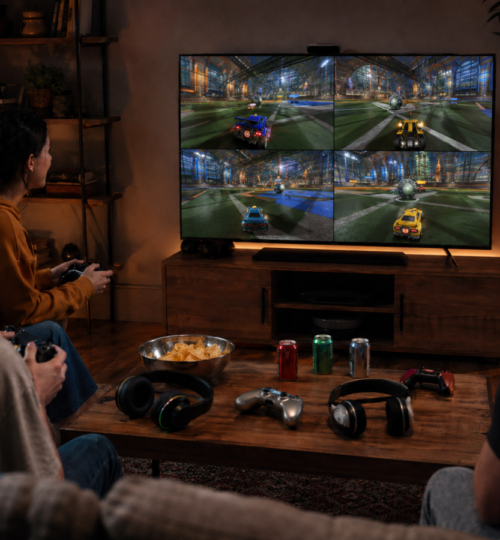
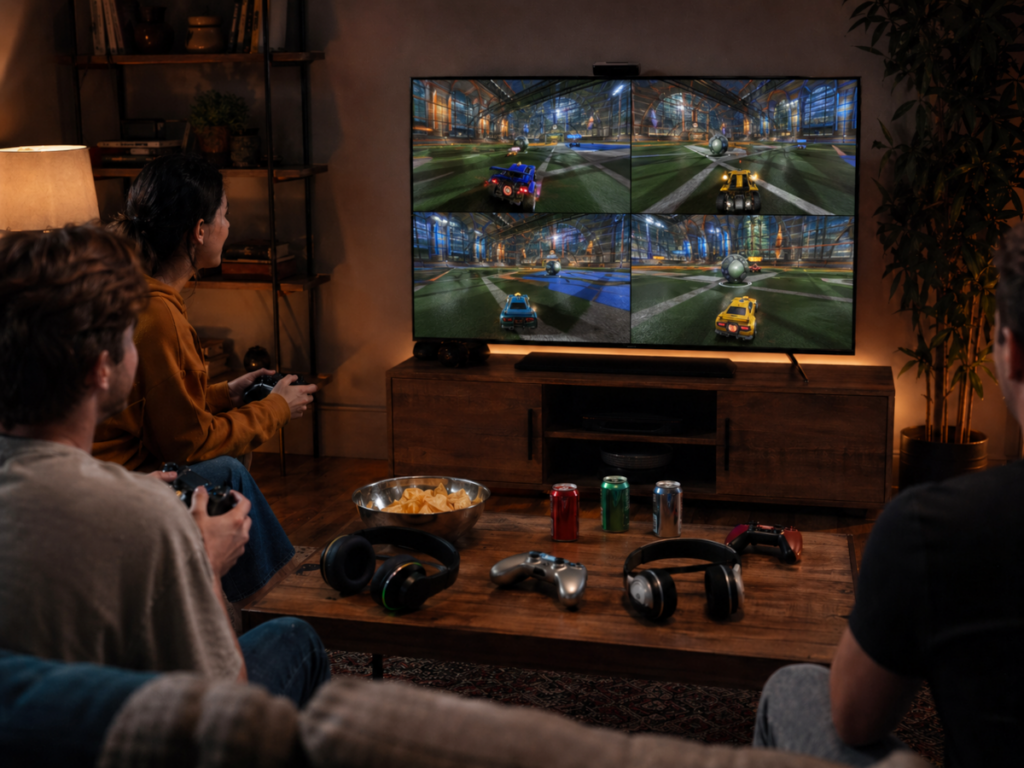
For a long time, split-screen felt like a relic from another gaming age. It belonged to the era of tangled controller cables, heavy CRT televisions, pizza boxes on the floor, and arguments over who got the top half of the screen. Then online multiplayer took over. Broadband improved, matchmaking became instant, party chat replaced the couch, and the console ecosystem slowly trained players to think of multiplayer as something that happened through servers, not in the same room.
But in 2026, something interesting is happening. Local multiplayer is not just surviving. It is becoming valuable again.
The comeback is not about rejecting online play. Nobody is pretending that global matchmaking, ranked ladders, cross-play, Discord coordination, or live-service competition are going away. For modern competitive gaming, online infrastructure is essential. But consoles have always had a second identity. They are not only competitive machines.
They are living room machines. They sit under the biggest screen in the house, surrounded by seats, waiting for people to gather around them. That identity still matters.
The renewed interest in split-screen and couch co-op reflects something deeper than nostalgia. Players are burned out on sterile lobbies, anonymous teammates, skill-based arguments, voice chat toxicity, battle pass chores, and the constant pressure of online progression. Local multiplayer offers a different kind of gaming experience.
It is immediate, social, physical, and personal. You are not just playing with someone. You are reacting with them, laughing with them, blaming them, celebrating with them, and sometimes threatening to never hand them the good controller again. That is a feeling online play still struggles to replicate.
Split-Screen Never Really Died, But It Did Get Pushed Aside
The story of split-screen is not a simple rise, fall, and rebirth. It never completely vanished. Nintendo kept it alive through party games, kart racers, platformers, sports titles, and family-friendly multiplayer. Indie developers carried the torch with couch co-op games built around chaos, teamwork, and shared failure. Fighting games, sports games, and racing games never fully abandoned local play either.
What changed was the mainstream expectation. During the Xbox 360 and PlayStation 3 era, online multiplayer became the dominant selling point for competitive games. By the PlayStation 4 and Xbox One generation, many major franchises treated local split-screen as expendable. The reasons were practical. Rendering two, three, or four viewpoints at once is demanding.
Modern games became visually heavier, more cinematic, more connected, and more dependent on online accounts and progression systems. Developers also had commercial incentives to push each player toward their own console, their own copy of the game, and their own subscription ecosystem.
The result was a quiet cultural shift. Multiplayer stopped meaning “come over.” It started meaning “log on.” That shift made sense for esports, ranked competition, and large-scale online games. But it also came with a cost. Gaming became more connected globally while becoming less social locally.
Friends could play across countries, but siblings sitting in the same room were often told they needed two systems, two screens, and two copies. That never felt quite right for console gaming.
The reason split-screen still matters on console is simple: consoles are naturally social hardware. A gaming PC is often a personal station. A console is usually a shared device. It lives in a living room, bedroom, dorm room, family room, basement, or apartment setup where multiple people can gather around one screen.
That hardware context changes everything. A console is more likely to be used by siblings, couples, roommates, parents and kids, or friends hanging out before a night out. Local multiplayer respects that environment.
Nintendo understands this better than anyone. The Nintendo Switch 2 launched in 2025 with a continued emphasis on flexible play, detachable controllers, and shared sessions. Nintendo’s own Mario Kart World messaging highlights local split-screen for up to four players on the same system, alongside local wireless and online play.
Nintendo also explains that Mario Kart World players can select 2P, 3P, or 4P on a single system, with the included Joy-Con 2 controllers covering two players and original Joy-Con controllers supported for additional players.
That matters because it reinforces the old console promise: buy the box, plug it into the TV, hand someone a controller, and play. In an age where games are increasingly tied to accounts, subscriptions, logins, stores, cross-platform IDs, and live-service calendars, that simplicity feels almost rebellious.
The Hazelight Effect: Co-Op as the Main Event
One of the biggest reasons local multiplayer feels fresh again is that some studios are treating co-op as the core design, not a bonus mode. Hazelight Studios has become the modern symbol of that philosophy. It Takes Two proved that a full game could be built around cooperation, communication, asymmetry, and shared discovery.
Split Fiction continued that mission, launching in March 2025 as a co-op action adventure from the creators of It Takes Two. Hazelight describes it as a co-op focused experience across PC, PlayStation, and Xbox. PlayStation’s listing for Split Fiction specifically confirms couch co-op and frames the game around two players coordinating through split-screen adventure design.
That is important because Split Fiction does not treat split-screen like a compromise. It treats it like the point. The best local co-op games are not just online games squeezed onto one screen. They are designed around communication. One player sees something the other does not. One player triggers a platform while the other moves.
One player solves a puzzle while the other fights off danger. One player panics, the other laughs, and suddenly the room becomes part of the game. That is where local multiplayer shines. It turns the space around the screen into gameplay.
Split-Screen Is Not Just for Casual Players
There is a lazy assumption that local multiplayer is only for party games, kids, or casual players. That misses the history of console competition entirely. Before ranked matchmaking became normal, competitive communities were built locally. Players learned by sitting next to better players. They talked trash in person. They ran tournaments in basements, LAN centers, college dorms, community halls, and living rooms. Local multiplayer was not just a casual feature. It was the foundation of many competitive scenes.
For a legacy online multiplayer community, that history matters. Sites like ours grew during a time when online ladders, clan matches, forums, and tournaments were expanding rapidly, but the culture was still deeply connected to local play. Players would practice together, watch each other, share strategies, and bring that energy online.
Split-screen and couch play are part of the same lineage. They teach cooperation, rivalry, timing, patience, and communication. They also create stories that ranked matchmaking rarely produces.
You remember the friend who always screen-peeked. You remember the sibling who picked the cheap character. You remember the racing game comeback on the final lap. You remember the boss fight where both players had one hit left and somehow survived. You remember the room. Online games create match histories. Local games create memories.
Why 2026 Players Are Reconnecting With Local Play
The renewed appeal of local multiplayer in 2026 comes from several overlapping trends. First, online multiplayer has become exhausting. Many players love competition, but they are tired of every game feeling like a job interview with a scoreboard. Skill-based matchmaking, seasonal resets, ranked anxiety, meta pressure, and battle pass timers can make even casual sessions feel structured and demanding.
Second, gaming has become more fragmented. Friends may own different platforms, subscribe to different services, or play different live-service ecosystems. Cross-play has helped, but it has not fully solved the friction. Local multiplayer removes much of that barrier. One room. One screen. One game.
Third, modern players are rediscovering the value of shared physical experiences. After years of remote socializing, voice chat, and online-only interaction, there is a renewed appreciation for doing things together in person. Board games, tabletop RPGs, watch parties, retro nights, and local co-op all benefit from that same cultural shift.
Fourth, families and partners are a bigger part of the gaming audience than they used to be. Many veteran players from the early 2000s now have spouses, kids, nieces, nephews, or younger relatives they want to play with. Split-screen makes gaming easier to share across generations.
A parent may not want to set up multiple accounts and headsets just to play with their kid. A couple may not want two consoles in the same room. Friends hanging out may not want to spend half an hour downloading updates before they can play. Local multiplayer reduces the ceremony. It gets people playing faster.
The Technical Challenge Is Still Real
Of course, split-screen is not easy to support. Modern games are technically demanding. A single-player game only has to render one viewpoint. A split-screen game may need to render two or more views at once, each with its own camera, effects, lighting, enemies, UI, and world state. That can strain frame rates, memory, resolution, and visual quality, especially on lower-spec hardware.
Baldur’s Gate 3 became one of the clearest examples of this challenge. When the game came to Xbox, split-screen support on Xbox Series S was a technical sticking point. Larian later moved to add split-screen co-op to Xbox Series S through Patch 8, alongside cross-play and other features. GameSpot noted that the Series S version had originally dropped split-screen before Patch 8 brought the feature forward.
That situation showed both sides of the issue. On one hand, players still cared deeply about local co-op. On the other, supporting it in a huge, systemic RPG was not trivial.
Developers have to make hard decisions. Do they lower visual settings in split-screen? Do they limit the number of players? Do they restrict certain modes? Do they spend months optimizing a feature that only part of the audience will use?
Those are real production questions. But the answer should not always be “cut local multiplayer.” Sometimes the better answer is to design for it earlier, communicate limitations clearly, and treat couch play as part of the game’s identity instead of a late-stage feature request.
Nintendo’s Advantage and the Console Identity Problem
Nintendo has a major advantage in this conversation because its hardware philosophy has consistently valued local play. The Switch line made detachable controllers part of the system’s identity, and the Switch 2 continues that social design language. Nintendo’s own Switch 2 launch messaging emphasized “All Together, Anytime, Anywhere,” along with new Joy-Con 2 controllers that can detach and snap to the system magnetically.
Sony and Microsoft have different strengths. PlayStation leans heavily into cinematic exclusives, premium production, and broad third-party support. Xbox leans into Game Pass, cross-device access, cloud saves, Play Anywhere, and ecosystem flexibility. Microsoft says Xbox Play Anywhere titles can be played across Xbox console, Windows PC, and supported handhelds at no extra cost when purchased digitally through supported stores.
Those strategies are valuable. But they also highlight a tension. The more console gaming becomes account-based and device-fluid, the more it risks losing the old “everyone gather around the TV” magic.
That does not mean Xbox and PlayStation need to become Nintendo. They do not. But they should recognize that local multiplayer is not an outdated feature. It is a console differentiator. If every platform becomes just another node in a cloud-connected ecosystem, the living room loses importance. Split-screen brings it back.
Local Multiplayer Builds Communities Differently
Online communities are powerful, but they are often temporary. Players queue, play, leave, and rarely speak again. Even in ranked games, long-term identity can be fragile. Names change. Teams disband. Seasons reset. Servers shut down.
Local multiplayer builds community differently. It starts with real people sharing the same space. That can be a family night, a dorm tournament, a local meetup, a retro event, a school club, a neighborhood rivalry, or a small LAN-style gathering. Those moments can become the seed of larger communities. This is where local multiplayer connects directly to legacy esports culture.
Before everything was automated, communities had to organize themselves. Players made brackets, ran ladders, scheduled matches, disputed results, formed teams, and built reputations. Local play encouraged that same kind of grassroots energy. It made competition feel human before it became data.
A revived gaming community in 2026 can learn from that. Split-screen nights, couch co-op challenges, local tournament brackets, family-friendly events, retro multiplayer spotlights, and community game nights can all help bridge veteran players and modern audiences.
Not every community event needs to be ranked. Not every match needs Elo. Sometimes the best way to rebuild a player base is to remind people that multiplayer was fun before it became optimized.
The Future Is Hybrid, Not Online-Only
The revival of split-screen does not mean online multiplayer is fading. The future is hybrid. A strong modern console game should support multiple ways to connect: couch co-op, local wireless, online co-op, cross-play, shared progression where it makes sense, and accessible drop-in options.
Mario Kart World is a good example of that broad multiplayer philosophy, offering local split-screen, local wireless, and online play. Split Fiction shows another path by making two-player cooperation the heart of the game while still supporting modern platform expectations. The winning design is not “old versus new.” It is “play how you want.”
That flexibility matters because players’ lives are different. Sometimes your friend is across the country. Sometimes they are on your couch. Sometimes your kid wants to play before dinner. Sometimes your old clanmate wants to jump online after work. Sometimes a game night starts with two people and becomes four. The best console multiplayer design respects all of those moments.
Why Split-Screen Still Matters
Split-screen matters because it preserves something essential about gaming: shared presence.
It lets players teach each other. It lets younger players sit beside veterans and learn by watching. It lets families play without turning the house into a network setup. It lets friends laugh at mistakes in real time. It lets competition feel personal without becoming toxic. It keeps the living room relevant.
For competitive communities, that is not a small thing. The future of multiplayer cannot only be matchmaking algorithms, seasonal cosmetics, ranked divisions, and remote voice chat. Those systems are powerful, but they are not enough by themselves. Multiplayer needs culture. It needs stories. It needs moments that players carry with them.
Local multiplayer creates those moments naturally. In 2026, split-screen is no longer just a memory from gaming’s past. It is a reminder of what console gaming still does best. It brings people together in the same room, hands them controllers, and lets the game do what games have always done at their best: turn competition, cooperation, frustration, laughter, and friendship into something worth remembering.