
Disclaimer: The views and opinions expressed in this article are solely those of the author. The mention of any products, services, or methods does not constitute an endorsement.
Every major era of PC gaming has been shaped by a hardware shift. The jump from software rendering to dedicated 3D accelerators changed what games could look like. Multi-core CPUs changed what worlds could simulate. SSDs changed loading, streaming, and open-world design. Ray tracing and AI upscaling changed how we think about lighting, resolution, and performance.
Quantum computing is not about to replace your GPU, CPU, RAM, or gaming rig. Not soon. Not in the way hype-heavy headlines sometimes suggest. The gaming PC of the near future will still be built around classical silicon: CPUs, GPUs, memory controllers, SSDs, power delivery, cooling, and increasingly specialized AI hardware. But the longer story is more interesting.
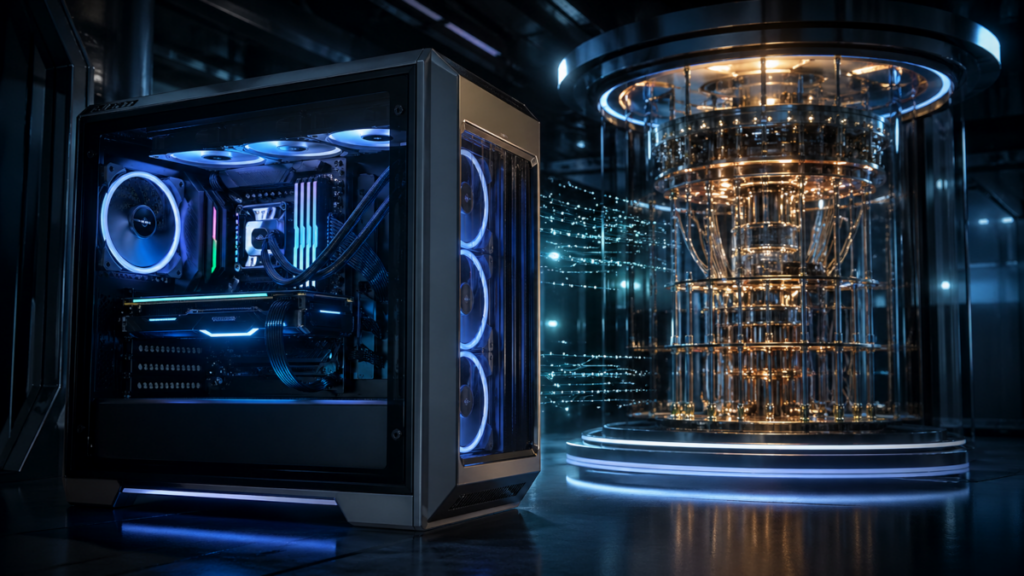
Quantum computing may eventually disrupt PC component architecture indirectly before it ever becomes something players own. It may reshape how components are designed, how materials are discovered, how thermal limits are pushed, how AI systems are trained, how network security evolves, and how hybrid supercomputing pipelines feed into the hardware that later lands on consumer desktops. In other words, quantum mechanics may not put a quantum chip inside your gaming tower tomorrow. It may change the tower before gamers ever see the chip.
What Quantum Computing Actually Does Differently
Classical computers store information in bits, which represent 0 or 1. Quantum computers use qubits, which can represent quantum states that allow different kinds of computation through superposition, entanglement, and interference. That does not mean a quantum computer is “all possible computers at once,” which is a common oversimplification. It means quantum systems can be engineered to solve certain categories of problems in ways that classical computers struggle to imitate efficiently.
That distinction matters for gamers because most gaming workloads are not natural quantum workloads. Rendering frames, polling input, running game logic, handling netcode, and calculating physics at 120 frames per second are not things a quantum computer is currently built to do better than a GPU or CPU.
The real value is more likely to appear behind the scenes. Quantum systems are being developed for problems in chemistry, materials science, optimization, cryptography, simulation, and high-performance computing. Those areas are deeply connected to the future of PC hardware, even if they do not look like gaming at first glance.
IBM’s current roadmap, for example, is focused on improving quantum processors, demonstrating error correction, and integrating quantum systems with high-performance computing workflows rather than selling consumer quantum boxes. IBM has described a path toward fault-tolerant systems, including a planned 2029 system called Starling that targets 200 logical qubits and circuits with 100 million gates. That is the correct frame: quantum computing is still a research and infrastructure race, not a plug-in replacement for your RTX card.
The Fragile Reality: Qubits Are Not Desktop Friendly
The first reason quantum PCs are not around the corner is brutally practical: quantum hardware is fragile. Many leading quantum systems require extreme isolation, specialized control electronics, and in some cases temperatures near absolute zero. IBM’s own hardware descriptions show quantum processors operating inside cryogenic systems, with elaborate cooling and wiring infrastructure required to maintain the environment where qubits can function.
That alone makes the idea of a consumer quantum expansion card unrealistic for the foreseeable future. A gaming PC is already a thermal balancing act with a CPU, GPU, VRMs, memory, storage, and case airflow. Quantum hardware adds an entirely different class of physical requirement.
There is also the issue of errors. Qubits are highly sensitive to noise. The industry is not merely trying to make more qubits. It is trying to make useful, stable, error-corrected qubits. This is why the phrase “logical qubit” matters. A logical qubit is built from multiple physical qubits and error correction methods, allowing it to behave more reliably than any one fragile physical qubit.
That is where the industry’s current attention is focused. IBM’s 2026 roadmap includes work on quantum processors capable of running larger circuits, quantum plus HPC mapping and profiling tools, and a Kookaburra module intended to demonstrate a logical processing unit and quantum memory as part of the path toward larger fault-tolerant systems.
For gamers, that means patience. Quantum computing is still climbing the mountain that classical computing climbed decades ago: reliability, scale, manufacturability, programmability, cost, and usefulness.
The First Disruption: GPUs May Become Quantum’s Control Tower
The irony is that quantum computing may strengthen the importance of GPUs before it threatens them. Modern quantum systems do not operate in isolation. They need classical computers to control them, interpret results, correct errors, simulate circuits, optimize workloads, and manage hybrid algorithms.
NVIDIA has been moving directly into this space through CUDA-Q, which is designed as a hybrid platform that can coordinate GPU, CPU, and QPU resources in one programming model. NVIDIA describes CUDA-Q as qubit-agnostic, meaning it can work across different quantum processing unit technologies while also using GPU acceleration when real quantum hardware is unavailable or insufficient.
That matters because the future of computing may not be “CPU versus GPU versus quantum.” It may be a layered system where each processor type handles the workload it is best suited for.
For gamers, this should sound familiar. The modern gaming PC already became heterogeneous. We do not expect the CPU to do everything. The GPU handles rendering and parallel compute. Dedicated media engines handle video encoding. Tensor cores or AI accelerators assist with upscaling and frame generation. Audio engines, network controllers, and storage controllers all handle specialized tasks.
Quantum computing fits that trend, but at a much larger scale and likely outside the home at first. The QPU becomes another specialized accelerator, sitting in a data center or research facility, connected to classical systems that make it usable.
NVIDIA’s NVQLink follows that logic. The company describes it as a way to connect quantum processors with accelerated computing systems, particularly for control algorithms and quantum error correction. In 2026, NVIDIA also described CUDA-Q realtime APIs that allow data to move between quantum controllers and GPUs as part of hybrid workflows.
So the first architectural lesson for PC gaming may not be “quantum replaces the GPU.” It may be “the GPU becomes part of the bridge to quantum.”
Component Design Could Change Before Components Do
The most believable gaming impact begins upstream, in research and manufacturing. PC components are physical objects made from materials: silicon, copper, solder, substrates, thermal interface materials, capacitors, memory cells, packaging layers, heat spreaders, and coolers. Performance is constrained by heat, resistance, leakage, signal integrity, manufacturing defects, and energy efficiency.
Quantum computers are naturally interesting for simulating quantum systems, including molecules and materials. If quantum computing becomes useful for materials science, it could help researchers discover better semiconductors, battery chemistries, superconducting materials, thermal compounds, or fabrication methods. That would not look like a “quantum gaming PC.” It would look like better GPUs, cooler CPUs, more efficient memory, longer-lasting batteries for handhelds, and new packaging methods for chiplets.
This is where gaming hardware could be disrupted quietly. A future GPU may not contain a quantum processor, but some of its materials or manufacturing techniques could be discovered through quantum-assisted simulation.
That kind of disruption is familiar. Gamers do not need to understand EUV lithography to benefit from smaller transistors. They do not need to understand shader compiler design to benefit from better drivers. They do not need to know how AI models are trained to use upscaling. Quantum may follow the same path: invisible research becomes visible performance.
Chiplet Architecture and the Quantum Mindset
Modern PC component architecture is already moving away from monolithic thinking. AMD, Intel, NVIDIA, and other hardware companies increasingly rely on chiplets, advanced packaging, high-bandwidth interconnects, specialized accelerators, and modular design.
Quantum computing pushes the industry even further toward modularity. IBM’s public roadmap describes a future involving modular processors and quantum plus HPC workflows, including components such as Nighthawk, Kookaburra, and later systems on the path to fault tolerance.
Even if consumer PCs never contain quantum modules in the near term, the architectural philosophy is familiar: do not build one giant general-purpose chip when multiple specialized units can cooperate.
Gaming PCs have already become small supercomputing ecosystems. The CPU manages game logic, operating system tasks, draw calls, decompression, and scheduling. The GPU handles massively parallel graphics and compute. Dedicated AI blocks increasingly participate in image reconstruction and frame prediction. NVMe storage now feeds worlds faster than older consoles could dream of. The motherboard is less a simple board and more a traffic system for specialized silicon.
Quantum computing reinforces that direction. The future PC may become more accelerator-heavy, more modular, and more software-defined, even if the quantum accelerator itself remains cloud-based.
Could Quantum Computing Affect Game AI?
This is where it is easy to get carried away. Quantum computing will not suddenly make NPCs conscious. It will not magically create infinite procedural worlds. It will not make anti-cheat perfect. It will not replace game developers.
But quantum-inspired and quantum-assisted optimization could eventually affect the tools around game development. Large games involve complex scheduling, pathfinding, asset optimization, testing, matchmaking, server allocation, animation blending, economy balancing, and AI behavior tuning. Many of those are optimization problems. Quantum computers may eventually help with some optimization categories, though the practical advantage is still uncertain and workload-dependent.
More realistically, quantum computing may support AI research indirectly through hybrid high-performance computing. Since modern gaming already uses AI for upscaling, animation, NPC behavior, content tools, moderation, and cheat detection, any change in the broader AI compute stack eventually touches games.
NVIDIA’s quantum strategy is especially relevant here because it connects quantum development with GPU-accelerated computing rather than treating quantum as a standalone island. Reuters reported in 2025 that NVIDIA planned a quantum research center in Boston with collaborators including Harvard, MIT, and quantum firms such as Quantinuum, Quantum Machines, and QuEra. That type of partnership hints at quantum’s near-term role: not replacing AI hardware, but becoming part of the research pipeline around it.
The Security Problem Gamers Will Eventually Notice
Quantum computing also has a darker side for digital infrastructure. A sufficiently powerful fault-tolerant quantum computer could threaten widely used public-key cryptography systems. That matters to gaming because modern multiplayer ecosystems depend on secure logins, payment systems, anti-cheat authentication, game ownership checks, encrypted communications, platform accounts, cloud saves, and digital marketplaces.
This does not mean your Steam account is doomed tomorrow. Practical cryptography-breaking quantum machines are not here yet. But the industry is already preparing for post-quantum cryptography because infrastructure transitions take years. Gaming platforms, esports services, anti-cheat providers, and payment processors will eventually need to support cryptographic systems designed to resist quantum attacks.
For a legacy online multiplayer community, this is not an abstract issue. Competitive gaming depends on trust. Players need to trust accounts, match results, tournament records, payment systems, rankings, and identity. Our own community history shows how much long-term records matter. If quantum-era security becomes a platform issue, competitive ecosystems will feel it.
The future of gaming hardware may include more secure enclaves, updated authentication chips, quantum-resistant firmware signing, and platform-level changes that players barely notice unless something breaks. Security upgrades rarely get the same attention as frame rates, but they are part of the architecture too.
Why Quantum Will Not Replace the Gaming GPU
The GPU is safe for a long time. Gaming graphics are a classical workload. Rasterization, ray tracing, denoising, texture sampling, shader execution, and frame pacing are all deeply tied to classical parallel computation. GPUs are incredibly good at this because their architecture maps well to the problem. Quantum computers do not simply make every task faster. They are specialized machines with specific strengths.
Even future cloud gaming systems are more likely to use quantum computing behind the scenes than in the rendering pipeline itself. A data center could use quantum-assisted optimization for logistics, cooling, materials research, or AI model development, while the actual game stream still comes from classical GPUs.
That is important for players who have seen too many “next big thing” cycles. Quantum computing is not another DLSS, not another ray tracing mode, not another shader model, and not another console generation. It is a deeper computing shift, but its gaming effects will probably arrive sideways.
The Long-Term Wild Card: Quantum Networks and Cloud Gaming
If quantum computing matures, quantum networking may become another major piece of the puzzle. Quantum communication and quantum-safe networking could influence secure data centers, cloud gaming infrastructure, esports integrity systems, and distributed computing. Again, this is not about a gamer plugging a quantum router into a bedroom setup. It is about backbone infrastructure.
Cloud gaming has always been limited by latency, compression, server proximity, business models, and ownership concerns. Quantum computing does not erase those problems. But future data centers that combine classical supercomputers, AI clusters, and QPUs could become more powerful simulation and optimization hubs. Developers might use those systems to build games, train AI, test balancing, or simulate massive systems before shipping optimized results to consumer hardware.
The player may never touch the quantum machine. The player may only experience the downstream effect: smarter development tools, better hardware, better security, more efficient servers, and more complex simulations.
What This Means for Competitive Gaming Communities
For a community built around ladders, leaderboards, tournaments, and player history, quantum computing is not a near-term feature. It is a long-term pressure wave moving through the technology stack.
Competitive players care about performance, fairness, latency, stability, input response, hardware reliability, anti-cheat, and the trustworthiness of records. Quantum computing could eventually touch all of those indirectly. Better materials could improve component efficiency. Better optimization could improve server placement and matchmaking. Better cryptography could protect accounts and tournament infrastructure. Better AI tooling could improve moderation, cheating detection, and game development pipelines.
But the heart of competition will remain human. Quantum computing will not replace clutch aim, team chemistry, map knowledge, or the weird emotional electricity of a close match. It may change the machines around the match. It may change how those machines are designed, secured, cooled, and connected. That is disruptive enough.
The Bottom Line
Quantum computing is not coming for your gaming PC in the simple, sci-fi way. Your next rig will still be judged by CPU performance, GPU horsepower, memory bandwidth, storage speed, thermals, drivers, display tech, and price.
The real story is slower, stranger, and probably more important.
Quantum computing may first reshape the research labs, data centers, design tools, materials pipelines, security standards, and hybrid computing systems that eventually define future PC components. It may not sit inside the case, but it could influence what the case contains.
For gamers, the smart position is neither hype nor dismissal. Quantum computing is not tomorrow’s graphics card. It is a long-term architectural force. And if history has taught PC gamers anything, it is that the biggest hardware revolutions often begin far away from the player, then arrive years later as something we suddenly cannot imagine gaming without.